
In this month's blog post, Dr Ida Milne, Irish Research Council ELEVATE fellow co-funded by Marie Curie Actions, writes about her postdoctoral project on childhood illness in twentieth-century Ireland.
We live in an era where we expect our
children to survive to adulthood without having their lives threatened by
common infectious diseases of childhood.
The situation was rather different in the Ireland of the early part of
the twentieth century. In 1911, more than 2,000 infants under the age of
two died from diarrhoeal illnesses, almost double the number that died the
previous year. The increase was not
helped by the hot summer, which exacerbated the hygiene difficulties in an era
when many houses, even of the affluent, did not have running water or flush
toilets. As a twenty first century mother, I find the idea of nursing a child
suffering from diarrhoea in an overcrowded third floor bathroomless tenement almost
unimaginable.
Child mortality in the early-twentieth century
Having healthy children who would survive
to adulthood was not taken as the norm, as we do now. Statistics tabulated by
the Registrar-General in 1911 show that one-fifth of the total 72,475 deaths in 1911
were children under 5; of these, 945 were caused by ‘convulsions’ and 1,370 by
bronchitis. Scarlet fever claimed the lives of 260 children under fifteen; 460
under-fifteens died from measles, and 819 under tens from whooping cough.
 |
| Slums in Dublin, c.1865-1914 (Image from NLI collection: L_ROY_07881) |
Dublin tenements, poverty, and childhood illness
Few families, rich or poor, remained untouched by these deaths, but the over-crowded living conditions of the poor could bring extremes of ill health. Stella Larkin McConnon, trade unionist James Larkin’s granddaughter, told me that the poor health of the nation’s children was one reason he became so interested in improving living conditions for families. The Larkins had good reason to be aware of the suffering. Stella’s own mother was brought up in Marlborough Street in the heart of Dublin’s tenements, and was the only one of ten children to survive to adulthood. Stella still remembers visiting the tenement, one room with only one metal bed, the only toilet downstairs in another part of the tenement, the cooking done on an open fire.
Improving child health
By 1981,
the landscape of death in childhood had changed radically. There were no deaths
in either Northern Ireland or the Republic from scarlet fever or whooping
cough, and only two from measles. Only
2.78 per cent of the total deaths, 916 of 32,929, were of children under five.
Many
factors contributed to the improvements over the course of the twentieth century: among them vaccination schemes
and more effective medicines, public health education and increased state
intervention in the health of children, better housing and diet and improved
air quality. It didn’t happen by accident – throughout the century, there were
individuals who identified areas to change and worked to effect that
change. Their number includes the first
chief medical officer for Dublin, Sir Charles Cameron, trade unionists like
James Larkin who worked to give families a decent wage, pioneering TB Dr
Dorothy Stopford Price, Department of
Local Government and Public Health Chief Medical Officer James Deeny, Noel
Browne and many others who played macro and micro roles in the significant
reduction in deaths from disease in childhood.
Research project on childhood disease
In October,
I began a three year Irish ResearchElevate Fellowship in the National University of Ireland and Queen’s
University, Belfast to research this dramatic changing landscape of childhood
disease, which is in general a good news
story for Irish society and Irish public health. While statistical and documentary sources
will be important to the project, a key feature will be a series of qualitative
interviews with medical professionals, with people who worked in relevant
Government and local authority roles, and with parents and sufferers. I intend
that these interviews should, at the conclusion of the project, be available in
an open access archive to other researchers.
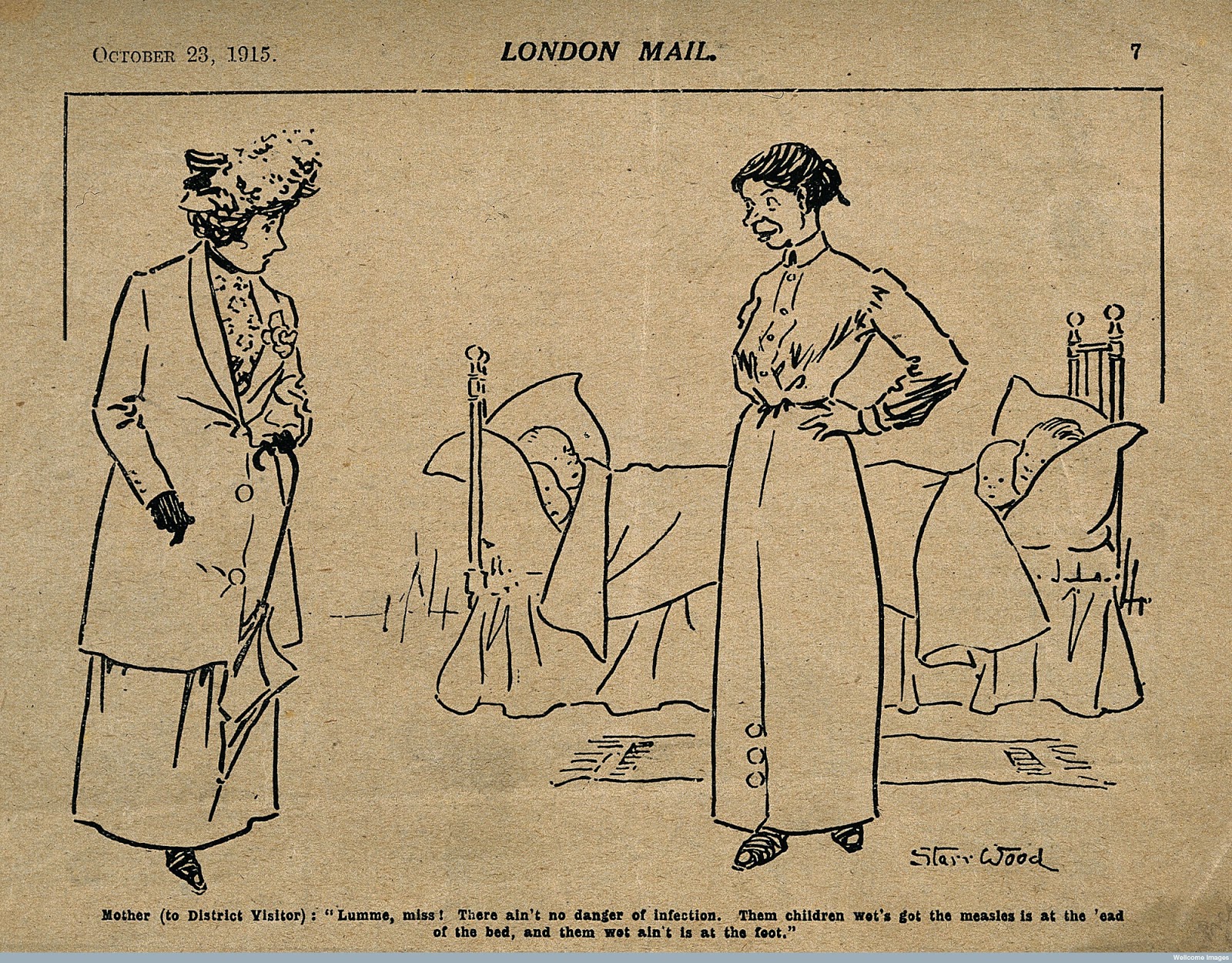 |
Mother (to District Visitor): "Lumme, miss! There ain't no danger
of infection. Them children wet's got the measles is at the 'ead of
the bed, and them wet ain't is at the foot.
London Mail, 23 October 1913
Image courtesy of the Wellcome Library
|
The project
builds on and was partly inspired by the RAMI Living Medical History project;
Susan Mullaney, Mary O’Doherty and
Patrick Plunkett of the RAMI section on history of medicine devised this
innovative project to interview retired medical doctors about their working
lives, collecting memories on the changes in medical practice over the course
of their careers. Several of the LMH interviewees had either suffered from
diseases like diphtheria and tuberculosis themselves, or had family who did,
and this really brought home to me how all-pervasive the effects of childhood
disease were on Irish society, that they were not merely confined to the poor
and the badly-housed, but could also invade better-off families.
Oral history of medical practitioners
Oral history interviews can add flesh to the dry bones of statistics. When working on my PhD on the effects of the 1918-19 influenza pandemic here, the people who spoke to me about suffering this influenza as small children, or who told me about how their families coped with the tragic losses of children or parents to the 1918-19 flu, breathed life into its history, recreating the fear caused by the unpredictability of this most awesome of influenza pandemics.
In the case
of this new project, I am hoping to find people who can talk about the changing
landscape of childhood illness in the twentieth century, from their own perspective,
whether as medical workers, patients, parents or as Department of Health
officials and politicians.
I’m curious about issues like knowledge
transfer – how and what did parents learn about treating the illnesses their
children caught? As a child growing up
in the 1960s, I recall my mother hanging blankets over the windows when we
caught measles; the information she had been passed down by her mother was that
children with measles could damage their eyesight if they read or were in daylight.
When I had my own children in the 1990s, I was
struck by the efficiency and dedication of a district nurse in north Kildare
who made sure we parents brought our children for vaccinations, and cajoled and
informed those parents who had reservations about allowing their children to be
vaccinated. Getting medical workers like her to talk about their work is one of
the goals of this project. This district nurse was, it seems to me, a local
hero, a micro role player who was a small but significant cog in the expanding
machinery which managed and significantly improved the health of our children
over the course of the twentieth century.
Dr Ida Milne is a social historian based at NUI Maynooth and Queen's University Belfast. She holds an ELEVATE Irish Research Council International Career Development Fellowship co-funded by Marie Curie Actions.


