Showing posts with label polio. Show all posts

Tuesday, 26 January 2016

'The Vast and Often Unpermitted Collection Being Organised in my Diocese': The Central Remedial Clinic, the Catholic Church, and Polio Rehabilitation in Dublin During the 1950s by Stephen Bance

As the incidence of polio began to rise in Ireland, voluntary organisations such as the Central Remedial Clinic were created to rehabilitate survivors of the disease. In this month's blog post Stephen Bance, PhD candidate at the Centre for the History of Medicine in Ireland, UCD, writes about Archbishop John Charles McQuaid's refusal to support the Central Remedial Clinic, given that it was not '100 per cent Catholic'. Others such as Bing Crosby saw no such problem, and were happy to lend a helping hand.


The Central Remedial Clinic


Occupational Therapy was an important part of the rehabilitation
process for polio survivors.
Source: Polio Journal: Official Publication of the Infantile
Paralysis Fellowship, Ireland
, 3:4 (1956), Front Cover.
The creation of rehabilitation facilities for polio survivors in Ireland during the mid-twentieth century was pioneered by voluntary groups. The most active and successful of these organisations was the Central Remedial Clinic (CRC). The CRC was established in 1950 by the remedial gymnast Kathleen O'Rourke and Lady Valerie Goulding, who became a central figure in rehabilitation and philanthropy in Ireland. As a civil-run, non-denominational organisation, the CRC depended upon revenue acquired through fundraising projects, and the success of these enterprises led to their expansion throughout the 1950s. During the same period, the polio rehabilitation unit at Baldoyle Orthopaedic Hospital, which was run by the Sisters of Mercy and was under the patronage of the Archbishop of Dublin John Charles McQuaid, sought public funds to renovate and improve their facility. The Baldoyle Polio Unit, established in 1943, had fallen into a state of disrepair by the early 1950s. The accommodation for patients on site was limited to a collection of dilapidated huts.1 Reverend Mother Mary Polycarp, who was in charge of the facility, wrote to McQuaid detailing the many anxious nights she had spent praying that the huts would not be 'blown down on the little patients who are in danger'.2

Bing Crosby and the CRC


Bing Crosby, 1967, with his horse Dominion Day, which won the
Blandford Stakes at the Curragh with trainer Paddy Prendergast.
Crosby took part in fundraising drives for the CRC.
Source: Dermot Barry/Irish Times.
With no state aid being made available, both the CRC and the Baldoyle Polio Unit began fundraising campaigns.3 The fundraising methods employed by the Baldoyle committee included radio broadcasts, newspaper advertisements, flag days, sweepstakes and sales of work.4 The CRC used similar methods; however, they also harnessed the allure of celebrity to bolster the public profile of their events. For example, a recorded appeal by Bing Crosby was aired on Radio Éireann in 1958,5 and Crosby later visited Dublin to speak at a CRC fundraising dinner.6

100 per cent Catholic, Only


Archbishop John Charles McQuaid, 1956, at the opening of
Our Lady's Children's Hospital, Crumlin. Source.
As the popularity and success of the CRC's fundraising became evident, Archbishop McQuaid wrote to Mother Polycarp expressing his frustration at the 'vast and often unpermitted collection being organised in my diocese by so many persons.'7 Given the influence that McQuaid wielded within the voluntary sector, the CRC asked the Archbishop if he would be prepared to be represented on the trustees committee.8 McQuaid declined due to the fact that Lady Goulding was not a Catholic, stating that it wasn't his policy 'to belong to something unless it was one hundred per cent Catholic'.9

Baldoyle

The Baldoyle fundraising campaign was cut short when McQuaid and the building committee entered into a bargaining process with the Department of Health in order to complete the renovations. The Minister for Health, T.F. O'Higgins, offered to provide funding for the project on condition that the remit of the Baldoyle unit would be expanded to cater for cerebral palsy cases as well as polio cases. This proposal was accepted, and the government provided a £40,000 grant to finish the construction process.10 The hospital was opened in July 1956. The new facility could accommodate 114 patients and included a school, an occupational therapy unit and a phyisotherapy unit.11
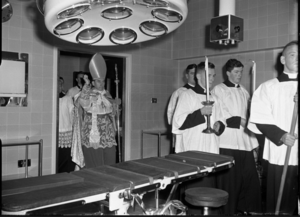
The Archbishop of Dublin, Most Rev. Dr.
McQuaid, inspecting the occupational therapy
department after he had opened and blessed the
new Physiotherapy Unit in St. Mary's
Orthopaedic Hospital, Baldoyle.
Source: Irish Independent, 22 November 1957

Expansion of the CRC


Lady Valerie Goulding with President Eamon de Valera
and children at the Central Remedial Clinic in the early 1970s.
Source: Irish Independent.
The success of the fundraising initiatives undertaken by the CRC meant that they expanded independently of the state. A new clinic was opened in Goatstown in January 1955 while a school with the capacity to educate twenty pupils was established on the premises in 1957.12 By the end of 1958, 700 patients were being treated annually.13 A new occupational therapy unit was built in November 1961 and a workshop was opened in March 1963.14 In December 1968, President de Valera opened the newest branch of the CRC at Clontarf.15 The Clontarf clinic was the first purpose built complex of its kind in Ireland, and cost approximately £250,000.16

An Absolutist Approach


McQuaid's snubbing of the CRC conformed to his absolutist approach to voluntarism along denominational lines; a similar situation had unfolded in 1943 when the presence of the Protestant Dorothy Price on the overwhelmingly Catholic executive committe of the National Anti-Tuberculosis League (NATL) led the Archbishop to publicly back the Red Cross Society as a Catholic alternative to the NATL.17 Similarly, the Baldoyle polio facility provided a 'one hundred per cent Catholic' alternative,and Reverend Mother Polycarp was optimistic that her unit could eventually replace the CRC. She wrote to McQuaid in 1957 stating that: 'when some of the Catholic doctors who are working with Lady Goulding realise your interest in the hospital they may send some of their little polio children on to us. I hope they do, for the children's sake'.18 This denominational approach to welfare was inherently divisive, but extremely prevalent in mid-twentieth century Ireland.19

Denominational Welfare


McQuaid's hostility towards the CRC was symptomatic of his combative attitude towards non-Catholic charitable organisations generally. Throughout the mid-twentieth century, the Archbishop readily pitched his organisation against other non-Catholic agencies, such as the St. John's Ambulance Brigade and the NATL.20The social work undertaken by the Archbishop was underpinned by the conviction that the protection of Catholic children meant the protection of the next generation of souls.21 However, unlike his response to the NATL in 1943, McQuaid declined to publicly articulate his aversion to the CRC. Definitive reasons for this discreet approach are not clear, however the series of very public altercations involving the Catholic hierarchy, the state and medical community during the previous decade, not least the Mother and Child Controversy, may have tempered somewhat McQuaid's desire to openly oppose the activities of non-Catholic voluntarism in the field of polio rehabilitation.

Stephen Bance

Stephen Bance is an Irish Research Council funded PhD Candidate at the Centre for the History of Medicine in Ireland (CHOMI), UCD. His thesis is provisionally titled, '"Crippled, Maimed, Lamed, Shattered and Broken": The Irish Experience of Polio, 1942-1970'. His PhD supervisor is Dr Catherine Cox. He received his BA in Single Honours History (UCD) in 2012, and went on to successfully complete the CHOMI MA programme on the Social and Cultural History of Medicine the following year.


1 Letter of appeal Joseph Bryan, Treasurer Baldoyle Building Committee, DDA L Files, Baldoyle Orthopaedic Hospital 3/2.↩
2 Letter Sister M. Polycarp to John Charles McQuaid, Jan. 1952, DDA L Files, Baldoyle Orthopaedic Hospital 3/2.↩
3 Letter Desmond O'Callaghan, Honorary Secretary, Baldoyle Building Committee, to Sister M. Polycarp, 16 Jan. 1952, DDA L Files, Baldoyle Orthopaedic Hospital 3/2.↩
4 Ibid.↩
5 Irish Times, 13 Mar. 1958.↩
6 Jacqueline Hayden, Lady G- A Biography of the Honourable Lady Goulding LL D (Dublin, 1994), p. 108.↩
7 Letter from John Charles McQuaid to Sister M. Polycarp, 11 Jan. 1952, DDA L Files, Baldoyle Orthopaedic Hospital 3/2.↩
8 Letter from Father Paddy Crean to John Charles McQuaid, 13 May 1951, DDA L Files, Central Remedial Clinic 9/2.↩
9 Hayden, Lady G-, p. 103.↩
10 Irish Times, 5 July 1956.↩
11 Ibid.↩
12 Irish Times, 13 Jan 1955; Irish Times, 21 Feb. 1957.↩
13 Irish Times, 1 Sept. 1958.↩
14 Irish Times, 2 Nov. 1961; Irish Times, 15 Mar. 1963.↩
15 Irish Times, 11 Jan. 1966.↩
16 Irish Times, 17 Jan. 1966.↩
17 See Anne MacLellan, '"That Preventable and Curable Disease": Dr Dorothy Price and the Eradication of Tuberculosis in Ireland, 1930-1960' (PhD Thesis, University College Dublin, 2011), p. 108.↩
18 Letter from Sister M. Polycarp to John Charles McQuaid, 22 Nov. 1957, DDA Files, Central Remedial Clinic 9/1.↩
19 Lindsey Earner-Byrne, Mother and Child: Maternity and Child Welfare in Dublin 1922-60 (Manchester, 2007), p. 223.↩
20 Lindsey Earner-Byrne, 'Managing Motherhood: Negotiating a Maternity Service for Catholic Mothers in Dublin, 1930-54', Social History of Medicine 19:2 (2006), 267.↩
21 Ibid.↩

Monday, 10 June 2013

The Irish experience of polio, 1940-70 by Stephen Bance

In this month's blog post, Stephen Bance, MA student at the Centre for the History of Medicine in Ireland, University College Dublin, writes about his research project on the history of polio in Ireland, 1940-1970.


Polio and history

One of the first recorded polio epidemics occurred on the island of Saint Helena, a British colony, in 1836. Outbreaks followed later in the century in Norway, France, Sweden and America. By March 1955, the World Health Organisation recognised that polio was ‘a practically world-wide disease’. In Ireland, polio was scarcely known prior to 1940. The first significant epidemic occurred in 1942 and the incidence of the disease fluctuated during the following years. The worst epidemic wave occurred in 1956, when approximately 500 cases were notified nationwide. Yet, with the exception of Laurence Geary’s short overview of the epidemic in Cork, polio has been largely ignored in Irish history. An exploration of polio in Ireland will provide a new lens through which to critique public health legislation in the mid-twentieth century and uncover Irish lay and medical understandings of disease. It will contribute to the Irish literature on the epidemiology of diseases, eradication programmes and public health policies, which, to date, has focused primarily on tuberculosis. 

Group of polio and arthritic patients on the sundeck, USA, undated photograph.
Courtesy of the National Library of Medicine, Images from the History of Medicine Collection. A015237


Polio project structure

The project is divided into three thematic sections:

1. What was the geographic and demographic distribution of polio?

This section of the project maps the incidence of the polio epidemic at a regional level with a view to revealing the topography of the disease. While the impact of the 1956 epidemic upon Cork has received analysis, little is known of polio consequences nationally or, indeed, whether its effects varied in urban and rural environments. In addition, the study will provide a demographic profile of its victims in terms of age, sex, marital status, class and outcome. It will also interrogate the types and forms of diagnosis and treatment assigned to sufferers. This data will establish whether the gender, class and age of sufferers impacted on susceptibility to the virus and on access to treatment and vaccination.

2. What were the social and cultural meanings assigned to polio and to its victims?

In his study of the American experience of polio, David Oshinsky contextualized the outbreak within the increasingly suburban, family-oriented, and hygiene obsessed 1950s, arguing that the nation’s most affected by polio were considered to be the most hygienic and least at risk to infectious diseases. The impact these domestic hygienic practices had on Ireland in the 1940s and 1950s is unclear, however it would appear that medical research on the epidemiology of the virus in Ireland examined whether the Irish were racially susceptible to the disease; an anti-body survey carried out by the Medical Research Council in 1956 revealed that antibody levels among Irish children were dangerously low. Examining medical research into disease aetiology conducted in Ireland, the study will uncover the social and cultural assumptions underpinning theories of susceptibility to polio.

Polio epidemics were capable of generating widespread fear and apprehension within the communities affected. In a contemporary account of the 1956 Cork epidemic, Patrick Cockburn suggested that public fear of the disease outlasted its virulence within society and the possibility of its return terrified communities. Drawing on newspapers, correspondence and memoirs, the study will look at the social responses to polio, especially the widespread fear of the disease and the consequent stigma attached to sufferers and groups who were identified as likely carriers of the virus. It will consider whether ‘fear’ had a negative impact upon public health initiatives, thereby exploring how social histories of diseases can become intertwined with political and policy narratives. Government press releases and publicity campaigns will give insight into the state’s efforts to assuage public terror. By situating the Irish experience within the international context, the study will consider whether there was universality to social reactions to polio in the twentieth century.

3. What was the public health response to polio in Ireland and how successful was it?

In his pioneering work on the history of public health, George Rosen argued that the protection and promotion of public health and welfare was one of the most important functions of the modern state. For Ireland however, it has been demonstrated that ‘few local authorities approached the problem of eradicating infectious disease with determination’ and only belatedly did public health became a matter of major public concern in the 1950s. James Deeny attested to a political disinterest in public health, concluding that in the case of tuberculosis, the Irish government ‘had been hoping the problem would go away’. Did they harbour similar hopes for polio? Preliminary research has revealed that Irish health authorities were slow to respond to the threat of polio, while specialist centres for treatment were only established fifteen years after the disease had been made notifiable. A Salk vaccination programme was introduced to Ireland in 1957, this was significantly later than in France, America and Britain.


A forgotten epidemic

Polio vaccine dropped onto sugar lump for young patients, c.1980.
Image courtesy of Wellcome Imagse, WFA WF/M/I/PR/P04
This section will examine the public health response to the epidemic at a local and national level, revealing the tensions at play that led to delays in implementing vaccination programmes and other initiatives. It will interrogate whether these failings were a result of underdeveloped public health infrastructure, politico-religious conservatism, an inert bureaucracy, economics or other factors. In addition, correspondence between public health bodies, the Medical Research Council and the Department of Health will reveal the factors informing the delivery of the vaccination programme; who was identified as especially vulnerable to the disease and why? The study will then uncover the impact delays in developing a robust public health response had on infection and mortality rates, especially among children, as Dr Noel Browne later lamented. By uncovering a near forgotten epidemic of 1950s Ireland, this project will add greater depth and sophistication to the literature on Irish health policy and infectious disease eradication.

Stephen Bance may be contacted at stephen "dot" bance "at" ucdconnect "dot" ie