Showing posts with label slums. Show all posts

Friday, 28 November 2014

Childhood illness in twentieth-century Ireland by Ida Milne

In this month's blog post, Dr Ida Milne,  Irish Research Council ELEVATE fellow co-funded by Marie Curie Actions, writes about her postdoctoral project on childhood illness in twentieth-century Ireland.

We live in an era where we expect our children to survive to adulthood without having their lives threatened by common infectious diseases of childhood.  The situation was rather different in the Ireland of the early part of the twentieth century. In 1911, more than 2,000 infants under the age of two died from diarrhoeal illnesses, almost double the number that died the previous year.  The increase was not helped by the hot summer, which exacerbated the hygiene difficulties in an era when many houses, even of the affluent, did not have running water or flush toilets. As a twenty first century mother, I find the idea of nursing a child suffering from diarrhoea in an overcrowded third floor  bathroomless tenement almost unimaginable. 

Child mortality in the early-twentieth century


Having healthy children who would survive to adulthood was not taken as the norm, as we do now. Statistics tabulated by the Registrar-General in 1911 show that one-fifth of the total 72,475 deaths in 1911 were children under 5; of these, 945 were caused by ‘convulsions’ and 1,370 by bronchitis. Scarlet fever claimed the lives of 260 children under fifteen; 460 under-fifteens died from measles, and 819 under tens from whooping cough.  

Slums in Dublin, c.1865-1914 (Image from NLI collection: L_ROY_07881)


Dublin tenements, poverty, and childhood illness


Few families, rich or poor, remained untouched by these deaths, but the over-crowded living conditions of the poor could bring extremes of ill health. Stella Larkin McConnon, trade unionist James Larkin’s granddaughter, told me that the poor health of the nation’s children was one reason he became so interested in improving living conditions for families.  The Larkins had good reason to be aware of the suffering.  Stella’s own mother was brought up in Marlborough Street in the heart of Dublin’s tenements, and was the only one of ten children to survive to adulthood.  Stella still remembers visiting the tenement, one room with only one metal bed, the only toilet downstairs in another part of the tenement, the cooking done on an open fire.

Improving child health


By 1981, the landscape of death in childhood had changed radically. There were no deaths in either Northern Ireland or the Republic from scarlet fever or whooping cough, and only two from measles.  Only 2.78 per cent of the total deaths, 916 of 32,929, were of children under five.

Many factors contributed to the improvements over the course of the twentieth century:  among them vaccination schemes and more effective medicines, public health education and increased state intervention in the health of children, better housing and diet and improved air quality. It didn’t happen by accident – throughout the century, there were individuals who identified areas to change and worked to effect that change.  Their number includes the first chief medical officer for Dublin, Sir Charles Cameron, trade unionists like James Larkin who worked to give families a decent wage, pioneering TB Dr Dorothy Stopford Price,  Department of Local Government and Public Health Chief Medical Officer James Deeny, Noel Browne and many others who played macro and micro roles in the significant reduction in deaths from disease in childhood.

Research project on childhood disease


In October, I began a three year  Irish ResearchElevate Fellowship in the National University of Ireland and Queen’s University, Belfast to research this dramatic changing landscape of childhood disease, which is in general a good news story for Irish society and Irish public health.  While statistical and documentary sources will be important to the project, a key feature will be a series of qualitative interviews with medical professionals, with people who worked in relevant Government and local authority roles, and with parents and sufferers. I intend that these interviews should, at the conclusion of the project, be available in an open access archive to other researchers. 
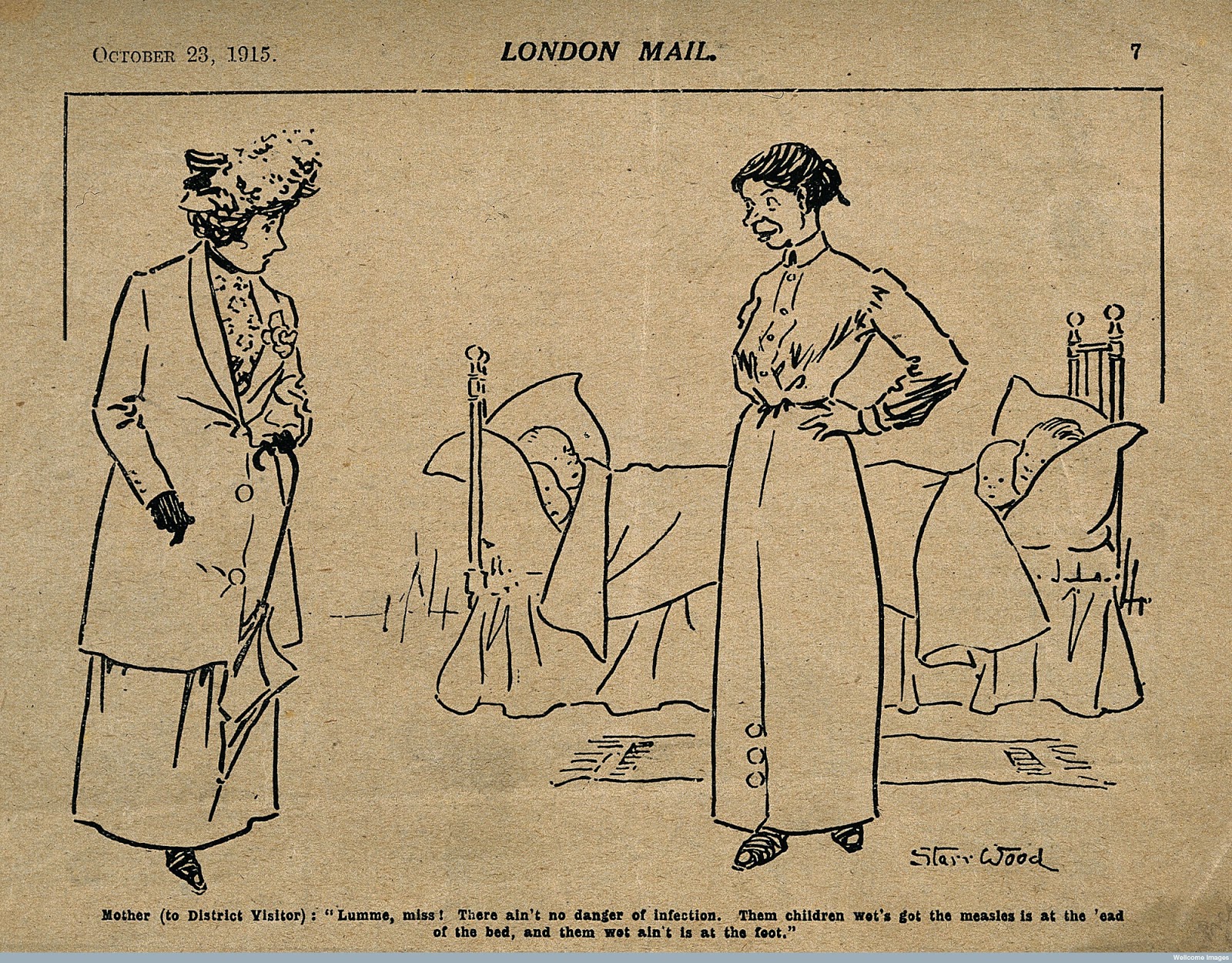
Mother (to District Visitor): "Lumme, miss! There ain't no danger
of infection. Them children wet's got the measles is at the 'ead of 
the bed, and them wet ain't is at the foot.
London Mail, 23 October 1913
Image courtesy of the Wellcome Library
The project builds on and was partly inspired by the RAMI Living Medical History project; Susan Mullaney, Mary O’Doherty and  Patrick Plunkett of the RAMI section on history of medicine devised this innovative project to interview retired medical doctors about their working lives, collecting memories on the changes in medical practice over the course of their careers. Several of the LMH interviewees had either suffered from diseases like diphtheria and tuberculosis themselves, or had family who did, and this really brought home to me how all-pervasive the effects of childhood disease were on Irish society, that they were not merely confined to the poor and the badly-housed, but could also invade better-off families.

Oral history of medical practitioners


Oral history interviews can add flesh to the dry bones of statistics. When working on my PhD on the effects of the 1918-19 influenza pandemic here,  the people who spoke to me about suffering this influenza as small children, or who told me about how their families coped with the tragic losses of children or parents to the 1918-19 flu, breathed life into its history, recreating the fear caused by the unpredictability of  this most awesome of influenza pandemics.

In the case of this new project, I am hoping to find people who can talk about the changing landscape of childhood illness in the twentieth century, from their own perspective, whether as medical workers, patients, parents or as Department of Health officials and politicians.

I’m curious about issues like knowledge transfer – how and what did parents learn about treating the illnesses their children caught?  As a child growing up in the 1960s, I recall my mother hanging blankets over the windows when we caught measles; the information she had been passed down by her mother was that children with measles could damage their eyesight if they read or were in daylight.

When I had my own children in the 1990s, I was struck by the efficiency and dedication of a district nurse in north Kildare who made sure we parents brought our children for vaccinations, and cajoled and informed those parents who had reservations about allowing their children to be vaccinated. Getting medical workers like her to talk about their work is one of the goals of this project. This district nurse was, it seems to me, a local hero, a micro role player who was a small but significant cog in the expanding machinery which managed and significantly improved the health of our children over the course of the twentieth century. 

Dr Ida Milne is a social historian based at NUI Maynooth and Queen's University Belfast. She holds an ELEVATE Irish Research Council International Career Development Fellowship co-funded by Marie Curie Actions. 

Tuesday, 22 October 2013

‘Out of the mouths of babes comes wisdom, and the poor women residing in the slums of Cork’ by Michael Dwyer

During the 1920s, extreme close quarter living conditions took a heavy toll on the health and life expectancy of the residents of Cork city. With a population of 80,000, 18,645 of the city’s inhabitants lived in unsatisfactory conditions with 8,675 inhabitants housed in 719 tenements and small houses. The tenements were generally in a shocking state of repair; crowded together in such a manner as to make it impossible to have fresh air and sunlight around each dwelling. The houses were small and resembled each other merely in their common dilapidation. The alleys, dignified by the name of streets and infused with a conglomerate of odours, said to be ‘almost Neapolitan’, began near the riverbank, in sordidness, and ascended the hills to something like squalor. As bad as the alleys were, the houses were generally worse. As Frank O’Connor succinctly put it, ‘God had abandoned the lanes of Cork city, and so had the Corporation’.

In 1926, a report produced by the Cork Town Planning Association Cork; A civic survey, highlighted the fact that mortality rates were highest in those districts which contained the largest amount of ‘insanitary property’. The survey revealed that the highest mortality rates occurred in dispensary districts three and four, both of which were located west of Shandon Street on the North side of the city. The mortality rates here numbered 2.9 per 1000, per annum and 2.7 per 1000, per annum respectively. Dispensary districts six and seven, located South west of St. Finbarr’s Cathedral, on the South side of the city recorded the second highest mortality rate at 2.4 per 1000 per annum and 2.6 per 1000 per annum respectively. The national mortality rate in 1923 is recorded as been 1.4 per 1000 per annum, making the mortality rate in the Cork Dispensary Districts twice as high as the national average.

The contemporary finger of blame for the high mortality rates, and in particular the high infant mortality rates was directed towards ‘the domestic ignorance of the poor womenfolk in our slum tenements… and to the shocking ignorance of the duties of motherhood’. However, this assertion by Professor Alfred O’Rahilly was roundly challenged by Professor Henry Corby who asserted that;

Out of the mouths of babes comes wisdom, and the poor women residing in the slums of Cork, who through force of circumstances felt compelled to ignore medical advice, have taught me what I consider to be a very valuable lesson.

Ariel view of District Three, on the north-west slopes of Cork city circa 1930. Source: Cork City Council.
'God had abandoned the lanes of Cork city, and so had the Corporation'. View of District Four, taken from the North Cathedral, circa 1930. Source: Cork City Council.

Addressing an article in the British Medical Journal relating to ante-natal care in private practice, Corby lamented that there had been little progress in the field of obstetrics over the previous fifty years to 1924, especially in regard to the preventative treatment of puerperal sepsis; a fatal illness caused by severe infection spread via the bloodstream, and generally contracted after a prolonged hospital confinement. During the 1920s, physicians routinely proscribed between ten and eighteen days post natal bed rest, and as a result, puerperal sepsis had been an all too common cause of death among women, regardless of  social status. Reflecting on his time spent as visiting physician to the Cork Maternity Hospital, Corby noted that he had been ‘forcibly struck’ by two things;


One, was the thorough contempt that the patients of the lanes exhibited for the medical science with regard to the amount of rest that should be taken after a confinement. The other was that puerperal sepsis was unknown among these [Cork] women, though they lived in the midst of squalid poverty and in surroundings which were the reverse of sanitary.

Corby contacted the matron of the Cork Maternity Hospital, and made inquires as to the duration of post natal bed rest taken by women under her care. The matron reported that the majority of women had ‘gotten up and gone about their daily chores on the third day after giving birth’. Furthermore, during her ten year tenure at the Cork Maternity Hospital, the Matron stated that only one case of death caused by sepsis had been recorded. Corby concluded that the adoption and application of the example set by ‘the women of the lanes’ to his own patients ‘resulted in good practical results’.

Similarly, an examination of J.C. Saunders, Typhoid epidemic in Cork city 1920, suggests that high mortality rates in the Cork dispensary districts were not necessarily caused by unsanitary practices among their inhabitants. Saunders account of the typhoid epidemic in Cork, ‘the biggest of its kind in the city and probably of the country also’, found that there had been 243 reported cases ‘but that it was highly probable that this figure represented only a portion of those which actually occurred’. The heaviest incidence was recorded in the northwest ward, that being the congested areas west of Shandon Street, where ‘there were a large number of insanitary and overcrowded dwellings and where the general standard of living is lower than that for the city generally’. The maximum incidence occurred in the eleven to fifteen age group, the youngest victim was three and a half years old and the oldest was seventy two years old.

An investigation focusing on the water supply concluded that it was contaminated with Balantidium Coli (B.coli). B. Coli causes infection when ingested by humans, faecal-oral being the commonest mode of transmission and it usually affects the large-intestine. Symptoms include diarrhoea, nausea, vomiting, fever, and severe fluid loss, a perfect disease to spread rapidly through a community living in extreme close quarters. The source of the contamination was identified as being discharge from Our Lady’s Cork Mental Hospital, which entered the River Lee through a sewage pipe, twenty yards from the pure water basin which supplied the drinking water for the entire city. The focus of the investigation turned to Our Lady’s Hospital, where it was established that typhoid had been endemic for over twenty years previously.  The cause by which the hospital had become ‘a reservoir of infection’ was traced to the institutions milk supply, which was found to be contaminated as a result of unsanitary practices at the production stage.

The overcrowded districts may well have been the ‘breeding ground for disease’ that many contemporary commentators depicted, and lives lived in squalid poverty in unsanitary accommodation presented a daily menace to the health and life of the workers and the poor. However, there is little doubt that the close-quarter habitation, an enforced condition of the physical state of the tenements, intensified the impact of external influences on their captives, who were victims of, rather than creators of their environment.

Michael Dwyer is a PhD candidate at the School of History, University College Cork. His current research relates to the historical significance of diphtheria and the roll-out of childhood immunisation programmes in Ireland. He is the winner of the James and Mary Hogan Prize in History (2011), the Saothar/IHSA Labour History Award (2012), and the Centre for the History of Medicine in Ireland Essay Prize (jointly, 2013). For further information see this link.