Showing posts with label tuberculosis. Show all posts

Monday, 6 November 2017

When Does The Air Matter? by Janet Greenlees

Air Quality and the Working Environment


In this month's blog post Dr Janet Greenlees, Senior Lecturer at Glasgow Caledonian University, looks at  the history of industrial air quality and considers how it has variously been considered a worker's health, community health, and economic concern.


When Does Air Matter?


Men and women weaving at the White Oak Mill in Greensboro, NC, 1909.
Courtesy of the National Museum of American History.
When do people think about the air quality inside buildings? Similar to other health issues, the honest answer probably would be when either they or someone they care about is affected by the poor air they breathe on a regular basis. That being the case, the air quality in working environments could only then be of concern to a relatively small number of people with any improvements sought by labour and their representatives or employers seeking to increase productivity. However, sometimes public health concerns about air quality can apply to both the community and the working environment. How then, is the public health discourse negotiated when the needs of industry can be affected? And, why do certain health issues attract public or political interest and intervention, while others do not? A simple answer might be that the only health issues to attract widespread public interest are those which can affect large numbers of people, such as contagious diseases. However, a closer look suggests regional and national variations regarding responses to public health concerns, even when the same issues and industries cross special boundaries.

An Air Laden with Dust and Dirt


During the nineteenth and early twentieth centuries, cotton cloth manufacturing grew rapidly in New England, America and Lancashire, Great Britain. Both industries subsequently declined, albeit at different rates. Cotton manufacturing was also an industry where men and women worked alongside each other, performing the same tasks for the same rates of pay and experiencing the same workplace health hazards. The air these men, women and sometimes children breathed was laden with dust and dirt, factory ventilation was poor and concerns were raised about the spread of contagious diseases in such environments, particularly tuberculosis. In addition, the noise from the machines was horrendous, particularly in the weaving rooms, and could cause hearing loss and in some cases, deafness. While since the earliest cotton factories, workers had been aware that inhaling dust and dirt made them feel unwell and the noise was uncomfortably loud, it was the late nineteenth century before the workplace became entwined with public health reform, starting with fears about tuberculosis contagion. Public and much scientific belief held that the tubercle bacilli attached itself to dust and quickly spread disease throughout the mill. In the progressive state of Massachusetts, the leading cotton cloth manufacturing state, these fears about TB contagion secured both a legislative ban of a particular technology, the suction shuttle, and selective employer cooperation at improving ventilation. In contrast, and despite widespread belief that England led the way with factory regulation, the tuberculosis risk in the Lancashire mills was debated, but economic concerns prevented both regulation and industrial reform.

Worker Fatigue and Factory Ventilation


The Boott Cotton Mill of Lowells, Massachusetts.
Courtesy of the Lowell Museum Collection.
During the early twentieth century new health concerns arose, firstly surrounding the importance ventilation and following the Great War, fatigue. Fatigue was not simply related to long hours of labour but also to working in poorly ventilated factories. In Massachusetts cotton towns, ventilation became a public health campaign with improvements introduced in many public buildings, including schools and government buildings and extending into workplaces. Some (but not all) employers accepted the notion that a healthy worker was a more productive worker. Ventilation attracted considerable British debate and scientific interest, but while some communities sought to improve factory ventilation and legislation imposed air quality standards on the cotton mills, in reality, employers remained able to operate as they saw fit. Factory air quality was secondary to the needs of industry. The Great War turned scientific, political and medical interest to fatigue research, particularly in Britain. Textile workers were included in the research; however, industrial decline meant political and scientific interest in operative fatigue quickly faded. The same was true in New England. During the 1920s, most of the cotton manufacturing industry shifted to the southern states. Remaining northern firms were more concerned about economic survival than the air quality in the mill. Worker and community concern about mill air quality also declined as jobs took priority. Indeed, wider economic concerns were increasingly influencing the public health agendas of both countries.

Cotton Dust Inhalation


Nevertheless, scientific and medical interest about occupationally specific health concerns was growing, particularly surrounding cotton dust inhalation. However, the physical symptoms of respiratory damage caused by dust inhalation mirrored those of respiratory diseases common to many textile towns, including bronchitis and pneumonia, namely, tightness of the chest, dyspnea and coughing. Therefore, doctors found it very difficult to identify cases of byssinosis, the respiratory disease caused by prolonged cotton or flax dust inhalation. While public concern grew surrounding the widespread dust found in urban environments, such concerns were not transferred to factory dust. There, dust remained an occupationally specific hazard about which middle class social and political reformers had little interest. This was only reinforced by the ambiguity surrounding diagnosis. For workers, dust was an everyday reality that was simply part of the job and unions sought compensation rather than reform. Britain was first to introduce byssinosis compensation for selected male workers in 1941, although it was the 1970s before compensation was extended to all affected workers. By this time, cotton manufacturing had virtually disappeared from the country. Despite individual American doctors and scientists recognizing byssinosis cases, it was 1969 before the federal government introduced compensation for byssinosis sufferers. Instead, public health concerns about dust remained confined to the urban living environment and, when combined with the ambiguity surrounding diagnosis, many workers were left to suffer on their own.

Interior of a Lancashire Cotton Mill with Mill
Workers at their Machines, Lancashire, c. 1890.

Managing the Health Impact of the Working Environment 


Lastly, noise, but not internal industrial noise, briefly became a public concern. Community concerns about specific urban noises increased as the twentieth century progressed. Societies were formed to tackle ‘unnecessary noise.’ However, the continuous crashing of metal-tipped shuttles against metal loom frames in the mills which caused hearing loss in many workers was ignored. Instead, communities, medics and even operatives accepted that hearing loss was a risk attributable to certain jobs, including weaving. Weavers adopted coping strategies to manage the noise, including sign language and lip reading. Indeed, despite the fact that other air quality issues had attracted public interest and industrial reform, operatives regularly found themselves needing to adopt coping strategies to manage the health consequences caused by working in confined spaces with poor air quality. Other strategies included taking unpaid time off, patent medicines, cooperative strategies, switching firms to where conditions were better and exiting the industry. Air quality at work was important to workers, but managing the health impact from the working environment comprised only one part of their decision-making surrounding work, health and community. Similarly, at different times, certain aspects of air quality became community health concerns. Only at certain times did the two environments entwine.

Janet Greenlees


Dr Janet Greenlees
Janet Greenlees is a Senior Lecturer in History at Glasgow Caledonian University, based in the Centre for the Social History of Health andHealthcare. Her research interests include women and work, public health and the working environment and maternal health and she has published on all these topics. The intersection of health in the community and work environment described above is explored in greater detail in her book: When the Air became Important: A Social History of the Working Environment in New England and Lancashire, 1860-1960 (Rutgers: Rutgers University Press, forthcoming 2018). For more on gender and workers’ responses to poor air quality at work, see ‘Workplace Health and Gender among CottonWorkers in America and Britain, c. 1880s-1940s’, International Review of Social History, 61, 3 (2016), 459-83.

Tuesday, 24 March 2015

The historical development of Irish Hospitals and the importance of their records by Brian Donnelly

In this month's post, Brian Donnelly, senior archivist at the National Archives of Ireland, outlines the development of Irish hospitals from the eighteenth to the twentieth century.

Rotunda Hospital, Dublin
(RCPI Archival collections: VM/1/4/19)

The establishment of the voluntary hospitals


The early eighteenth century saw the establishment of voluntary hospitals by philanthropists, mainly in Dublin but also in the larger provincial towns. Jervis Street hospital (the Charitable Infirmary) was the first voluntary hospital Ireland and was founded in 1718.  Many of these, like Dr. Steeven’s Hospital (founded in 1733) and Mercer’s (founded 1734) would survive into the twentieth century.  The eighteenth century also saw the establishment of specialist hospitals, most of them voluntary, such as the Rotunda Lying In Hospital, founded in 1745, St. Patrick’s Hospital for mental illness, founded in 1747 and the Westmoreland Lock Hospital, for the treatment of venereal disease, in 1792. 

A modern public health service at county level began in 1765 when a parliamentary enactment provided for the erection and support of an infirmary for each county in Ireland and also permitted support for several existing hospitals, mainly in Dublin and Cork, out of public funds.  The county infirmaries were to be maintained by grand jury presentments, parliamentary grants and local subscriptions. The grand juries were groups of landowners who were called together by the High Sheriff in each county twice a year for legal and local administrative reasons.

The House of Industry hospitals, district lunatic asylums and medical dispensaries


The Dublin house of industry, a precursor of the workhouses of the nineteenth century, was founded in 1772. This institution became in time a vast concern, providing hospitals for the sick, an asylum for children, bridewells, penitentiaries for women and young criminals, a house of industry for vagrants, and cells for lunatics.  From it evolved the House of Industry hospitals – the Richmond, Whitworth and Hardwicke - and it played a major role in establishing the first and largest of the public lunatic asylums – the Richmond Lunatic Asylum – which opened for patients in 1814. Following the report of the Committee on the Lunatic Poor in 1817, the Lord Lieutenant was enabled by statute to build asylums where he considered necessary and, over the next half century, a well-developed mental health infrastructure was in place. By 1871, twenty two asylums were being financially supported by the grand juries. In 1850 a central asylum “for insane persons charged with offences in Ireland” was opened in Dundrum. This institution, the first criminal lunatic asylum in these islands, was under the direct control of the Lord Lieutenant who appointed the staff and made regulations for its management. 

A few dispensaries were supported by voluntary subscriptions in several of the larger towns and cities from the late eighteenth century, but it was not until 1805 that grand juries were authorised to give grants to dispensaries in rural areas. By the early 1830s, there were 450 dispensaries throughout the country, administered by committees of management and supported partly by subscriptions and partly by grand jury grants. There were fewer dispensaries in poorer areas, where voluntary contributions were wanting, and where it was difficult to raise enough money to start them. Inadequate as many of these dispensaries were, they represented the first steps towards domiciliary medical treatment of the rural population.


Robert Graves (1796-1853)
 (RCPI Archival collections: VM/1/2/S/35)

The impact of epidemics on the development of medical infrastructure


Epidemic disease was a major impetus in the development of a medical infrastructure. Typhus was a major scourge in Ireland in the early nineteenth century and, while several fever hospitals had been established in the larger towns in the late eighteenth century, it was not until 1807 that legislation was passed to encourage their construction throughout the country. A fever epidemic of unprecedented proportions raged in Ireland between 1816 and 1819. Under an 1818 Act, local boards of health could be established, supported partly by grand juries, which had extensive powers to combat disease. Grand juries were empowered to make presentments equal to twice the amount raised by private subscription to build fever hospitals. In 1819, legislation enabled officers of health to be appointed in parishes and a parish health tax could be levied. 

The establishment of the Central Board of Health in 1820 marked a major step in the centralisation of medical relief and local boards of health were to play a major role in combating epidemics over the following decades. The Central Board of Health collected statistics about local health conditions, advised where local boards of health should be established and when grant to hospitals should be made. When cholera broke out in Ireland in March 1832, the Central Board of Health, renamed the Cholera Board for the duration of the epidemic, supervised measures to combat the disease which included the establishment of local boards of health. 

Dublin hospitals like the Meath were at the forefront of the fight against infectious disease from the 1820s and introduced new methods of bedside clinical training to the English speaking world.  The census commissioners noted in 1854 that to these metropolitan hospitals “the Irish School of Medicine is largely indebted for the celebrity which it has so long enjoyed”. The Meath hospital received international recognition in the early nineteenth century due to the innovative teaching methods and research carried out by its physicians, Robert Graves and William Stokes. The latter had survived an attack of typhus in 1827 and identified the first case of cholera in Ireland in 1832. This new approach to clinical training had originated on the continent and its introduction into the Meath hospital heralded what has been described as the heroic age of the Irish School of Medicine. The voluntary hospital infrastructure continued to expand during the nineteenth century and following Catholic Emancipation many Catholic religious orders became involved in founding hospitals.

The Irish Poor Law, 1838


The enactment of the Irish Poor Law of 1838 was to have a dramatic effect on the provision of public health services for the rest of the nineteenth century. The country was divided into over one hundred and fifty poor law unions each with a workhouse at its centre and administered by a board of guardians.The structure of the poor law system, being modern and efficient and more easily subject to central control, was adapted on nearly all occasions where a new local function was created or an old one modified .The Medical Charities Act of 1851 led to the modernisation and extension of the old grand jury dispensary network under the boards of guardians and made a domiciliary medical service available to large sections of the population, the destitute poor, for the first time. 

By 1852, every poor law union had been divided into a number of dispensary districts, each with a dispensary and medical officer.  Patients had to apply to a poor law guardian for a ticket every time they wanted to attend a dispensary free of charge. Committees of management were responsible to the boards of guardians for the management of the dispensaries and appointing the dispensary doctors. In 1863, the dispensary doctors were made registrars of births and deaths and of Roman Catholic marriages and the practice of registering births, marriages and deaths was standardised on the 1st of January 1864. When registering deaths, the dispensary doctors were required to note the cause of death and duration of illness, thus enabling accurate statistics of mortality to be compiled for the first time. The registration of births enabled such measures as the compulsory vaccination of children against smallpox to be carried out effectively and by the end of the nineteenth century this scourge had, to a great extent, been eliminated.

While many boards of guardians had allowed the non-destitute to enter workhouse hospitals for treatment during the 1850s, the 1862 Poor Law (Amendment) Act officially opened the workhouse hospitals to the non-destitute sick. As a result of these developments, Ireland had one of the most advanced health services in Europe in the mid-nineteenth century, if policy and structure are to be taken as criteria. The Local government (Ireland) Act, 1898, replaced the grand juries by democratically elected county and rural district councils. The county councils took over the administration, either directly or through joint committees, of the district lunatic asylums.

Newcastle Sanatorium, Wicklow.
Image courtesy of NLI (L_ROY_05467)

Tuberculosis and the sanatorium


While Ireland had a low death rate from infectious disease in the first decade of the twentieth century, tuberculosis was the marked exception. The last years of the nineteenth century saw the first attacks made against the disease with the establishment of Newcastle Sanatorium in 1893. In 1904, the sanitary authorities of County Cork combined with Cork Corporation to establish Heatherside Sanatorium near Doneraile. In 1907, the Dublin City and County authorities established Crooksling Sanatorium. A Tuberculosis Prevention Act was passed in 1908 which gave the county councils power to provide sanatoria and brought the first veterinary inspectors into the employment of the sanitary authorities.  Peamount Sanatorium was founded in 1912 through the efforts of the Women’s National Health Association, the most formidable health pressure group of the early twentieth century.

Public health provision in post-independent Ireland


The turbulent years of the early 1920s saw some revolutionary changes in the public health system. In general, the boards of guardians outside Dublin were abolished and were replaced by county boards of health and public assistance, essentially sub-committees of the county councils. Most workhouses were closed to save money and central institutions called county homes were established in each county where the poor were to be relieved. While the newly styled county homes were to be reserved in theory for the old and infirm many soon included unmarried mothers, children and the mentally retarded.  Following the establishment of the Irish Free State the Department of Local Government and Public Health formally became, in 1924, the central government authority for local government and health administration. The Minister took over the Lord Lieutenant’s duties in relation to the mental hospitals. In 1930, the establishment of the Irish Hospitals Sweepstakes, a lottery to provide financial assistance to hospitals, provided a financial lifeline to many voluntary hospitals who were struggling to survive following a reduction in the number of endowments and bequests after the Great War.

The post-war period and declining mortality


There were significant developments in health care in the 1940s and 1950s. The Mental Health Treatment Act of 1945 modernised the legal code under which the mental services operated and provided important safeguards against the arbitrary detention of patients although the numbers of persons being treated continued to increase until, by 1959, there were 20,000 patients in Irish mental hospitals.  In the years immediately after 1945 there was a major effort to develop anti-tuberculosis services. The Tuberculosis (Establishment of Sanitoria) Act of 1945 permitted the Minister for Local Government and Public Health to arrange for the building of sanatoria and to transfer these to local authorities when completed. This was a major departure from established practice for the central authority as it stepped outside its normal functions of directing and co-ordinating the local services. Sanatoria were built at Dublin, Cork and Galway and were handed over when completed to the local authorities as was provided under the Act. 

There was also widespread building and conversion of buildings for the treatment of tuberculosis cases by local authorities.  These developments, together with the payment of maintenance allowances for dependents of persons undergoing treatment for infectious disease, mass radiography, BCG vaccination and new drugs such as streptomycin, led to a great decline in mortality for the disease and in the number of new cases appearing.  In 1947 the Department of Local Government and Public Health was divided into two separate departments. The Health Act of 1953 extended eligibility for general hospital services and maternity care to a much wider class. Health authorities were now required to provide child welfare clinic services and the school health service was improved. The dispensary service and dispensary doctors were transferred from the public assistance code to the health authorities. The old dispensary ticket system was done away with and replaced by medical cards. A more liberal code for the governing of county homes was introduced and provision was made for the development of a comprehensive rehabilitation service.

William Stokes (1804-78) and William Wilde (1815-76)
(RCPI Archival Collections: PDH/6/2/12)

1970s regionalisation and the Irish 'love affair' with the hospital bed


By the 1960s, it was felt that as the state had taken over the major financial interest in the health service there should be a new administrative framework combining national and local interests.  For technical and logistical reasons it was believed that better services could be provided on a regional rather than a county basis.  The establishment of the health boards under the Health Act, 1970, marked a major break in the link between the health services and county administration. At this time Ireland had the highest proportion of hospital beds to population in western Europe and the Irish hospital system was described as “one of a large number of small institutions scattered throughout the country”. The following decades would see the closure or amalgamation of many voluntary and state hospitals into larger units and the dismantling of the old mental hospital infrastructure.

The historical value of Irish hospital records


That Irish hospital records are of great historical interest has long been acknowledged. Dr. William Wilde, the internationally renowned nineteenth century physician and statistician, recognised one hundred and seventy years ago that the hospital registers of the Rotunda Hospital represented the ‘most interesting and earliest statistical tables on record’.  Ireland’s medical institutions, both voluntary and public, have a peculiarly rich and varied history and have played a paramount role in medical advances over the last three centuries.  While some collections of hospital archives are now safe in archival custody, many collections remain in peril. These archives have no protection under the law and it is often only through the good offices of interested hospital staff that material has been preserved. 


Brian Donnelly is a Senior Archivist at the National Archives with responsibility for Business and Hospital records. Images courtesy of Fergus Brády, Archivist, RCPI. 

Friday, 28 November 2014

Childhood illness in twentieth-century Ireland by Ida Milne

In this month's blog post, Dr Ida Milne,  Irish Research Council ELEVATE fellow co-funded by Marie Curie Actions, writes about her postdoctoral project on childhood illness in twentieth-century Ireland.

We live in an era where we expect our children to survive to adulthood without having their lives threatened by common infectious diseases of childhood.  The situation was rather different in the Ireland of the early part of the twentieth century. In 1911, more than 2,000 infants under the age of two died from diarrhoeal illnesses, almost double the number that died the previous year.  The increase was not helped by the hot summer, which exacerbated the hygiene difficulties in an era when many houses, even of the affluent, did not have running water or flush toilets. As a twenty first century mother, I find the idea of nursing a child suffering from diarrhoea in an overcrowded third floor  bathroomless tenement almost unimaginable. 

Child mortality in the early-twentieth century


Having healthy children who would survive to adulthood was not taken as the norm, as we do now. Statistics tabulated by the Registrar-General in 1911 show that one-fifth of the total 72,475 deaths in 1911 were children under 5; of these, 945 were caused by ‘convulsions’ and 1,370 by bronchitis. Scarlet fever claimed the lives of 260 children under fifteen; 460 under-fifteens died from measles, and 819 under tens from whooping cough.  

Slums in Dublin, c.1865-1914 (Image from NLI collection: L_ROY_07881)


Dublin tenements, poverty, and childhood illness


Few families, rich or poor, remained untouched by these deaths, but the over-crowded living conditions of the poor could bring extremes of ill health. Stella Larkin McConnon, trade unionist James Larkin’s granddaughter, told me that the poor health of the nation’s children was one reason he became so interested in improving living conditions for families.  The Larkins had good reason to be aware of the suffering.  Stella’s own mother was brought up in Marlborough Street in the heart of Dublin’s tenements, and was the only one of ten children to survive to adulthood.  Stella still remembers visiting the tenement, one room with only one metal bed, the only toilet downstairs in another part of the tenement, the cooking done on an open fire.

Improving child health


By 1981, the landscape of death in childhood had changed radically. There were no deaths in either Northern Ireland or the Republic from scarlet fever or whooping cough, and only two from measles.  Only 2.78 per cent of the total deaths, 916 of 32,929, were of children under five.

Many factors contributed to the improvements over the course of the twentieth century:  among them vaccination schemes and more effective medicines, public health education and increased state intervention in the health of children, better housing and diet and improved air quality. It didn’t happen by accident – throughout the century, there were individuals who identified areas to change and worked to effect that change.  Their number includes the first chief medical officer for Dublin, Sir Charles Cameron, trade unionists like James Larkin who worked to give families a decent wage, pioneering TB Dr Dorothy Stopford Price,  Department of Local Government and Public Health Chief Medical Officer James Deeny, Noel Browne and many others who played macro and micro roles in the significant reduction in deaths from disease in childhood.

Research project on childhood disease


In October, I began a three year  Irish ResearchElevate Fellowship in the National University of Ireland and Queen’s University, Belfast to research this dramatic changing landscape of childhood disease, which is in general a good news story for Irish society and Irish public health.  While statistical and documentary sources will be important to the project, a key feature will be a series of qualitative interviews with medical professionals, with people who worked in relevant Government and local authority roles, and with parents and sufferers. I intend that these interviews should, at the conclusion of the project, be available in an open access archive to other researchers. 

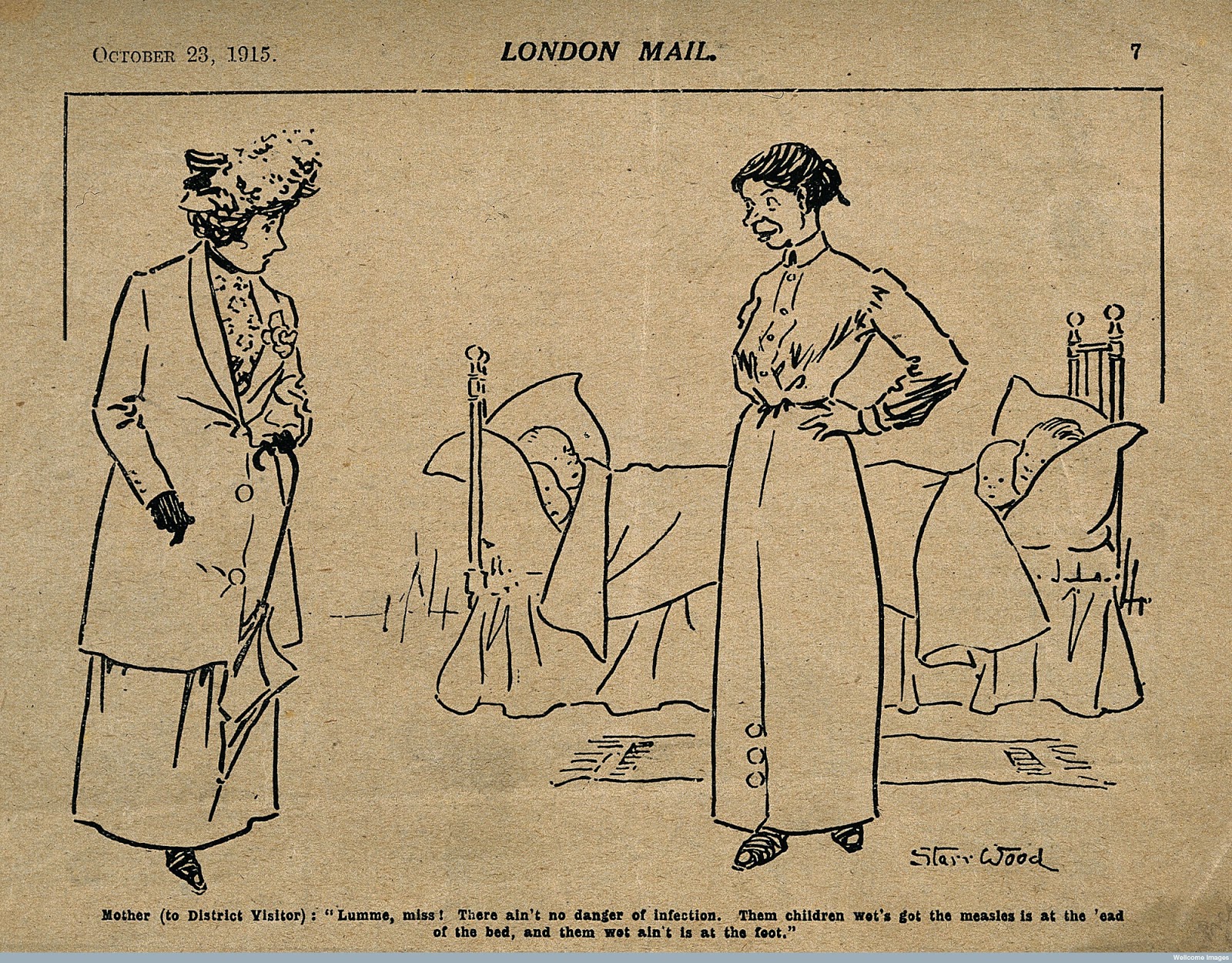
Mother (to District Visitor): "Lumme, miss! There ain't no danger
of infection. Them children wet's got the measles is at the 'ead of 
the bed, and them wet ain't is at the foot.
London Mail, 23 October 1913
Image courtesy of the Wellcome Library
The project builds on and was partly inspired by the RAMI Living Medical History project; Susan Mullaney, Mary O’Doherty and  Patrick Plunkett of the RAMI section on history of medicine devised this innovative project to interview retired medical doctors about their working lives, collecting memories on the changes in medical practice over the course of their careers. Several of the LMH interviewees had either suffered from diseases like diphtheria and tuberculosis themselves, or had family who did, and this really brought home to me how all-pervasive the effects of childhood disease were on Irish society, that they were not merely confined to the poor and the badly-housed, but could also invade better-off families.

Oral history of medical practitioners


Oral history interviews can add flesh to the dry bones of statistics. When working on my PhD on the effects of the 1918-19 influenza pandemic here,  the people who spoke to me about suffering this influenza as small children, or who told me about how their families coped with the tragic losses of children or parents to the 1918-19 flu, breathed life into its history, recreating the fear caused by the unpredictability of  this most awesome of influenza pandemics.

In the case of this new project, I am hoping to find people who can talk about the changing landscape of childhood illness in the twentieth century, from their own perspective, whether as medical workers, patients, parents or as Department of Health officials and politicians.

I’m curious about issues like knowledge transfer – how and what did parents learn about treating the illnesses their children caught?  As a child growing up in the 1960s, I recall my mother hanging blankets over the windows when we caught measles; the information she had been passed down by her mother was that children with measles could damage their eyesight if they read or were in daylight.

When I had my own children in the 1990s, I was struck by the efficiency and dedication of a district nurse in north Kildare who made sure we parents brought our children for vaccinations, and cajoled and informed those parents who had reservations about allowing their children to be vaccinated. Getting medical workers like her to talk about their work is one of the goals of this project. This district nurse was, it seems to me, a local hero, a micro role player who was a small but significant cog in the expanding machinery which managed and significantly improved the health of our children over the course of the twentieth century. 

Dr Ida Milne is a social historian based at NUI Maynooth and Queen's University Belfast. She holds an ELEVATE Irish Research Council International Career Development Fellowship co-funded by Marie Curie Actions.