Tuesday, 5 May 2015

The Cork Street Fever Hospital Archive by Fergus Brady

In 2013, the Cork Street Fever Hospital archive was donated to the Royal College of Physicians of Ireland (RCPI). Following a recent funding award, the archivists at the RCPI began the process of cataloguing and preserving these extensive and important medical records. The project is now complete and the final collection list is available to browse through the online RCPI catalogue. In this month's post, Fergus Brady, Archivist, RCPI, reports on the archive and outlines the history of this fascinating Irish medical institution.

Photo of nurses and patients on the lower landing of Cork Street Fever Hospital, Dublin, Ireland, 1903
Nurses and patients on the 'lower landing', Cork Street Fever Hospital, 1903
(RCPI Archival Collections: CSFH/1/2/1/6)


RCPI win Wellcome Trust funding to catalogue Cork Fever Hospital Archive


A project, funded by the Wellcome Trust, to fully catalogue the archive of Cork Street Fever Hospital has been completed by the staff of the Royal College Physicians of Ireland Heritage Centre. As part of the project, appropriate measures were also taken to ensure the long-term preservation of the archive so that the hospital’s records will be accessible to researchers both in the present and into the future.

The origins of the House of Recovery and Fever Hospital, Cork Street, Dublin


Minutes, Governors of Cork Street Fever Hospital, 1801
(RCPI Archival Collections: CSFH/1/1/1)
The House of Recovery and Fever Hospital on Cork Street, Dublin, grew out of a series of meetings held between a group of wealthy and philanthropic men drawn from Anglican and Quaker congregations during October 1801. In the late eighteenth and early nineteenth centuries in Dublin, as elsewhere in Europe, insanitary conditions ensured that infectious diseases were prevalent among the general population. Those present at the October meetings had a clear idea of the nature and scale of such health issues, stating that ‘...no adequate Hospital accommodation has hitherto been provided for the relief of the Sick poor of Dublin afflicted with fever (especially such as may be of a contagious Nature)’. Influenced by the fever hospital movement in Britain, the provisional Committee believed that the solution lay in the ‘establishment of a House of Recovery to which patients on the first appearance of Fever might be removed’.1

The fever hospital opens


Original entrance to Cork Street Fever Hospital, erected in 1804
Original entrance to the hospital, erected 1804
(RCPI Archival Collections: CSFH/7/1/6)
Less than three years later, on 14 May 1804, the newly-erected House of Recovery and Fever Hospital on Cork Street admitted its first batch of patients. As its name suggests, the hospital physically separated the sick from the convalescent by the constructing two buildings 116 feet apart in what was an early attempt at infection control.2 The erection of such purpose-built buildings was intentional, as the hospital’s founders were influenced by prevailing theories regarding the control of infectious diseases.


Early years and fever epidemics


Drawing of Cork Street Fever Hospital and House of Recovery, 1899
Cork Street Fever Hospital and House of Recovery, 1899
(RCPI Archival Collections: CSFH/1/2/1/5)
In the early decades of the hospital’s existence its catchment area expanded from the Dublin Liberties to the whole of the city. Hospital buildings were extended to meet the admissions triggered by the regular epidemics which ravaged the poorest districts in the city. A fever epidemic in 1817—1819 put severe pressure on the hospital, with admissions doubling in 1818. In 1826 an epidemic of typhus necessitated the erection of emergency tents. The 1830s and 1840s were periods of exceptional activity, as the number of patients admitted swelled due to outbreaks of cholera and typhus. In 1847 tents were erected and 400 emergency beds provided to allow for the admission of patients suffering from a typhus outbreak, which had been stimulated in large part by the influx into Dublin of thousands of famine-stricken refugees from the countryside. These regular epidemics took their toll on the health of the medical staff, and in particular the nursing staff, many of whom were struck down with fevers contracted during the course of their work.

The 'Red House'


Nurse and two children on the balcony of the Red House, Cork Street Fever Hospital, Dublin, Ireland, 1909
Nurse and two children on the balcony of the Red House, 1909
(RCPI Archival Collections: CSFH1/2/1/6)
In the 1860s and 1870s epidemics of smallpox placed great pressure on the hospital’s resources, with a record case fatality rate of 21 per cent recorded in 1878. In the last few decades of the century measles, typhoid, scarlet fever and smallpox predominated, prompting the hospital governors to build the ‘Red House’ on the grounds of Cork Street, and to open an auxiliary hospital for convalescents at Beneavin, Finglas. In 1891, hospital reports recorded diphtheria for the first time, a disease which became a significant health problem in the early twentieth century with the arrival in Dublin of the virulent gravis strain.


The move to Cherry Orchard


Patient arriving in ambulance at Cork Street Fever Hospital, Dublin, Ireland, 1896
Patient arriving at hospital in ambulance, 1896
(RCPI Archival Collections: CSFH/1/2/1/5)
In the early twentieth century there were two changes that significantly altered the running of the hospital: in 1904, the hospital was granted a Royal Charter under which Dr. John Marshall Day was designated first Medical Superintendent; and, in 1936, the Dublin Fever Hospital Act changed the hospital from voluntary to municipal control. This alteration sought to “make provision for the establishment of a new fever hospital in or near the city of Dublin and for the closing of the House of Recovery and Fever Hospital, Cork Street, Dublin”.3 Planning for the development of a new hospital was long and protracted, however, with both the Second Word War and a 1944 sworn inquiry into alleged maladministration in the hospital contributing to delays. Led by the efforts of Dr. Day’s successor as Medical Superintendent, Dr. C. J. McSweeney, a 74-acre site was finally secured at Blackditch, Palmerstown, Co. Dublin, and building tenders received in early 1950. The hospital board decided that as the name Blackditch evoked images of plague and death, the address of the new hospital should be changed to Cherry Orchard. In November 1953, patients and staff vacated the premises at Cork Street and moved to the new House of Recovery and Dublin Fever Hospital, Cherry Orchard.


The Cork Street Fever Hospital archive


Staff of Cork Street Fever Hospital, Dublin, Ireland 1938. Dr. C. J. McSweeney, Medical Superintendent, is  pictured sixth from the right in the second row
Staff of Cork Street Fever Hospital, 1938
Dr. C. J. McSweeney, Medical Superintendent, is
pictured sixth from the right in the second row
(RCPI Archival Collections: CSFH/1/3/4/1) 
The archive of Cork Street Fever Hospital is large and varied, and consists of a series of records relating to hospital management, staff, students, patients, finances, buildings, hospital history and events. There are also records of inquiries, routine administration and domestic tasks, and individual Medical Superintendents. The run of minute books is remarkably complete, stretching from the first meetings of the provisional managing committee in 1801 to 1953, a span interrupted only by a gap of twelve years between 1828 and 1842. Similarly annual reports, which usually include medical reports, run from 1801 to 1953 with few omissions. Records relating to individual Medical Superintendents are particularly plentiful for Dr. C. J. McSweeney’s tenure (1934–1953), and consist for the most part in report books, research and teaching notes, drafts of articles and papers, and other ephemera. Patient records are, unfortunately, less comprehensive, with the earliest surviving register of patients dating from 1924 to 1929. Access to patient records and other sensitive files containing personal data are subject to Data Protection legislation and conditions laid out in the RCPI Heritage Centre’s guidelines. There are also some records across the various series which date from the decades following the transfer of the hospital to Cherry Orchard.

If you have any queries about the collection, please contact heritagecentre@rcpi.ie.


1. Cork Street Fever Hospital Committee Proceedings, 23 October 1801.↩
2. Patricia Conway, Sheila Fitzgerald and Seamus O’Dea, Cherry Orchard Hospital: The First 50 Years (Dublin, 2003), p.  2.↩
3. Ibid., p. 3.↩

Tuesday, 24 March 2015

The historical development of Irish Hospitals and the importance of their records by Brian Donnelly

In this month's post, Brian Donnelly, senior archivist at the National Archives of Ireland, outlines the development of Irish hospitals from the eighteenth to the twentieth century.

Rotunda Hospital, Dublin
(RCPI Archival collections: VM/1/4/19)

The establishment of the voluntary hospitals


The early eighteenth century saw the establishment of voluntary hospitals by philanthropists, mainly in Dublin but also in the larger provincial towns. Jervis Street hospital (the Charitable Infirmary) was the first voluntary hospital Ireland and was founded in 1718.  Many of these, like Dr. Steeven’s Hospital (founded in 1733) and Mercer’s (founded 1734) would survive into the twentieth century.  The eighteenth century also saw the establishment of specialist hospitals, most of them voluntary, such as the Rotunda Lying In Hospital, founded in 1745, St. Patrick’s Hospital for mental illness, founded in 1747 and the Westmoreland Lock Hospital, for the treatment of venereal disease, in 1792. 

A modern public health service at county level began in 1765 when a parliamentary enactment provided for the erection and support of an infirmary for each county in Ireland and also permitted support for several existing hospitals, mainly in Dublin and Cork, out of public funds.  The county infirmaries were to be maintained by grand jury presentments, parliamentary grants and local subscriptions. The grand juries were groups of landowners who were called together by the High Sheriff in each county twice a year for legal and local administrative reasons.

The House of Industry hospitals, district lunatic asylums and medical dispensaries


The Dublin house of industry, a precursor of the workhouses of the nineteenth century, was founded in 1772. This institution became in time a vast concern, providing hospitals for the sick, an asylum for children, bridewells, penitentiaries for women and young criminals, a house of industry for vagrants, and cells for lunatics.  From it evolved the House of Industry hospitals – the Richmond, Whitworth and Hardwicke - and it played a major role in establishing the first and largest of the public lunatic asylums – the Richmond Lunatic Asylum – which opened for patients in 1814. Following the report of the Committee on the Lunatic Poor in 1817, the Lord Lieutenant was enabled by statute to build asylums where he considered necessary and, over the next half century, a well-developed mental health infrastructure was in place. By 1871, twenty two asylums were being financially supported by the grand juries. In 1850 a central asylum “for insane persons charged with offences in Ireland” was opened in Dundrum. This institution, the first criminal lunatic asylum in these islands, was under the direct control of the Lord Lieutenant who appointed the staff and made regulations for its management. 

A few dispensaries were supported by voluntary subscriptions in several of the larger towns and cities from the late eighteenth century, but it was not until 1805 that grand juries were authorised to give grants to dispensaries in rural areas. By the early 1830s, there were 450 dispensaries throughout the country, administered by committees of management and supported partly by subscriptions and partly by grand jury grants. There were fewer dispensaries in poorer areas, where voluntary contributions were wanting, and where it was difficult to raise enough money to start them. Inadequate as many of these dispensaries were, they represented the first steps towards domiciliary medical treatment of the rural population.


Robert Graves (1796-1853)
 (RCPI Archival collections: VM/1/2/S/35)

The impact of epidemics on the development of medical infrastructure


Epidemic disease was a major impetus in the development of a medical infrastructure. Typhus was a major scourge in Ireland in the early nineteenth century and, while several fever hospitals had been established in the larger towns in the late eighteenth century, it was not until 1807 that legislation was passed to encourage their construction throughout the country. A fever epidemic of unprecedented proportions raged in Ireland between 1816 and 1819. Under an 1818 Act, local boards of health could be established, supported partly by grand juries, which had extensive powers to combat disease. Grand juries were empowered to make presentments equal to twice the amount raised by private subscription to build fever hospitals. In 1819, legislation enabled officers of health to be appointed in parishes and a parish health tax could be levied. 

The establishment of the Central Board of Health in 1820 marked a major step in the centralisation of medical relief and local boards of health were to play a major role in combating epidemics over the following decades. The Central Board of Health collected statistics about local health conditions, advised where local boards of health should be established and when grant to hospitals should be made. When cholera broke out in Ireland in March 1832, the Central Board of Health, renamed the Cholera Board for the duration of the epidemic, supervised measures to combat the disease which included the establishment of local boards of health. 

Dublin hospitals like the Meath were at the forefront of the fight against infectious disease from the 1820s and introduced new methods of bedside clinical training to the English speaking world.  The census commissioners noted in 1854 that to these metropolitan hospitals “the Irish School of Medicine is largely indebted for the celebrity which it has so long enjoyed”. The Meath hospital received international recognition in the early nineteenth century due to the innovative teaching methods and research carried out by its physicians, Robert Graves and William Stokes. The latter had survived an attack of typhus in 1827 and identified the first case of cholera in Ireland in 1832. This new approach to clinical training had originated on the continent and its introduction into the Meath hospital heralded what has been described as the heroic age of the Irish School of Medicine. The voluntary hospital infrastructure continued to expand during the nineteenth century and following Catholic Emancipation many Catholic religious orders became involved in founding hospitals.

The Irish Poor Law, 1838


The enactment of the Irish Poor Law of 1838 was to have a dramatic effect on the provision of public health services for the rest of the nineteenth century. The country was divided into over one hundred and fifty poor law unions each with a workhouse at its centre and administered by a board of guardians.The structure of the poor law system, being modern and efficient and more easily subject to central control, was adapted on nearly all occasions where a new local function was created or an old one modified .The Medical Charities Act of 1851 led to the modernisation and extension of the old grand jury dispensary network under the boards of guardians and made a domiciliary medical service available to large sections of the population, the destitute poor, for the first time. 

By 1852, every poor law union had been divided into a number of dispensary districts, each with a dispensary and medical officer.  Patients had to apply to a poor law guardian for a ticket every time they wanted to attend a dispensary free of charge. Committees of management were responsible to the boards of guardians for the management of the dispensaries and appointing the dispensary doctors. In 1863, the dispensary doctors were made registrars of births and deaths and of Roman Catholic marriages and the practice of registering births, marriages and deaths was standardised on the 1st of January 1864. When registering deaths, the dispensary doctors were required to note the cause of death and duration of illness, thus enabling accurate statistics of mortality to be compiled for the first time. The registration of births enabled such measures as the compulsory vaccination of children against smallpox to be carried out effectively and by the end of the nineteenth century this scourge had, to a great extent, been eliminated.

While many boards of guardians had allowed the non-destitute to enter workhouse hospitals for treatment during the 1850s, the 1862 Poor Law (Amendment) Act officially opened the workhouse hospitals to the non-destitute sick. As a result of these developments, Ireland had one of the most advanced health services in Europe in the mid-nineteenth century, if policy and structure are to be taken as criteria. The Local government (Ireland) Act, 1898, replaced the grand juries by democratically elected county and rural district councils. The county councils took over the administration, either directly or through joint committees, of the district lunatic asylums.

Newcastle Sanatorium, Wicklow.
Image courtesy of NLI (L_ROY_05467)

Tuberculosis and the sanatorium


While Ireland had a low death rate from infectious disease in the first decade of the twentieth century, tuberculosis was the marked exception. The last years of the nineteenth century saw the first attacks made against the disease with the establishment of Newcastle Sanatorium in 1893. In 1904, the sanitary authorities of County Cork combined with Cork Corporation to establish Heatherside Sanatorium near Doneraile. In 1907, the Dublin City and County authorities established Crooksling Sanatorium. A Tuberculosis Prevention Act was passed in 1908 which gave the county councils power to provide sanatoria and brought the first veterinary inspectors into the employment of the sanitary authorities.  Peamount Sanatorium was founded in 1912 through the efforts of the Women’s National Health Association, the most formidable health pressure group of the early twentieth century.

Public health provision in post-independent Ireland


The turbulent years of the early 1920s saw some revolutionary changes in the public health system. In general, the boards of guardians outside Dublin were abolished and were replaced by county boards of health and public assistance, essentially sub-committees of the county councils. Most workhouses were closed to save money and central institutions called county homes were established in each county where the poor were to be relieved. While the newly styled county homes were to be reserved in theory for the old and infirm many soon included unmarried mothers, children and the mentally retarded.  Following the establishment of the Irish Free State the Department of Local Government and Public Health formally became, in 1924, the central government authority for local government and health administration. The Minister took over the Lord Lieutenant’s duties in relation to the mental hospitals. In 1930, the establishment of the Irish Hospitals Sweepstakes, a lottery to provide financial assistance to hospitals, provided a financial lifeline to many voluntary hospitals who were struggling to survive following a reduction in the number of endowments and bequests after the Great War.

The post-war period and declining mortality


There were significant developments in health care in the 1940s and 1950s. The Mental Health Treatment Act of 1945 modernised the legal code under which the mental services operated and provided important safeguards against the arbitrary detention of patients although the numbers of persons being treated continued to increase until, by 1959, there were 20,000 patients in Irish mental hospitals.  In the years immediately after 1945 there was a major effort to develop anti-tuberculosis services. The Tuberculosis (Establishment of Sanitoria) Act of 1945 permitted the Minister for Local Government and Public Health to arrange for the building of sanatoria and to transfer these to local authorities when completed. This was a major departure from established practice for the central authority as it stepped outside its normal functions of directing and co-ordinating the local services. Sanatoria were built at Dublin, Cork and Galway and were handed over when completed to the local authorities as was provided under the Act. 

There was also widespread building and conversion of buildings for the treatment of tuberculosis cases by local authorities.  These developments, together with the payment of maintenance allowances for dependents of persons undergoing treatment for infectious disease, mass radiography, BCG vaccination and new drugs such as streptomycin, led to a great decline in mortality for the disease and in the number of new cases appearing.  In 1947 the Department of Local Government and Public Health was divided into two separate departments. The Health Act of 1953 extended eligibility for general hospital services and maternity care to a much wider class. Health authorities were now required to provide child welfare clinic services and the school health service was improved. The dispensary service and dispensary doctors were transferred from the public assistance code to the health authorities. The old dispensary ticket system was done away with and replaced by medical cards. A more liberal code for the governing of county homes was introduced and provision was made for the development of a comprehensive rehabilitation service.

William Stokes (1804-78) and William Wilde (1815-76)
(RCPI Archival Collections: PDH/6/2/12)

1970s regionalisation and the Irish 'love affair' with the hospital bed


By the 1960s, it was felt that as the state had taken over the major financial interest in the health service there should be a new administrative framework combining national and local interests.  For technical and logistical reasons it was believed that better services could be provided on a regional rather than a county basis.  The establishment of the health boards under the Health Act, 1970, marked a major break in the link between the health services and county administration. At this time Ireland had the highest proportion of hospital beds to population in western Europe and the Irish hospital system was described as “one of a large number of small institutions scattered throughout the country”. The following decades would see the closure or amalgamation of many voluntary and state hospitals into larger units and the dismantling of the old mental hospital infrastructure.

The historical value of Irish hospital records


That Irish hospital records are of great historical interest has long been acknowledged. Dr. William Wilde, the internationally renowned nineteenth century physician and statistician, recognised one hundred and seventy years ago that the hospital registers of the Rotunda Hospital represented the ‘most interesting and earliest statistical tables on record’.  Ireland’s medical institutions, both voluntary and public, have a peculiarly rich and varied history and have played a paramount role in medical advances over the last three centuries.  While some collections of hospital archives are now safe in archival custody, many collections remain in peril. These archives have no protection under the law and it is often only through the good offices of interested hospital staff that material has been preserved. 


Brian Donnelly is a Senior Archivist at the National Archives with responsibility for Business and Hospital records. Images courtesy of Fergus Brády, Archivist, RCPI. 

Thursday, 5 February 2015

Conference report: Medical training, student experience and the transmission of knowledge by Anne Hanley

In the first blog post of 2015, Dr Anne Hanley reports on 'Medical training, student experience and the transmission of knowledge' - a conference which took place at the Centre for the History of Medicine in Ireland in October and which was funded by the Irish Research Council and the Wellcome Trust. Podcasts of papers from the conference were recorded by Real Smart Media and may be accessed here. 

I recently attended the conference, 'Medical training, student experience and the transmission of knowledge, c.1800-2014' (or #MTSE14 if you want to look over our live tweets), at University College Dublin. Needless to say its focus, and the discussion generated from its wide-ranging collection of papers, was excellent and very much overdue.

Students dissecting

Medical education


Despite an ever-growing interest in the history of medicine, the subject of medical education and student experience continues to be overlooked (the last international symposium dedicated to this subject having taken place in the early 1990s). Yet throughout the nineteenth century medical education was being increasingly formalized, centralized, and consolidated. It became the backbone of one’s medical career. Strangely, however, it has occupied the negative space in histories of clinical practice and patient care. This omission is incredibly problematic (but I digress…).

So, when Laura Kelly emailed to ask if I would give a paper at a conference devoted to the history of medical training and knowledge production, I sent back an immediate and unequivocal ‘YES!!’. (There were so many excellent papers about which I want to talk that my own paper, ‘Venereology at the Polyclinic’, will have to take a back seat for now.)


An important focus of MTSE was the centrality of pedagogy. Traditionally, histories of medical education have been written as administrative histories of major teaching hospitals. They have concentrated on the big names, significant infrastructural changes, and major medical developments that altered practice in these hospitals. Rarely have such histories considered in the implications of the big names and significant changes for the day-to-day learning and experiences of students. Happily, however, historians of medicine are beginning to recognize the importance of pedagogically-focused histories and MTSE really demonstrated this change. It brought a whole host of issues to the fore and, as those of you who follow me on Twitter will have gathered, I was rather excited by the rich collection of papers.

Professor John Harley Warner delivering his keynote.
Image courtesy of Real Smart Media

John Harley Warner keynote address


We began with the keynote address from John Harley Warner, who introduced us to his most resent and gruesomely fascinating work on the photographic history of dissection in American medical schools. As Warner observed, nineteenth-century medicine was often a solitary occupation and so medical schools provided an important opportunity for group learning and for developing a collective professional identity. And this is particularly well-evidenced in the strange collections of photographs in which groups of students posed around tables upon which they were dissecting cadavers. One particularly interesting aspect of Warner’s keynote was the figure of the medical school porter who often appeared in these photographs and who Warner identified as playing a key role in the facilitation of medical education (but I’ll return to this shortly).

Attendees at MTSE.
Image courtesy of Real Smart Media.

Microbes to matron


Many fantastic papers followed, including Claire Jones’s presentation of her most recent research on the ‘Microbes to Matron’s’ project. Her focus on the pedagogy and practice of infection control in British nursing between 1870 and 1900 offers an important counterpoint to what have traditionally been male-focused accounts of medical education. It is very easy to forget that there were (and continue to be) other groups of trained medical professionals beyond doctors who provided care to a wide cross-section of the population. What also interested me about Jones’s paper were the types of sources she and her fellow project investigators are drawing upon. By using surgical nursing examinations, Jones demonstrated the increasingly active role of nurses in their own education, and in surgical practice more broadly.


Dollhouse diorama

Crime scenes and dollhouse dioramas


Similarly, Neil Pemberton’s paper on teaching crime scene investigation through dollhouse dioramas also prompted us to reconsider the role of women in medical and scientific training. By appropriating the traditional female practice of miniature making, women like Frances Glessner Lee created a new way of thinking about crime scene science. Nathalie Sage Pranchère also looked at the important role of women in medicine, speaking about the development of nineteenth-century French midwifery training. Importantly, she also described how obstetric teachers used models to develop the anatomical and obstetric knowledge of their midwifery students. As we saw with Pranchère’s paper, the role of material objects in medical training and practice is becoming an increasingly central focus of historical scholarship and this was reflected throughout MTSE. For example, Jenna Dittmar used the collections from Cambridge’s former Anatomical Museum to demonstrate how human remains allow biological anthropologists to examine the historical tools and techniques of dissection.

Speakers Greta Jones, Anne Hanley,
Nadav Davidovitch and Victoria Bates.
Image courtesy of Real Smart Media.

Spaces of medical education


Another important theme to emerge from MTSE was the different spaces of medical education. Warner described the dissection room as a space for developing collective professional identify. Michael Brown spoke about the dynamic space of the nineteenth century lecture theatre, in which students and their lecturers were appealing to culturally resonant sets of values. Clare Hickman presented eighteenth-century botanic gardens as important spaces for thinking about the material culture of medical teaching. Hickman’s paper, like Warner’s keynote, also demonstrated that the history of medical education is never simply about those who learned the art of medicine but also those in the background. Like the African American medical school porters who procured cadavers for students, gardeners were important (but silent and overlooked figures) in the maintenance of teaching spaces and the facilitation of teaching practices.

Attendees at MTSE.
Image courtesy of Real Smart Media.
MTSE demonstrated how the nature of medical training has changed over time and within distinct national contexts. Through an excellent collection of papers we explored the emergence of centralized and consolidated systems of medical training. We looked at the development of new tools of training and the different spaces in which these tools were employed. And we looked at how medical knowledge and codes of professional identity were being assimilated by medical and dental students, nursing probationers, midwives, and qualified practitioners seeking further education.


I came away from MTSE with a new appreciation for the diversity of student experiences and systems of knowledge dissemination, and will certainly be drawing upon these ideas in future. With any luck, events like MTSE will slowly begin to generate greater interest in the important place of medical training in wider narratives of medical history.

Dr Anne Hanley is an LHRI Research Fellow at the University of Leeds with particular expertise in the history of modern medicine, medical education, health policy and the history of science. She recently completed her PhD at the University of Cambridge on the development and dissemination of venereological knowledge among English medical professionals, 1886-1913. She writes a blog Clinical Curiosities and tweets at @annerhanley.


Friday, 28 November 2014

Childhood illness in twentieth-century Ireland by Ida Milne

In this month's blog post, Dr Ida Milne,  Irish Research Council ELEVATE fellow co-funded by Marie Curie Actions, writes about her postdoctoral project on childhood illness in twentieth-century Ireland.

We live in an era where we expect our children to survive to adulthood without having their lives threatened by common infectious diseases of childhood.  The situation was rather different in the Ireland of the early part of the twentieth century. In 1911, more than 2,000 infants under the age of two died from diarrhoeal illnesses, almost double the number that died the previous year.  The increase was not helped by the hot summer, which exacerbated the hygiene difficulties in an era when many houses, even of the affluent, did not have running water or flush toilets. As a twenty first century mother, I find the idea of nursing a child suffering from diarrhoea in an overcrowded third floor  bathroomless tenement almost unimaginable. 

Child mortality in the early-twentieth century


Having healthy children who would survive to adulthood was not taken as the norm, as we do now. Statistics tabulated by the Registrar-General in 1911 show that one-fifth of the total 72,475 deaths in 1911 were children under 5; of these, 945 were caused by ‘convulsions’ and 1,370 by bronchitis. Scarlet fever claimed the lives of 260 children under fifteen; 460 under-fifteens died from measles, and 819 under tens from whooping cough.  

Slums in Dublin, c.1865-1914 (Image from NLI collection: L_ROY_07881)


Dublin tenements, poverty, and childhood illness


Few families, rich or poor, remained untouched by these deaths, but the over-crowded living conditions of the poor could bring extremes of ill health. Stella Larkin McConnon, trade unionist James Larkin’s granddaughter, told me that the poor health of the nation’s children was one reason he became so interested in improving living conditions for families.  The Larkins had good reason to be aware of the suffering.  Stella’s own mother was brought up in Marlborough Street in the heart of Dublin’s tenements, and was the only one of ten children to survive to adulthood.  Stella still remembers visiting the tenement, one room with only one metal bed, the only toilet downstairs in another part of the tenement, the cooking done on an open fire.

Improving child health


By 1981, the landscape of death in childhood had changed radically. There were no deaths in either Northern Ireland or the Republic from scarlet fever or whooping cough, and only two from measles.  Only 2.78 per cent of the total deaths, 916 of 32,929, were of children under five.

Many factors contributed to the improvements over the course of the twentieth century:  among them vaccination schemes and more effective medicines, public health education and increased state intervention in the health of children, better housing and diet and improved air quality. It didn’t happen by accident – throughout the century, there were individuals who identified areas to change and worked to effect that change.  Their number includes the first chief medical officer for Dublin, Sir Charles Cameron, trade unionists like James Larkin who worked to give families a decent wage, pioneering TB Dr Dorothy Stopford Price,  Department of Local Government and Public Health Chief Medical Officer James Deeny, Noel Browne and many others who played macro and micro roles in the significant reduction in deaths from disease in childhood.

Research project on childhood disease


In October, I began a three year  Irish ResearchElevate Fellowship in the National University of Ireland and Queen’s University, Belfast to research this dramatic changing landscape of childhood disease, which is in general a good news story for Irish society and Irish public health.  While statistical and documentary sources will be important to the project, a key feature will be a series of qualitative interviews with medical professionals, with people who worked in relevant Government and local authority roles, and with parents and sufferers. I intend that these interviews should, at the conclusion of the project, be available in an open access archive to other researchers. 
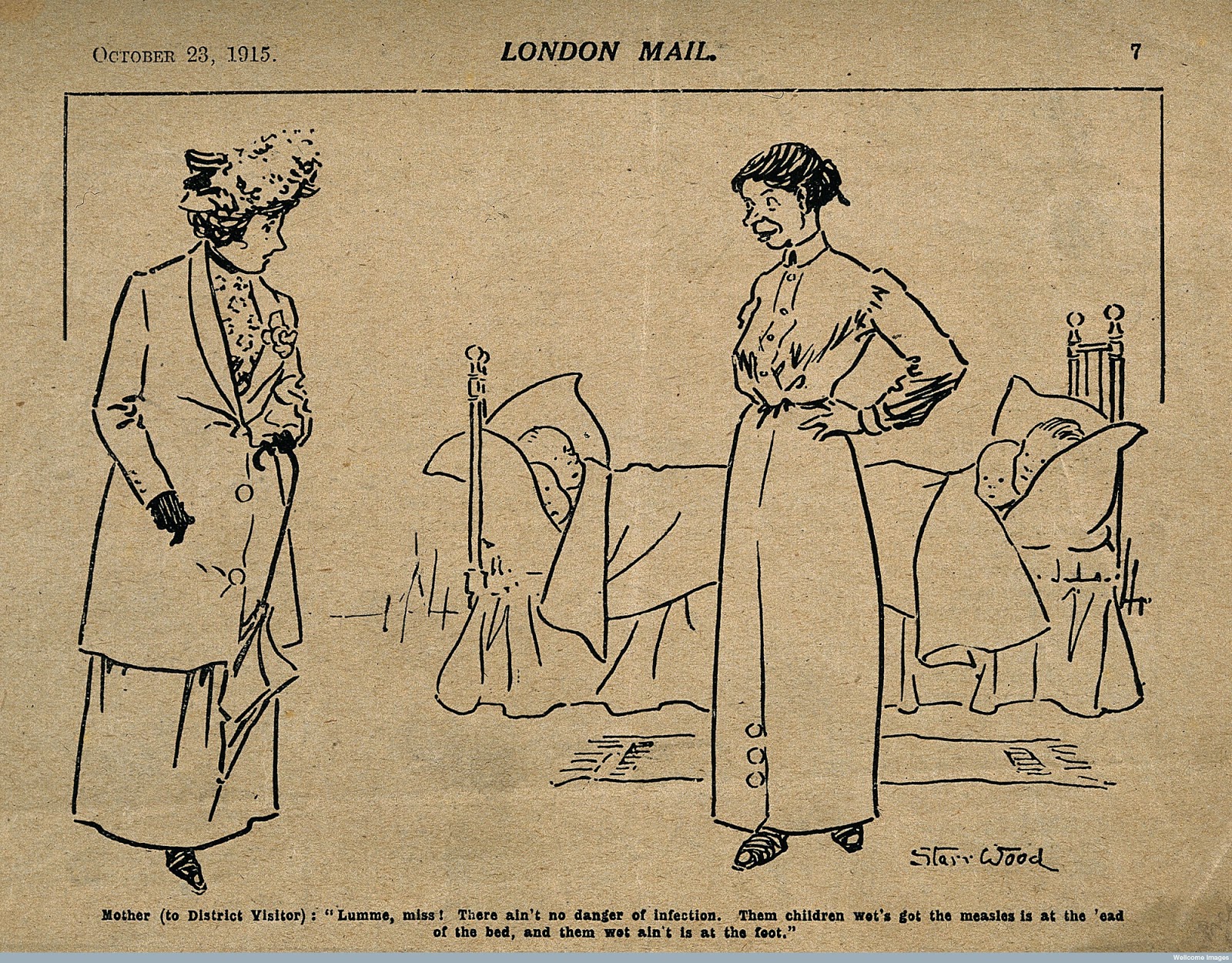
Mother (to District Visitor): "Lumme, miss! There ain't no danger
of infection. Them children wet's got the measles is at the 'ead of 
the bed, and them wet ain't is at the foot.
London Mail, 23 October 1913
Image courtesy of the Wellcome Library
The project builds on and was partly inspired by the RAMI Living Medical History project; Susan Mullaney, Mary O’Doherty and  Patrick Plunkett of the RAMI section on history of medicine devised this innovative project to interview retired medical doctors about their working lives, collecting memories on the changes in medical practice over the course of their careers. Several of the LMH interviewees had either suffered from diseases like diphtheria and tuberculosis themselves, or had family who did, and this really brought home to me how all-pervasive the effects of childhood disease were on Irish society, that they were not merely confined to the poor and the badly-housed, but could also invade better-off families.

Oral history of medical practitioners


Oral history interviews can add flesh to the dry bones of statistics. When working on my PhD on the effects of the 1918-19 influenza pandemic here,  the people who spoke to me about suffering this influenza as small children, or who told me about how their families coped with the tragic losses of children or parents to the 1918-19 flu, breathed life into its history, recreating the fear caused by the unpredictability of  this most awesome of influenza pandemics.

In the case of this new project, I am hoping to find people who can talk about the changing landscape of childhood illness in the twentieth century, from their own perspective, whether as medical workers, patients, parents or as Department of Health officials and politicians.

I’m curious about issues like knowledge transfer – how and what did parents learn about treating the illnesses their children caught?  As a child growing up in the 1960s, I recall my mother hanging blankets over the windows when we caught measles; the information she had been passed down by her mother was that children with measles could damage their eyesight if they read or were in daylight.

When I had my own children in the 1990s, I was struck by the efficiency and dedication of a district nurse in north Kildare who made sure we parents brought our children for vaccinations, and cajoled and informed those parents who had reservations about allowing their children to be vaccinated. Getting medical workers like her to talk about their work is one of the goals of this project. This district nurse was, it seems to me, a local hero, a micro role player who was a small but significant cog in the expanding machinery which managed and significantly improved the health of our children over the course of the twentieth century. 

Dr Ida Milne is a social historian based at NUI Maynooth and Queen's University Belfast. She holds an ELEVATE Irish Research Council International Career Development Fellowship co-funded by Marie Curie Actions. 

Tuesday, 4 November 2014

Workshop report: Soviet healthcare in the comparative perspective by Susan Grant

In this month's blog post, Susan Grant reports on the recent 'Soviet healthcare in the comparative perspective' workshop which took place at UCD in May 2014.

Historians of Soviet and medical history met in the UCD Humanities Institute May 29-30 to discuss Soviet healthcare in comparative perspective. Generously supported by the Wellcome Trust, UCD Seed Funding, and the Irish Research Council, this workshop represented an important international gathering of scholars from Ireland, the UK, Canada, and the United States.  The inter-disciplinary nature of the workshop meant that there was much debate and discussion among participants (the programme is available on the CHOMI website here).

Nursing in the Soviet Union


The overall aim of the workshop was to analyse the history of Soviet nursing and healthcare in comparative perspective, and to critically examine issues such as professionalization, gender, and care. The workshop mandate was to evaluate Soviet nursing relative to international nursing and healthcare, and to explore how nursing in the Soviet Union developed in relation to other medical professions. Participants were asked to consider the development of Russian healthcare and to compare the Soviet healthcare system to that of other countries.

Comparative aspects of Soviet healthcare


The workshop was a great success, particularly in facilitating cross-disciplinary discussion about the comparative aspects of Soviet healthcare. Panels focused on three key aspects of Soviet healthcare: professionalization, gender and care. The issue of care and the idea of the ‘virtue script’ (as conceptualised and explained in the work of Prof. Sioban Nelson, University of Toronto) fostered a particularly engaging dialogue about how nursing care is conceived and understood. This fed into discussions of what constitutes a ‘good’ and ‘bad’ nurse, as well as patient perceptions of ‘good’ and ‘bad’ nurses.  Nursing care, whether in the Soviet Union or elsewhere, depends on a variety of factors and an individual’s experience of nursing care. Studies of Soviet nursing are limited and probing expectations of care from an international perspective proved very productive in thinking about approaches to Soviet nursing and healthcare practices.

Panel on gender


Papers that focused on gender were particularly helpful in illuminating the difficulties and challenges of dealing with source material such as memoirs, interviews, etc. Prof. Dan Healey, Dr Laura Kelly, and Prof. Christopher Burton shared their experiences of working with memoir literature and the problems this can raise in terms of medical history. This was very informative for everyone, and especially instructive in highlighting the similar experiences of scholars who focus on different periods and countries. Indeed, scholars of medical and nursing history, and also the history of Russia, Ireland, Great Britain, etc., found that they had much in common. Participants specialising in Soviet history were surprised to learn of the liberal aspects of medicine in Ireland at the turn of the century. Cross-disciplinary dialogue here proved fruitful and underlined points of intersection and diversion between Russia and the West.

Transnational healthcare


The comparative dimensions of international healthcare were underscored in the panel featuring Prof. Susan Solomon, Prof. Paul Weindling, and Prof. Anne Marie Rafferty. Papers here focused on the transnational aspects of healthcare, dealing with Soviet cultural diplomacy in the 1920s, continental nurses in the UK  1933-1945, and nursing and decolonization during the second colonial occupation of Malaya, 1946-1955.


Round table on professionalization


The issue of professionalization was discussed in the opening and round table discussions. Scholars of Russian history, including Prof. Donald Filtzer, Prof. Benjamin Zajicek, and Dr Susan Grant presented their papers on professionalisation and practice in Soviet healthcare history.  Discussions about professionalization were elaborated on in the roundtable session, with participants Prof. Susan Solomon, Prof. Sioban Nelson, Prof. Dan Healey, and Prof. Anne Marie Rafferty contributing to a lively debate. It was questioned whether or not theories of professionalisation and histories of the professions are helpful as methods in analyzing both healthcare history and the Soviet case. Findings here were inconclusive, with some scholars acknowledging the merits of professionalisation literature in their work on the Soviet Union or healthcare, and others noting that they found this literature less useful.

The workshop proved that healthcare history continues to be a vibrant field and one that has much value when considering comparative international experiences. We look forward to more discussion of these debates in the future.

Monday, 29 September 2014

Cows, contagion and sanitation and Victorian Dublin by Juliana Adelman

We are back after the summer break! In this month's post, Dr Juliana Adelman writes about her research on the history of animals and public health in nineteenth-century Dublin.


When I began working on the history of animals I was not sure where I would end up.  I was initially interested from the perspective of a historian of science with a focus on the history of natural history. However, it quickly became clear that I was much more interested in  animal-human interactions outside of the laboratory and museum.  Looking at how animals affected and were affected by changes to ideas about health and disease has allowed me to reconnect with my undergraduate experience in a microbiology lab from a totally different angle. 


Medical progress?


Looking at medicine and disease through animals really highlights how social and contingent that knowledge is.  When we look at the history of disease in humans and how society has sought to address it, we can find it difficult to get away from the idea that things are moving forward.  There is no question that human life expectancy is longer, for example, than it was in the past.  We rarely protest against the idea that states have some obligation to the health of their citizens.  Most of us go to a doctor when we feel really sick and expect that they will help us.  While the social history of medicine has made it clear that the system of medicine we have now was in no way inevitable, most of us have fully absorbed the social attitudes that it represents.  

Disease and animal-human relationships

Cattle Market, Dublin (view from North Circular Road towards Prussia St)
Image courtesy of National Library of Ireland: Lawrence Photograph Collection
(L_ROY_08909)
When we look at disease from the perspective of animal-human relationships, however, we are forced to face the ways that our feelings and attitudes about animals have affected and been affected by the course of medicine.  For example, in our age of swine flu and avian flu and BSE we can hardly conceive of not believing diseases to pass between humans and other animals.  Yet, as Anne Hardy has pointed out and Abigail Woods's current project seeks to address, there has been no successful attempt to unite human and animal medicine as a single discipline.  There have been few attempts to address animal disease with practices other than containment by slaughter.  We have pushed animals to the margins of developed society, far away from cities and centres of population, but the ways that we depend on them continue to be highlighted in one food contamination story after another.  

The erasure of animals


So I guess what interests me is how did we get here?  To this place where urban residents depend for subsistence on animals, fear infections spread from animals, yet see themselves as completely separate from the animal world.  You need only look around Dublin to see how thoroughly we have erased their former presence: the site of the former cattle market and city abattoir now contain social housing, the North Circular Road never sees cattle blocking traffic, the Great Western railway terminus (where cattle from the country once arrived in droves) is a bus terminus.  I do not advocate the return of cows to urban Dublin, just a bit more consciousness of their role in our history.


Podcast


Podcast of a lecture 'Cows, contagion and sanitation in Victorian Dublin' by Dr. Juliana Adelman, given at the Centre for the History of  Medicine in Ireland (CHOMI, UCD) Seminar Series, 26 September 2013.


Juliana Adelman is lecturer in History at St. Patrick's College, Drumcondra. To listen to a podcast of a recent paper given by Juliana at the CHOMI Seminar Series, click here and for details of the forthcoming 'Science in the City' event she is organising, click here. Juliana may be contacted at juliana "dot" adelman "at" spd "dot" dcu "dot" ie. 


Wednesday, 25 June 2014

A Malady of Migration: theatre production in Coventry and Dublin

At a time when the issues of migration and mental health are seldom out of the news, the Centre for the History of Medicine in Ireland (CHOMI) has worked with the Centre for the History of Medicine at the University of Warwick (CHM) and Talking Birds theatre company to develop a new theatre production which explores why the mid-nineteenth century saw a prevalence of mental disorders among Irish migrants.The new piece is called 'A Malady of Migration' and is based on research being carried out by Professor Hilary Marland of Warwick and Dr Catherine Cox of University College Dublin, in a project called Madness, Migration and the Irish in Lancashire, c.1850-1921, funded by the Wellcome Trust. They are supported by postgraduate students and others, who will conduct supplementary research and take supporting roles in the drama.

There will be an expert panel discussion after the Thursday evening performances in each venue and a post performance discussion on Saturday lunchtime, providing opportunities for audience members to discuss the making of the piece with researchers and the theatre company, and to engage in debate on issues raised by the performances. A series of short briefing sheets have been produced to complement the drama and provide background information. These can be accessed here.

Check out the Malady of Migration website here!

Performances

Shop Front Theatre, City Arcade, Coventry CV1 3HW (opposite Argos):
Thurs 26th to Sat 28th June 2014
1pm - £6 (£3) and 7pm - £8 (£4)
Box office 0845 680 1926 talkingbirds.co.uk


The New Theatre, Temple Bar, Dublin:
Thurs 3rd to Sat 5th July 2014
1pm - €8 (€4) and 7.30pm - €10 (€5)
Box office 01 670 3361 thenewtheatre.com


A Malady of Migration


Madness, migration, and the Irish in Lancashire, 1850-1921