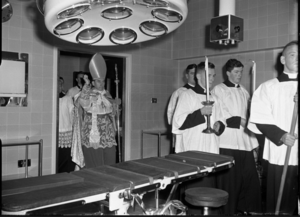
Friday, 5 February 2016

Website Launch: Exploring the History of Prisoner Health

A new website, Exploring the History of Prisoner Health - or histprisonhealth.com - has been launched by the team (co-PIs Dr Catherine Cox (CHOMI, UCD) and Professor Hilary Marland (CHM, University of Warwick)) researching the Wellcome Trust-funded project, 'Prisoners, Medical Care and Entitlement to Health in England and Ireland, 1850-2000'.


Policy Workshop

Exploring the History of Prisoner Health, has been launched in advance of the project's upcoming policy workshop, The Prison and Mental Health - From Confinement to Diversion, which is going to be held in the Shard, London, 12 February. The workshop itself aims  to explore the potential for historians, criminologists, NGOs, policy makers and prison service employees to share ideas and information around the theme of mental health in the prison system.

Project Themes

The website's blog details some of the main project research strands on prisoner mental illness, physical health, juvenile prisoners, political prisoners, as well as the Prison Medical Service. Content will be developed as research progresses and new strands come on board.


Tuesday, 26 January 2016

'The Vast and Often Unpermitted Collection Being Organised in my Diocese': The Central Remedial Clinic, the Catholic Church, and Polio Rehabilitation in Dublin During the 1950s by Stephen Bance

As the incidence of polio began to rise in Ireland, voluntary organisations such as the Central Remedial Clinic were created to rehabilitate survivors of the disease. In this month's blog post Stephen Bance, PhD candidate at the Centre for the History of Medicine in Ireland, UCD, writes about Archbishop John Charles McQuaid's refusal to support the Central Remedial Clinic, given that it was not '100 per cent Catholic'. Others such as Bing Crosby saw no such problem, and were happy to lend a helping hand.


The Central Remedial Clinic


Occupational Therapy was an important part of the rehabilitation
process for polio survivors.
Source: Polio Journal: Official Publication of the Infantile
Paralysis Fellowship, Ireland
, 3:4 (1956), Front Cover.
The creation of rehabilitation facilities for polio survivors in Ireland during the mid-twentieth century was pioneered by voluntary groups. The most active and successful of these organisations was the Central Remedial Clinic (CRC). The CRC was established in 1950 by the remedial gymnast Kathleen O'Rourke and Lady Valerie Goulding, who became a central figure in rehabilitation and philanthropy in Ireland. As a civil-run, non-denominational organisation, the CRC depended upon revenue acquired through fundraising projects, and the success of these enterprises led to their expansion throughout the 1950s. During the same period, the polio rehabilitation unit at Baldoyle Orthopaedic Hospital, which was run by the Sisters of Mercy and was under the patronage of the Archbishop of Dublin John Charles McQuaid, sought public funds to renovate and improve their facility. The Baldoyle Polio Unit, established in 1943, had fallen into a state of disrepair by the early 1950s. The accommodation for patients on site was limited to a collection of dilapidated huts.1 Reverend Mother Mary Polycarp, who was in charge of the facility, wrote to McQuaid detailing the many anxious nights she had spent praying that the huts would not be 'blown down on the little patients who are in danger'.2

Bing Crosby and the CRC


Bing Crosby, 1967, with his horse Dominion Day, which won the
Blandford Stakes at the Curragh with trainer Paddy Prendergast.
Crosby took part in fundraising drives for the CRC.
Source: Dermot Barry/Irish Times.
With no state aid being made available, both the CRC and the Baldoyle Polio Unit began fundraising campaigns.3 The fundraising methods employed by the Baldoyle committee included radio broadcasts, newspaper advertisements, flag days, sweepstakes and sales of work.4 The CRC used similar methods; however, they also harnessed the allure of celebrity to bolster the public profile of their events. For example, a recorded appeal by Bing Crosby was aired on Radio Éireann in 1958,5 and Crosby later visited Dublin to speak at a CRC fundraising dinner.6

100 per cent Catholic, Only


Archbishop John Charles McQuaid, 1956, at the opening of
Our Lady's Children's Hospital, Crumlin. Source.
As the popularity and success of the CRC's fundraising became evident, Archbishop McQuaid wrote to Mother Polycarp expressing his frustration at the 'vast and often unpermitted collection being organised in my diocese by so many persons.'7 Given the influence that McQuaid wielded within the voluntary sector, the CRC asked the Archbishop if he would be prepared to be represented on the trustees committee.8 McQuaid declined due to the fact that Lady Goulding was not a Catholic, stating that it wasn't his policy 'to belong to something unless it was one hundred per cent Catholic'.9

Baldoyle

The Baldoyle fundraising campaign was cut short when McQuaid and the building committee entered into a bargaining process with the Department of Health in order to complete the renovations. The Minister for Health, T.F. O'Higgins, offered to provide funding for the project on condition that the remit of the Baldoyle unit would be expanded to cater for cerebral palsy cases as well as polio cases. This proposal was accepted, and the government provided a £40,000 grant to finish the construction process.10 The hospital was opened in July 1956. The new facility could accommodate 114 patients and included a school, an occupational therapy unit and a phyisotherapy unit.11
The Archbishop of Dublin, Most Rev. Dr.
McQuaid, inspecting the occupational therapy
department after he had opened and blessed the
new Physiotherapy Unit in St. Mary's
Orthopaedic Hospital, Baldoyle.
Source: Irish Independent, 22 November 1957

Expansion of the CRC


Lady Valerie Goulding with President Eamon de Valera
and children at the Central Remedial Clinic in the early 1970s.
Source: Irish Independent.
The success of the fundraising initiatives undertaken by the CRC meant that they expanded independently of the state. A new clinic was opened in Goatstown in January 1955 while a school with the capacity to educate twenty pupils was established on the premises in 1957.12 By the end of 1958, 700 patients were being treated annually.13 A new occupational therapy unit was built in November 1961 and a workshop was opened in March 1963.14 In December 1968, President de Valera opened the newest branch of the CRC at Clontarf.15 The Clontarf clinic was the first purpose built complex of its kind in Ireland, and cost approximately £250,000.16

An Absolutist Approach


McQuaid's snubbing of the CRC conformed to his absolutist approach to voluntarism along denominational lines; a similar situation had unfolded in 1943 when the presence of the Protestant Dorothy Price on the overwhelmingly Catholic executive committe of the National Anti-Tuberculosis League (NATL) led the Archbishop to publicly back the Red Cross Society as a Catholic alternative to the NATL.17 Similarly, the Baldoyle polio facility provided a 'one hundred per cent Catholic' alternative,and Reverend Mother Polycarp was optimistic that her unit could eventually replace the CRC. She wrote to McQuaid in 1957 stating that: 'when some of the Catholic doctors who are working with Lady Goulding realise your interest in the hospital they may send some of their little polio children on to us. I hope they do, for the children's sake'.18 This denominational approach to welfare was inherently divisive, but extremely prevalent in mid-twentieth century Ireland.19

Denominational Welfare


McQuaid's hostility towards the CRC was symptomatic of his combative attitude towards non-Catholic charitable organisations generally. Throughout the mid-twentieth century, the Archbishop readily pitched his organisation against other non-Catholic agencies, such as the St. John's Ambulance Brigade and the NATL.20The social work undertaken by the Archbishop was underpinned by the conviction that the protection of Catholic children meant the protection of the next generation of souls.21 However, unlike his response to the NATL in 1943, McQuaid declined to publicly articulate his aversion to the CRC. Definitive reasons for this discreet approach are not clear, however the series of very public altercations involving the Catholic hierarchy, the state and medical community during the previous decade, not least the Mother and Child Controversy, may have tempered somewhat McQuaid's desire to openly oppose the activities of non-Catholic voluntarism in the field of polio rehabilitation.

Stephen Bance

Stephen Bance is an Irish Research Council funded PhD Candidate at the Centre for the History of Medicine in Ireland (CHOMI), UCD. His thesis is provisionally titled, '"Crippled, Maimed, Lamed, Shattered and Broken": The Irish Experience of Polio, 1942-1970'. His PhD supervisor is Dr Catherine Cox. He received his BA in Single Honours History (UCD) in 2012, and went on to successfully complete the CHOMI MA programme on the Social and Cultural History of Medicine the following year.


1 Letter of appeal Joseph Bryan, Treasurer Baldoyle Building Committee, DDA L Files, Baldoyle Orthopaedic Hospital 3/2.↩
2 Letter Sister M. Polycarp to John Charles McQuaid, Jan. 1952, DDA L Files, Baldoyle Orthopaedic Hospital 3/2.↩
3 Letter Desmond O'Callaghan, Honorary Secretary, Baldoyle Building Committee, to Sister M. Polycarp, 16 Jan. 1952, DDA L Files, Baldoyle Orthopaedic Hospital 3/2.↩
4 Ibid.↩
5 Irish Times, 13 Mar. 1958.↩
6 Jacqueline Hayden, Lady G- A Biography of the Honourable Lady Goulding LL D (Dublin, 1994), p. 108.↩
7 Letter from John Charles McQuaid to Sister M. Polycarp, 11 Jan. 1952, DDA L Files, Baldoyle Orthopaedic Hospital 3/2.↩
8 Letter from Father Paddy Crean to John Charles McQuaid, 13 May 1951, DDA L Files, Central Remedial Clinic 9/2.↩
9 Hayden, Lady G-, p. 103.↩
10 Irish Times, 5 July 1956.↩
11 Ibid.↩
12 Irish Times, 13 Jan 1955; Irish Times, 21 Feb. 1957.↩
13 Irish Times, 1 Sept. 1958.↩
14 Irish Times, 2 Nov. 1961; Irish Times, 15 Mar. 1963.↩
15 Irish Times, 11 Jan. 1966.↩
16 Irish Times, 17 Jan. 1966.↩
17 See Anne MacLellan, '"That Preventable and Curable Disease": Dr Dorothy Price and the Eradication of Tuberculosis in Ireland, 1930-1960' (PhD Thesis, University College Dublin, 2011), p. 108.↩
18 Letter from Sister M. Polycarp to John Charles McQuaid, 22 Nov. 1957, DDA Files, Central Remedial Clinic 9/1.↩
19 Lindsey Earner-Byrne, Mother and Child: Maternity and Child Welfare in Dublin 1922-60 (Manchester, 2007), p. 223.↩
20 Lindsey Earner-Byrne, 'Managing Motherhood: Negotiating a Maternity Service for Catholic Mothers in Dublin, 1930-54', Social History of Medicine 19:2 (2006), 267.↩
21 Ibid.↩

Friday, 22 January 2016

Centre for the History of Medicine in Ireland (CHOMI) Seminar Series, Semester Two, 2015-2016

Centre for the History of Medicine in Ireland (CHOMI), Seminar Series


Semester Two, 2015-2016

Thursday 4 February 2016 
Dr Alice Mauger (University College Dublin)
'The cost of insanity: public, voluntary and private asylum care in nineteenth-century Ireland'

Thursday 3 March 2016
Dr Janet Greenlees (Glasgow Caledonian University)
'The tenuous relationship between gender, health and work, c. 1860-1960'

Thursday 7 April 2016
Dr Luz Mar González-Arias (University of Oviedo)
'Landscapes of pain: the representation of illness in Dorothy Molloy's cancer poetry'

All seminars take place at 5 pm, Room K114, School of History, Newman Building, UCD, Belfield, Dublin 4.


Saturday, 12 December 2015

Medical Practitioners in Early Modern Irish Wills by John Cunningham

The destruction of the Public Records Office of Ireland in the conflagration of 1922 took with it almost all records on the administration of English government in Ireland from the thirteenth century. In this month's blog post, John Cunningham, an Associate Research Fellow on the Wellcome Trust funded project, 'The medical world of early modern England, Wales and Ireland, c. 1500-1715', demonstrates how alternative extant sources can yet throw light on the world of medical practitioners in early modern Ireland.
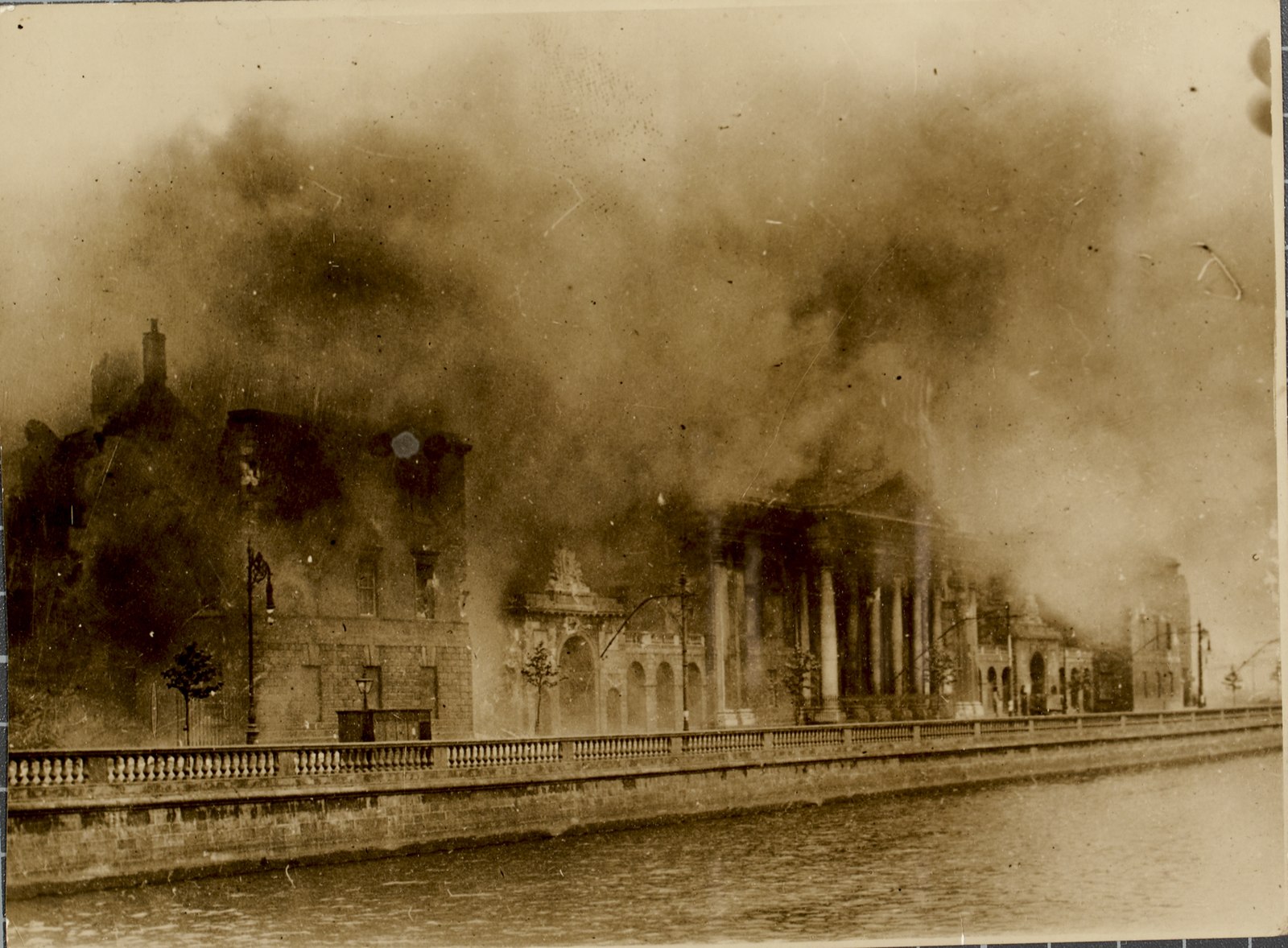
The Four Courts in Dublin in flames during the Battle of Dublin,
30 June 1922. National Library of Ireland: NLI: HOG57. The Irish
Four Courts was occupied by IRA irregulars from April 1922.
Marking the beginning of the Irish Civil War, on 28 June, Irish
Free-State forces began shelling the Four Courts. On 30 June 1922,
the Public Record Office of Ireland, part of Four Courts Complex,
was destroyed in a massive explosion of stored munitions.
Information relating to the lives and occupations of medical practitioners can be found scattered across a broad range of sources for the history of early modern Ireland. Given the fact that almost all Irish wills were destroyed in 1922, it could be reasonably assumed that the surviving material of this type is of very limited use for the study of practitioners. Fortunately, however, the availability of some useful indexes and the large number of extant abstracts and notes made by genealogists and others allows for the identification of hundreds of medics active in Ireland between the mid-sixteenth century and 1750.

Early Modern Practitioners Project


As part of my work for the Early Modern Practitioners Project at the University of Exeter, I have recently been exploring surviving wills and other testamentary materials. This research will help to inform the Irish content of our project database, which will contain information on many thousands of medical practitioners in early modern England, Ireland and Wales. In this blog post, I will discuss some of the research challenges posed by Irish wills and briefly highlight a number of ways in which they can serve as a useful source for the history of medicine in Ireland.

Irish Wills as a Historical Source


Although the body of fragmentary will data that has survived for early modern Ireland is dwarfed by the sources of that nature extant for England, wills nonetheless constitute a vital source for the study of many aspects of Irish society in that period. At the same time, it must be recognised that will-making was very far from being a universal activity in early modern Ireland, and that women and persons of lower social status are inevitably under-represented. Moreover, many wills from this period had already been lost before the nineteenth century, when greater efforts were made to preserve such documents and to compile useful indexes

Will Index


Title Page of Vicar's Index to
Prerogative Wills.
Post-1922, our insight into a large portion of early modern Irish wills has been confined to index entries. Such indexes are most useful where occupational labels are included alongside names, addresses, and dates, such as in Sir Arthur Vicar's Index to the prerogative wills of Ireland, 1536-1810.1 Roughly 180 medical doctors, apothecaries, barber-surgeons and surgeons are listed in Vicars for the period up to 1750. For diocesan wills, however, the available indexes often contain little or no occupation data. Here, the Dublin wills index published in 1894 forms a notable and valuable exception, listing the names and occupations of around 115 medics active prior to 1750.2

A will index entry can serve as a useful reference point around which to assemble further information relating to individual practitioners, whether from a related will abstract or from a variety of other sources. James Field M.D. provides a useful early example. His will is indexed in Vicars under the year 1624, with his address given as Dublin.3 A corresponding abstract can be found in Sir William Betham's MSS, giving the names of Field's wife and children, and this information is complemented by the further details given in Field's funeral entry.4 This individual can also be found as 'James Fildeus' in the register of medical graduates at Rheims in 1606, the earliest record of a Hibernus occurring in that rich source.5 Some context for Field's involvement in medicine is provided by the fact that his surname was an anglicised form of Ó Fithcheallaigh, a Gaelic hereditary medical family active in west Munster.6 For example, 'William Fihilly of Limerick, physician' had received a grant of 'English liberty' in 1557.7 Another member of this family, Dr John Field, was among those implicated in the 1641 rebellion in Co. Kerry; his estate outside Tralee was confiscated as a result.8

Master of the Barber-Surgeons' Guild


Entry in Vicars for William Kelly (1597).
There are at least two practitioners in Vicars who pre-dated Dr James Field: William Kelly, 'gent', who died in 1597; and John Morphy, 'alderman', who died in 1603.9 Kelly was master of the barber surgeons' guild in Dublin in 1576, the same year that he took on Morphy as an apprentice.10 Morphy in turn became master in 1588, and was elected alderman of Dublin in 1596.11 These examples illustrate one of the pitfalls of relying on will indexes for an era when labels of status and occupation could be both fluid and multiple. Fortunately, details of the lives and deaths of both Kelly and Morphy can be recovered from other sources, not least the records of the barber-surgeons guild preserved in the library of Trinity College Dublin.12 The latter source also sheds some light on the career of Stephen Cradocke, a barber who features in the Dublin diocesan will index under the year 1577.13

Dublin Wills entry for Stephen Cradock, a barber.

'Inventory Attached But No Interesting Names'


When moving from indexes to study more detailed will abstracts and copies, it is necessary to keep in mind the extent to which the latter body of material has been shaped by the priorities of nineteenth and early twentieth-century genealogists and other researchers. A brief note attached to an abstract of a Cloyne will from 1727 is illustrative: 'Inventory attached but no interesting names'.14 My colleague Alan Withey has shown how probate inventories for apothecaries's shops can be used to explore the 'medical marketplace' in early modern Wales. The absence of equivalent material for Ireland is unfortunate.15

Pages from of one Sybil Kirkpatrick's eight notebooks in which
she copied the wills of Irish medical men from originals once
held in the Public Record Office. Royal College of Physicians of
Ireland, Heritage Centre, TPCK/5/3/1.
In most of the relevant manuscripts, it is necessary to pick out the medical wills from among those made by gentlemen, clergymen, merchants, widows, and others. An exception to this is provided by Sybil Kirkpatrick's notebooks preserved in the Royal College of Physicians of Ireland (RCPI), which contain transcripts of medical wills alone. Kirkpatrick's transcripts, made in the Public Record Office of Ireland in 1910-11, have preserved extensive details of forty pre-1750 wills.16 Most of these relate to prominent Dublin-based physicians. They thus complement the rich materials compiled by Sybil's better known brother, Thomas Percy Claude Kirkpatrick, also preserved in the RCPI.

Social Networks


Wills do not usually reveal extensive details about the nature and extent of an individual's medical practice. They can, however, contain useful information on aspects such as social networks, status and wealth, patron-client relationships, book ownership, and succession planning. The latter issue unsurprisingly features in some wills made by members of the Gaelic hereditary medical families. The 1663 will of Gerald Fennell, 'Doctor of Phisicke', demonstrated his concern to ensure that his cousin and namesake would be able to continue the family's long tradition of service to the Butlers. He used his will to recommend the younger doctor to the duke and duchess of Ormond, stating that he bad been 'bredd by me for the service of their house'.17 Similar concern for his family's medical future was shown in the 1728 will of Dr Patrick Shiel of Breandrum, Co. Mayo. He directed that 'unbyassed men' were to decide which of his two nephews, Owen or Patrick, was 'of a superior genius' for the study of medicine. These men were to take account of 'capacity of learning ... gravity of life, probity of manners, good humour and other virtuous qualities'. Shiel's will also reveals marital ties between his family and the Dunlevy or Ultagh family, who had been hereditary physicians to the O'Donnells of Tyrconnell. Shiel himself was closely involved with that branch of the O'Donnells who had relocated to Co. Mayo, in the previous century; he listed Colonel Manus O'Donnell among his 'trusty well beloved friendes'.18

Dublin College of Physicians


Wills can be helpful too for piecing together the relationship that existed between medics. In his will made in 1677, Dr William Hickey mentioned Dr Thomas Connor.19 Other sources show that Connor was Hickey's son-in-law, and that both men were active in the Dublin College of Physicians in the 1670s.20 Hickey's will also made reference to the surgeon Nicholas Gernon, who evidently provided him with medical care in his final illness. Gernon was a native of Dublin who had been admitted to freedom in 1644.21 When he in turn died around 1692, his widow Bridget remarried to Francis Dempsey, another Dublin surgeon.22 Another of those active in the College of Physicians in the 1670s was Dr Edmund Meara.23 Decades earlier, in 1638, he had been one of the witnesses to the will of John Verdon, MD, of Dublin.24 A decade earlier again, Verdon and Edmund's father, Dr Dermot Meara, had been involved in efforts to establish a college of physicians in Dublin.25 Another of the witnesses to Verdon's will in 1638 was the barber-surgeon Simon Cullen, while the apothecary Stephen Hore was appointed executor. Little is known of Verdon, but his surname suggests that he originated in Co. Louth, a likelihood reinforced by the reference he made to his 'loving cousin Sir Christopher Bellew'.26

Medical Witnesses


Extract from Ferrar's description of Dr Hall's Alms House.
History of Limerick (1787).
One of the trends evident across the period is the appearance of medics as beneficiaries, as executors, or as witnesses to wills of persons of high social status. Given that medics were trusted by their patients and that they were likely to be present when wills were being made shortly before death, this phenomenon is not surprising. A mid-sixteenth century example is provided by the will of Morrough O'Brien, first earl of Thomond, whose 1551 will was witnessed by 'Master Doctor Nelan'.27 Other instances involving noble families include James Fennell, a physician who witnessed the earl of Ormond's will in 1614, and Dr Jeremie Hall, who witnessed the earl of Orrery's will in 1681 and was subsequently appointed an executor by the dowager countess in 1688.28 A full transcript of Hall's will also survives; it provided for the foundation of almshouses and schools both in Limerick and in Boothtown, Yorkshire. This document, containing extensive details relating to his building plans, his books, legacies to Trinity College, Lord Powerscourt and the earls of Orrery, Donegall and Stafford, and various other matters, would have taken some time to compose.29 It certainly lacks the urgency of the will of the Cromwellian Lieutenant-Colonel John Grey, made as he lay dying of wounds following the failed assault on Clonmel in May 1650. Those present included the surgeon John Hoggsfleshe, to whom Grey left £5.30 An episode of altogether more intense medical care is suggested by the 1715 will of Henry Meredith Esq., of Newtown, Co. Meath. It was witnessed by three fellows of the King and Queen's College of Physicians of Ireland: Duncan Cuming; William Smith; and Edward Worth.31

Obscure Practitioners


While figures such as Cuming and Worth are relatively well-known, wills and related data can also provide vital evidence for the existence of far more obscure practitioners who may not have left any other trace in the archive. Loughlen Keaghry, 'Dr of Physicke', made his will at Laragh Beg near Athenry in November 1730; unfortunately, I have not yet come across any other reference to him.32 The Hugh Fergus who witnessed his will was presumably the MD of that name, a member of another of the Gaelic hereditary medical families that remained active into the eighteenth century.33 Another of the obscure individuals to whom I have so far only found one reference is Millisent Alwright, a Dublin midwife who died around 1740.34 It is likely that Keaghry and Alwright will remain among the very many practitioners about whom very little can now be discovered. In many other cases, however, the combination of will data with material drawn from a wide variety of other sources can enable us to learn more about the practitioners who populated the medical world of early modern Ireland.

Can You Help?


To date, my efforts to gather data relating to practitioners have been supported by a number of scholars of early modern Ireland, who have given advice on sources or kindly shared the findings of their own research. As it is not possible for one individual to consult every source, such collective endeavour is essential to maximising the value of our project database, which will be open access and fully available online. I would be very happy to hear from anyone who wishes to contribute advice or information. I can be contacted at cunninjo@tcd.ie

Dr John Cunningham


Dr John Cunningham is an Associate Research Fellow on the Wellcome Trust funded project, 'The Medical World of Early Modern England, Wales and Ireland, c. 1500-1715'. His research focus on this project is on medical practitioners in early modern Ireland. John previously held an Irish Research Council CARA Postdoctoral Mobility Fellowship, during which time he spent two years at the University of Freiburg and a year at Trinity College Dublin (TCD). His project was entitled 'Ireland and Bohemia in the seventeenth century'. He completed his PhD at NUI Galway in 2009. His dissertation was entitled 'Transplantation to Connacht, 1641-1680: theory and practice'. John has taught history in Galway and Dublin, including a seminar course at TCD called 'The Nobility in Early Modern Ireland'. His research interests include early modern Britain and Ireland, the history of medicine, and Central Europe in the early modern period.

Project Podcast


You can listen to a podcast about the project, 'The Medical World of Early Modern England, Wales and Ireland, c. 1500-1715', for BBC History Magazine, from 29 November 2012.


1 Arthur Vicars (ed.), Index to the prerogative wills of Ireland, 1536-1810 (Dublin, 1897).↩
2 Deputy Keeper of Public Records in Ireland (hereafter DKPRI), Twenty-sixth report (Dublin, 1894).↩
3 Vicars (ed.), Prerogative wills, p. 166.↩
4 National Library of Ireland (hereafter NLI), Genealogical Office (hereafter GO) MS 225, p. 39; NLI, GO MS 79, p. 117.↩
5 List of Rheims Graduates, kindly supplied by Professor Laurence Brockliss.↩
6 Nollaig Ó Muraile, 'The hereditary medical families of Gaelic Ireland', Irish Texts Society Seminar, University College Cork, 7 November 2015. I am grateful to Dr Marc Caball and Dr Declan Downey for their insights into the Field family.↩
7 Fiants of Philip & Mary, no. 140, in DKPRI, Ninth report (Dublin, 1877), p. 73.↩
8 Deposition of Stephen Love, 2 February 1644, TCD MS 828, fos 124r-127v; Field, Dr John, The Down Survey of Ireland, Trinity College Dublin (2013).↩
9 Vicars (ed.), Prerogative wills, pp 264, 337.↩
10 Barber surgeons, Book of enrolment of apprentices and journeymen, 1530-1607, TCD MS 1447/6, fos 30v-31r.↩
11 Ibid., fo. 40v; Calendar of the ancient records of Dublin, ed. John T. Gilbert and Rosa Gilbert (19 vols, Dublin 1889-1944), ii, 306.↩
12 Barber surgeons, Book of enrolment of apprentices and journeymen, 1530-1607, TCD MS 1447/6; NLI, GO MS 65, pp 6, 82; NLI, GO MS 225, pp 188, 264; Fiants of Elizabeth, no. 3747, in DKPRI, Thirteenth report (Dublin, 1881), p. 143.↩
13 DKPRI, Twenty-sixth report (Dublin, 1894), p. 196; NLI, GO MS 290, p. 70.↩
14 NLI, GO MS 534, p. 62.↩
15 Alun Withey, '"Persons that live remote from London": apothecaries and the medical marketplace in seventeenth- and eighteenth-century Wales', Bulletin of the History of Medicine, 85 (2011), pp 222-247.↩
16 Sybil Kirkpatrick will notebooks, Heritage Centre, RCPI, TPCK 5/3/1.↩
17 Prerogative will book, 1664-84, NAI, MFGS 41/1, fos 99A-100B.↩
18 Prerogative will book, 1728-9, NAI, MFGS 41/4, fos 359B-364A.↩
19 Sybil Kirkpatrick will notebooks, Heritage Centre, RCPI, TPCK 5/3/1, i, p. 71.↩
20 Account book beginning 21 January 1672, Heritage Centre, RCPI, MS 3/3/1; NLI, GO MS 257, p. 143; NAI, RC 6/3, p. 23.↩
21 'Nichus Gernon', Ancient Freemen of Dublin Database, Library and Heritage, Dublin City Council. ↩
22 NLI, GO MS 258, p. 70.↩
23 Account book beginning 21 January 1672, Heritage Centre, RCPI, MS 3/3/1.↩
24 NLI, Reports on private collections, no. 32, pp 547-548.↩
25 Marian Lyons, 'The role of the graduate physicians in professionalising medical practice in Ireland, c. 1619-1654', in James Kelly and Fiona Clark (eds), Ireland and medicine in the seventeenth and eighteenth centuries (Farnham, 2010), p. 25.↩
26 NLI, Reports on private collections, no. 32, pp 547-548.↩
27 Brian Ó Dálaigh, 'A comparative study of the wills of the first and fourth earls of Thomond', North Munster Antiquarian Journal, 34 (1992), pp 57-59.↩
28 T. Blake Butler, Ormond Deeds, viii(Typescript in NLI MSS Reading Room), D3580; NLI, GO MS 532, pp 24-26.↩
29 Sybil Kirkpatrick will notebooks, Heritage Centre, RCPI, TPCK 5/3/1, i, pp 40-57.↩
30 NLI, GO MS 530, p. 142.↩
31 Registry of deeds: abstracts of wills, ed. P. Beryl Eustace (3 vols, Dublin 1954-84), i, no. 101.↩
32 NLI GO MS 425, p. 109.↩
33 Vicars (ed.), Prerogative of wills, p. 165; Diarmaid Ó Catháin, 'John Fergus MD: eighteenth-century doctor, book collector and Irish scholar', Journal of the Royal Society of Antiquaries of Ireland, 118 (1988), pp 139-162.↩
34 NLI, GO MS 257, p. 225.↩

Monday, 19 October 2015

Adolescence in Modern Irish History


Adolescence in Modern Irish History
September of this year marked the timely arrival of a new and fascinating edited collection, Adolescence in Modern Irish History, published by Palgrave Macmillan - the latest addition to the publisher's impressive and well-received series, Palgrave Studies in the History of Childhood. Edited by Catherine Cox, (Director and co-founder of CHOMI, UCD) and Susannah Riordan, (School of History, UCD), the volume is the first of its kind to address the question of adolescence in Irish history. Its chapters draw together new archival sources and research findings by nine emerging and established scholars working at the cutting edge of research into Irish adolescence. 

Spanning the birth of the 'affective revolution' in the early nineteenth century up to the genesis of the teenager in 1960s Ireland, the essays in this collection explore the emergence of Irish adolescence in its social, economic, political and literary contexts. Engaging with the extensive international literature on the subject, the editors argue that Irish adolescence both resembled and diverged from the British, American and continental European experience during the nineteenth and twentieth centuries. Adolescence in Ireland was particularly shaped by its demography, tied as that was to practices of late marriage, permanent celibacy, large families and the extensive emigration of young people. Coupled with Ireland's limited industrial development and the persistence of the pre-industrial family economy, these conditions strongly informed the possibilities of Irish adolescence in terms of adolescence autonomy, educational opportunities, and employment prospects.

Naturally, the long-shadow of Ireland's apparently troubled relationship with institutions looms large across this volume with a chapter on Irish borstal offenders, extensive treatment of industrial schools, and the confinement of unmarried mothers. Yet Riordan, at least on the question of the young unmarried mother, cautions against the often axiomatic conclusion that the carceral and unforgiving approach to problematic female sexuality so favoured in Ireland can best attributed to clerical actors. Indeed, she finds that in the newly independent Irish state of the 1920s and 1930s, a 'social work lobby', comprising feminist, religious and social work organisations, sought the introduction of protective legislation against the sexual exploitation of the sexually-compromised adolescent who they characterised as typically innocent and subject to seduction and betrayal by older and more powerful men. More punitive perspectives on unmarried, adolescent motherhood were instead more typically the preserve of traditional practitioners of the law and medicine.

Editors: Adolescence in Modern Irish History

Catherine Cox, Director and co-founder of the Centre for the History of Medicine in Ireland (CHOMI), University College Dublin (UCD).

Susannah Riordan, lecturer in Modern Irish History, School of History, UCD, and an associated staff member of CHOMI. 

2010 Workshop


This collection emerged from a workshop in January 2010, which was funded by the Wellcome Trust, the Centre for the History of Medicine, University College Dublin, and the UCD Humanities Institute. 

Contents:


Introduction
Catherine Cox and Susannah Riordan

Robert Hyndman's Toe: Romanticism, Schoolboy Politics and the Affective Revolution in Late Georgian Belfast

'A Sudden and Complete Revolution in the Female': Female Adolescence and the Medical Profession in Post-Famine Ireland

The 'Wild Irish Girl' in Selected Novels of L.T. Meade

'The Most Dangerous, Reckless, Passionate .. Period of Their Lives': The Irish Borstal Offender, 1906-1921

An Irish Nationalist Adolescence: Na Fianna Éireann, 1909-1923

'Storm and Stress': Richard Devane, Adolescent Psychology and the Politics of Protective Legislation 1922-1935

'How Will We Kill the Evening?': 'Degeneracy' and 'Second Generation' Male Adolescence in Independent Ireland

A Powerful Antidote? Catholic Youth Clubs in the Sixties

The Emergence of an Irish Adolescence: 1920s to 1970s

Thursday, 8 October 2015

AIDS and History by David Kilgannon

In this month's blog post, David Kilgannon, a Wellcome Trust funded PhD candidate in the Department of History, NUI Galway, looks at the response of two voluntary organisations, Gay Health Action and the Irish Haemophilia Society, to the arrival of AIDS in 1980s Ireland. In 2015, David completed his Wellcome Trust funded MA on the history of AIDS activism in Ireland at the Centre for the History of Medicine in Ireland, University College Dublin.

First Reported Cases of Aids

Report on the appearance of Kaposi's 
Sarcoma and Pneumocystis Pneumonia 
among homosexual men in New York 
and California, Morbidity and Mortality
Weekly Report, 3 July 1981.  Published
by the Centers for Disease Control and 
Prevention. Public domain.

The first clinical observed cases of AIDS arose among a group of homosexual men in Los Angeles in 1981. All five men presented with Pneumocystis pneumonia, a rare form of pneumonia, which is usually successfully fought off by the human immune system. The increasing prevalence of gay men with impaired immune systems throughout 1981-82 led the US Centers for Disease Control in June 1982 to classify this new disease as Gay Related Immune Deficiency (GRID). However, this model was soon found to be inadequate when non-homosexual patients, including women and children, presented with GRID symptoms. This resulted in the reclassification of the condition as Acquired Immune Deficiency Syndrome, or AIDS, in August 1982.

AIDS: State Response & Policy Failure 


Yet, the initial appearance of AIDS among gay men and intravenous drug users, and its continuing association with these socially marginalised groups was incredibly influential in shaping what were often desultory state responses to the syndrome, with the reaction of national healthcare systems to the incipient epidemic often appearing apathetic and lethargic. For example, in the United States it took a full three years after the first identification of the condition for the Department of Health and Human Services to produce and distribute their first AIDS information booklet for the public. While state responses were often insufficient, the appearance of AIDS instigated a substantial response by voluntary and activists groups. Roy Porter identified this phenomenon as one of the seminal features of the response to the spread of AIDS from the 1980s onwards.

AIDS Activism in Ireland


Number of cases of Sero-positivity in Ireland, 1985-1990
The historical study of AIDS, and AIDS activism in particular, has received sustained historical analysis in the United States and the United Kingdom. However, it has yet to be examined in Ireland. This lacuna is striking, as Ireland arguably presents a distinctive national context relating to AIDS. Three features are particularly notable. The principal prophylactic advocated for AIDS prevention, the condom, had limited availability in Ireland until 1985. Under the Health (Family Planning) Act (1979), anyone wishing to purchase a condom required a doctor's prescription. Secondly, the largest constituent group affected by AIDS in the United States, the gay community, was effectively criminalised in Ireland until 1993. Thirdly, in the 1980s the Irish health service underwent a period of drastic reductions in capacity, losing over a third of hospital beds during this decade. Taken together, these factors make a study of AIDS activism in Ireland particularly worthy of analysis in relation to its counterparts in the broader Anglophone world. My research attempted to examine two such examples of this phenomenon in Ireland. Namely, the activist responses from the gay and haemophilia communities to AIDS, as exemplified through the work of Gay Health Action and the Irish Haemophilia Society. 

Gay Health Action


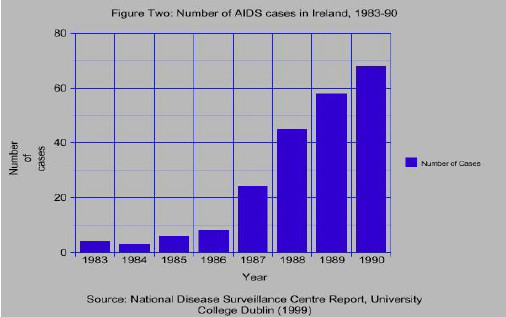
Number of AIDs cases in Ireland, 1983-1990
The work of Gay Health Action was explored through an examination of their records found in the Irish Queer Archive held at the National Library of Ireland. These sources indicate that Gay Health Action's activism was directly influenced by the international impact and context of AIDS. Articles from the National Gay Federation's magazine Out reveal a community that was quite aware of the devastation of the gay community in other countries. This awareness played a key role in instigating the foundation of Gay Health Action in January 1985 even though AIDS was not yet then a prominent public health threat in Ireland. At that point, only eleven deaths had been attributed to the syndrome in Ireland. Gay Health Action worked to raise awareness by disseminating information on the disorder, producing information leaflets and running education seminars. The group organised itself within the existing structures of the gay community, using already established methods of information dissemination within the community and establishing a telephone helpline that had clear antecedents to earlier forms of gay activism. This led Gay Health Action to take an increasingly prominent role in the management of all matters relating to AIDS in Ireland, speaking as experts on the condition to media and running an information service that superseded the role of the state's Health Education Bureau.

Irish Haemophilia Society


Number of AIDS related deaths in Ireland, 1982-1990
Yet, this form of activist response was not replicated among the varied voluntary groups representing communities that were directly impacted by the advent of AIDS in Ireland. The Irish Haemophilia Society, many of whose members became afflicted with AIDS due to the use of imported blood products which were infected with HIV,  took a quite different approach. As a reading of Lindsay Tribunal Report, the Irish Haemophilia Society's proceedings transcripts, and the society's newsletters reveals, they only began to seriously grapple with the challenge of AIDS following the infection of more than a third of their members. This fact meant that the preventative, public education role fulfilled by an organisation such as Gay Health Action was less relevant to the Irish Haemophilia Society and its members. Instead the organisation focused primarily on providing pastoral care to infected Irish haemophilia sufferers, including supports that assisted those dying from AIDS.

The Voluntary Sector and Epidemic Disease


By examining previously unstudied responses by voluntary groups to an epidemic disease in 1980s Ireland, this project aspires to add greater depth to our knowledge of Irish health policy and the role of the voluntary sector in addressing the challenges associated with an epidemic disease.

David Kilgannon is a PhD researcher in the Department of History in the National University of Ireland (Galway). His project, which is co-supervised by Dr Kevin O'Sullivan and Dr Sarah-Anne Buckley, examines the changing treatment of the disabled in twentieth century Ireland and is funded by the Wellcome Trust. His Master's dissertation, 'How to survive a plague': AIDS activism in Ireland, 1983-1989', examined voluntary sector efforts against the AIDS virus in 1980s Ireland. It was completed in the Centre for the History of Medicine in Ireland, School of History, University College Dublin under the supervision of Dr Catherine Cox.

Tuesday, 1 September 2015

Centre for the History of Medicine in Ireland (CHOMI) Seminar Series, Semester One, 2015-2016

Centre for the History of Medicine in Ireland (CHOMI), Seminar Series


Semester One, 2015-2016

Thursday 17 September 2015
Dr Georgina Laragy (Queen's University, Belfast)
'Children, welfare and space in the industrial city: Belfast 1880-1939'

Thursday 8 October 2015
Dr John Cunningham (Trinity College Dublin)
'Medicine in early modern Ireland: identifying and locating practitioners'

Thursday 5 November 2015
Dr Ciarán McCabe (Maynooth University)
'"Contagion is supposed to have been introduced from the country": civic and charitable responses to the 1817-19 fever epidemic in Dublin city'

Time: 5 pm (for all seminars)
Location: Room K114, School of History and Archives corridor, Newman Building, Belfield, UCD, Dublin 4.

Download CHOMI Seminar Series Programme