Showing posts with label private asylums. Show all posts

Monday, 11 April 2016

The Cost of Insanity by Alice Mauger

The Cost of Insanity: Public, Voluntary and Private Asylum Care in Nineteenth-Century Ireland

How did Irish medical practitioners and lay people interpret and define mental illness? What behaviours were considered so out of the ordinary that they warranted locking up, in some cases never to return to society? Did exhibiting behaviour that threatened land and property interests, the financial success of the family or even just that which caused embarrassment eclipse familial devotion and render some individuals 'unmanageable'? These questions are addressed in this month's post by Dr Alice Mauger. In 2014, Alice successfully completed her doctoral thesis at the UCD Centre for the History of Medicine in Ireland on domestic and institutional provision for the non-pauper insane in Ireland during the nineteenth century.

The Evolution of Asylum Care


Paying patients in the Richmond District Asylum (1885-1900).
Pictures courtesy of the Grangegorman Community Museum
The nineteenth century saw the evolution of asylum care in Ireland. While Jonathan Swift famously left most of his fortune to found Ireland's first lunatic asylum in 1746, it would be 70 years before the government followed his lead. In 1817 it enacted legislation permitting districts throughout Ireland to form asylums and by 1900, twenty-two such hospitals accommodated almost 16,000 patients. Growing demand for care for other social groups prompted the decision, in 1870, to admit some fee-paying patients, charged between £6 and £24 per annum, depending on their means. Out of this 16,000 only around 3% actually paid for their care. Private asylums, meanwhile, charged extremely high fees that were out of reach for the majority of society (usually several hundred pounds per year) and by 1900, thirteen private asylums housed 300 patients. Occupying a sort of middle ground, voluntary asylums, established by philanthropists, offered less expensive accommodation to those who could not afford high private asylum fees (from around £24 to a few hundred pounds). By 1900, these four voluntary asylum had outstripped the thirteen private ones, providing for 400 patients.

The Road to Committal


Advertisement for Farnham House, Private Asylum and
Hospital for the Insane, Finglas Dublin.
Source: Medical Directory (London, 1899), p. 1616.
Families were usually responsible for determining when it was time to commit a patient, where to send them and how much they should pay for their care. Factors such as cost, spending power, standard of accommodation, a hospital's religious ethos and the sort of people confined there all coloured these decisions. Broadly speaking, certain social groups (of the same religion) chose certain asylums.

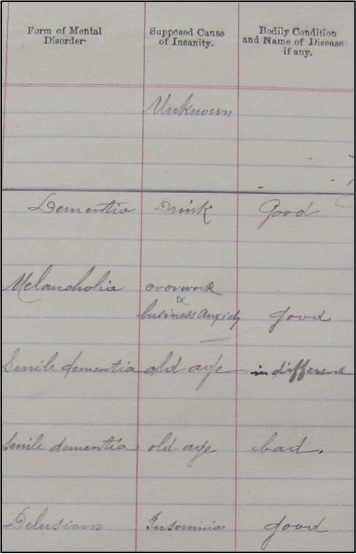
Once admitted, patients were assessed by the medical authorities who determined a cause for their illness along with a diagnosis. This process was based on the medical certificate obtained prior to committal; evidence supplied by the patient and family; and the medical practitioner's own views. The two primary nineteenth-century diagnoses – mania and melancholia – reveal relatively little about reasons for committal. The causes named, however, were far more colourful and wide-ranging and expose much about contemporary perceptions of the life events or circumstances that led to mental illness and therefore committal. Given causes encompassed a range of 'psychological' factors such as grief, bereavement, business or money anxieties and religion, and physical influences including accidents and injuries, physical illnesses, hereditary and alcohol. These later two were the most frequently employed, demonstrating widespread medical understandings of the physical nature of insanity. However, many patients, families and increasingly asylum doctors, reported that fears about financial stability, land interests and the state of the economy had caused the illness.1 In reality, it was often these anxieties that resulted in committal, especially among those with a degree of resources, such as white-collar workers, shopkeepers and farmers.

The Case of John D


Entries in Casebook 2, c.1898.
Source: St John of God's Hospital,
Patient Records.
Land and property interests certainly featured in the case of John D. In 1891, at the age of 77, John was committed to the Enniscorthy lunatic asylum by this two sons. John's sons provided details of his personal history to the asylum authorities; details which were later transcribed by the asylum's Resident Medical Superintendent, Dr Thomas Drapes, into his case notes. Reportedly a 'healthy old man', the first symptom noticed by John's sons was that he wanted to marry his servant, a girl of twenty:

Says if he doesn't marry her his soul is lost and that he'll burn in hell ... he is very supple and has often tried to take away across the country to get to this girl ... Son says he won't allow bedclothes to be changed or bed made since the girl left, as he says no one can make it but her.2
While John was a patient in the asylum, this girl visited him disguised as his niece. Following this, John's sons told Drapes to prevent any further communication between the pair. They were very much against the proposed marriage, insisting that 'she and her family are a designing lot' and 'all encourage her to get him to marry her'. One son informed Drapes that in his opinion his father would have married '"anything in petticoats" for past two years or so'. Allegedly, the girls he proposed to were 'not at all suitable, and "strealish" in appearance and habits'.

Underlying this narrative were anxieties about John's property. A farmer and a shopkeeper, John was certainly not a pauper. His maintenance in the asylum was £18 per annum and while he was in the asylum, John presented Drapes with a further £16 'to keep for him'. The sons made clear their anxieties about the family business. On one visit they stated that lately, their father 'was not capable of properly doing business in his shop'.

The real motivation for committing John, however, became clear when the patient later informed Drapes that 'he gave his sons up his land, but wished to retain his shop for himself and get a wife to mind it for him'. John also gave what Drapes termed a 'rational explanation' for his romance with the servant girl, explaining that:

the girl had been so spoken of in connection with him that her character had suffered, and that if he did not make her the only reparation he could by marrying her, he would suffer in the next world.3

Just two months after his committal Drapes discharged John. In his notes he wrote that this was 'greatly against the wishes of his sons, but I have not been able to find any distinct evidence of his insanity'.4 By 1901, John, now aged 87, had married a woman of 27, possibly the servant girl. However, ten years later, it was his son who resided at this address with his own wife and six children suggesting that he had ultimately inherited the property.5 The most plausible explanation for this outcome was that John's young wife had not borne him any children, which would have prevented her from being entitled to property rights following his death.

Conclusions


The case of John D adheres comfortably both to contemporary public hysteria over the perceived vulnerability of private patients to wrongful confinement and commonly held representations of the rural Irish.6 Although some historians have emphasised the detrimental impact of issues such as the consolidation of landholdings, emigration, land hunger and Famine memories on emotional familial bonds, historians of psychiatry have identified the 'range of familial emotional contexts' which asylum patients came from.7 Families often sent letters querying treatment, offering advice and enclosing food and money for patients.8

Yet, in cases where property or business interests were at stake, these factors tended to eclipse those of familial devotion. In fact, the high numbers of fee-paying patients who were unable to control their business or function in their profession suggests this was a major reason for committal. While the extent to which John D actually struggled in his shop is difficult to ascertain, it is conceivable that a number of other relatives' claims regarding patients' incapacity to work were genuine.

The association between working life and mental illness speaks volumes about contemporary society's interpretation of insanity and what drove families to commit relatives to asylums. In relation to social status, those unable to maintain their position within their given occupation were defined in terms of this failure. Land disputes and an inability to manage one's affairs threatened to shatter emotional familial bonds. In these cases, families may have viewed committal as a last resort in order to protect their resources or livelihood. After all, in smaller rural towns, relatives would have little control over the actions or interactions of a mentally-ill person positioned behind the shop-counter or at a farmers' market.

Dr Alice Mauger


Dr Alice Mauger was awarded a PhD by University College Dublin in 2014 for her thesis which examined institutions for the non-pauper insane in nineteenth-century Ireland. Prior to this she completed the MA programme on the Social and Cultural History of Medicine at the UCD Centre for the History of Medicine in Ireland, UCD. Both her MA and PhD were funded by the Wellcome Trust. Dr Mauger has published on the history of psychiatry in Ireland and is currently writing a monograph stemming from her doctoral research.
Below you can listen to Alice's talk, entitled 'The Cost of Insanity', given on 4 February 2016 as part of the UCD Centre for the History of Medicine in Ireland Seminar Series.


1 Fears of poverty and unemployment among pauper asylum patients are discussed by: Akihito Suzuki, 'Lunacy and labouring men: narratives of male vulnerability in mid-Victorian London' in Roberta Bivins and John V. Pickstone (eds), Medicine, Madness and Social History: Essays in Honour of Roy Porter (Basingstoke, 2007), p. 118; and, Catherine Cox, Negotiating Insanity in the Southeast of Ireland, 1820-1900 (Manchester, 2012), pp 59, 121.↩
2 Clinical Record Volume No. 3 (Wexford County Council, St Senan's Hospital, Enniscorthy, p. 264)↩
3 Ibid.↩
4 Ibid.↩
5 Census of Ireland 1901.↩
6 David Fitzpatrick, 'Marriage in post-Famine Ireland', in Art Cosgrave (ed.), Marriage in Ireland (Dublin, 1985), pp 116-31; Timothy Guinnane, The Vanishing Irish: Households, Migration, and the Rural Economy in Ireland, 1850-1914 (Princeton, 1997).↩
7 Cox, Negotiating Insanity, pp 108-9; Guinnane, The Vanishing Irish, pp 142-43, 230-35.↩
8 Oonagh Walsh, 'Lunatic and criminal alliances in nineteenth-century Ireland' in Peter Bartlett and David Wright (eds), Outside the Walls of the Asylum: The History of Care in the Community 1750-2000 (London and New Brunswick, 2001), p. 145.↩

Friday, 22 January 2016

Centre for the History of Medicine in Ireland (CHOMI) Seminar Series, Semester Two, 2015-2016

Centre for the History of Medicine in Ireland (CHOMI), Seminar Series


Semester Two, 2015-2016

Thursday 4 February 2016 
Dr Alice Mauger (University College Dublin)
'The cost of insanity: public, voluntary and private asylum care in nineteenth-century Ireland'

Thursday 3 March 2016
Dr Janet Greenlees (Glasgow Caledonian University)
'The tenuous relationship between gender, health and work, c. 1860-1960'

Thursday 7 April 2016
Dr Luz Mar González-Arias (University of Oviedo)
'Landscapes of pain: the representation of illness in Dorothy Molloy's cancer poetry'

All seminars take place at 5 pm, Room K114, School of History, Newman Building, UCD, Belfield, Dublin 4.


Thursday, 12 June 2014

‘[S]he is in a highly hysterical state. She’s a woman who resists’: the Dangers of Spiritualism in J. S. Le Fanu’s All in the Dark (1866) by Valeria Cavalli

In this month's post, Dr Valeria Cavalli examines the  theme of spiritualism in Irish writer Joseph Sheridan Le Fanu's novel All in the Dark (1866), and what the author's warnings about the dangers of spiritualism tell us about Victorian attitudes to women and madness. 

The dangerous habit of practising séances


When William Maubray is called to his dear aunt Dinah’s deathbed, he hopes that he will get there in time to say goodbye. He is certainly surprised, then, to find her in quite good shape, if not for her firm conviction that she is going to die before midnight. Dr. Drake explains to the puzzled young man that his aunt suffers from nothing more serious than the ailments of a woman of her age, but that she has recently fallen victim of self-deception. The eccentric old woman has in fact taken up the dangerous habit of practising séances, and the risk is that she will drive herself mad if she insists in taking seriously the ominous revelations of her spirit friend. Written in the peak years of Spiritualism, Joseph Sheridan Le Fanu’s All in the Dark brings forth a way more terrifying reality than being haunted by ghosts, that is, being locked away in a lunatic asylum on the basis of one’s unorthodox creed.

The rise of spiritualism


Emerging in America in the late 1840s, Spiritualism spread almost immediately to Europe, finding fertile terrain in the state of religious uncertainty which was troubling part of the population, regardless of class, age, or gender. When scientific discoveries brought the credibility of the Bible into question, believers began to feel uneasy with the way Christianity explained the supernatural, and began to look for comfort in the occult. In fact, the occult could account for the supernatural according to the laws of nature: whatever forces were inexplicably ruling the Universe or man, they were completely natural, and their present state, if still unknown to science, was open to investigation. However, scientists and members of the Church together raised their voices in opposition to the movement from its very first appearance, and criticism poured from the pages of periodicals and newspapers.

Joseph Sheridan Le Fanu. 

Spiritualism and female transgression


As Alex Owen has pointed out in her Darkened Room (1989), many medical men regarded the movement with distaste and suspicion in part because of the increasing role it offered to women. In those years, the ideal woman was the submissive wife and mother, “the angel in the house” in charge of the domestic sphere. In giving women the authority and the right to exercise their innate spiritual powers, Spiritualism infringed on the culturally imposed limits of respectable womanhood. In the darkened room, not only did women become the principal actors of the séance, they also transgressed gender norms, by assuming male roles or highly sexualised trance personae. The subversiveness of the movement alarmed and alerted the medical profession, which was in charge of policing any deviations from the social order imposed by Victorian patriarchy. The emerging medical branches of psychiatry and gynaecology effectively teamed up to prove that women’s health depended on female biology. Since women’s role was primarily that of generator, physical and intellectual activities would compromise the balance of nerve force necessary for the functioning of the reproductive organs, thus causing mental instability. Most cases of insanity due to sexual illness tended to result in monomanias, among which Spiritualism was counted, and doctors began to consider any kind of suspension of everyday consciousness suspicious and to associate mediumistic trance, with its uncontrollable convulsions and frequent use of inappropriate language, with the pathological symptoms of hysteria.

'Queer fancies'


In All in the Dark, Dinah Perfect is depicted as a strong-willed, authoritative, and eccentric woman. Her faithful servant explains that Dinah has always been very extravagant, with her odd dispositions concerning her corpse and coffin:

She was very particular, […] and would have her way; […] she had her coffin in the house this seven years – nigh eight a’most – upright in the little press by the left of the bed, in her room – the cupboard like in the wall. Dearie me! ’twas an odd fancy, […] and she’d dust it, and take it out, she would wi’ the door locked, her and me, once a month. She had a deal o’them queer fancies, she had. [II, pp.168-9]

'She is in a highly hysterical state'


It is no surprise, then, that when the novelty of table-rapping reaches the Old World, it appeals mightily to a housebound, bored, middle-class spinster like Dinah, who is looking for excitement and escapism from the monotony of everyday life, and from the increasing fear of ageing and dying. However, Dinah’s credulity is quickly associated with hysteria. Echoing Dr William Carpenter’s theory on unconscious cerebration, the non-believing, sceptical (and alcoholic) Dr Drake describes the dangerous effects that Spiritualism could have on Dinah’s mind, by convincing her of the reality of her delusions to the point that her body comes to provoke the effects that she expects to happen. Dr Drake is afraid that Dinah will ‘frighten herself out of her wits’, and explains to William that Spiritualism can affect the nerves [I, p. 60]:

Why, you know what hysteria is. Well, she is in a highly hysterical state. She’s a woman who resists; it would be safer, you see, if she gave way and cried a bit now and then, when nature prompts, but she won’t, except under awful high pressure, and then it might be serious; those things sometimes run oft’ into fits. [I, pp. 38-9]


Wrongful confinement


At a time when the advances in the realm of the mind became increasingly associated with scandals related to wrongful confinement, Le Fanu questions the power held by Victorian psychiatry over extravagant and independent women. Dinah Perfect is certainly a bizarre character, with her many fancies and her addiction to table-turning. However, her oddities do not seem sufficient to diagnose her as incipiently insane. Dinah is an elderly woman troubled by the frightening thought of upcoming death. Her anxiety and hysterical crises echo the spiritual uncertainty that afflicted the author’s sister and wife, like many other Victorians. Moreover, her uneasy shifting between her family’s orthodox Christianity and the occult is reminiscent of Le Fanu’s own crisis of faith, which led him to find comfort in the doctrine of the Scandinavian mystic Emanuel Swedenborg.


 Le Fanu's wife Susanna (née Bennett), and his sister Catherine. All three experienced a crisis of faith at some point in their lives. The images of Susanna and Catherine appear in W. J. McCormack’s biography of Le Fanu.

'That foolish spirit-rapping'


Having experienced first hand the anxiety of spiritual doubt, Le Fanu is far from labelling Dinah mad, even though he does not sympathise with Spiritualism. In fact, all throughout the novel, Dinah sounds reasonable and practical, advising her ward on the importance of a good match in marriage, and her nephew on the more advantageous prospect of the Church rather than the Bar as a profession. Even on spiritual matters, the Rector confirms that, ‘I found her views […] all very sound; indeed, if it had not been for that foolish spirit-rapping, which led her away – that is, confused her – I don’t think there was anything in her opinions to which exception could have been taken’ [II, pp. 171-2]. On all subjects but Spiritualism, Dinah is perfectly sound. However, her fancy for table-turning would, for orthodox Victorian psychiatry, be a strong enough proof of her insanity, as the real case of Louisa Nottidge had shown.

Louisa Nottidge


Like Dinah Perfect, Louisa Nottidge was a wealthy middle-aged spinster who had also spent money ‘very wildly’ upon the word of a Spiritualist [I, p. 8]. In 1846, Nottidge decided to leave her mother’s home to follow the influential millenarian prophet Henry Prince. Prince was the founder of a small community in Somerset called the Agapemone (the Abode of Love), where he taught about free love and preached of everlasting life to a group of devotees who had agreed to donate all their wealth to the congregation. Three of the five Nottidge sisters had already joined the prophet (who had thus gained some £18,000), so that when Louisa communicated her decision to her mother, the latter had to act quickly in order not to lose another daughter, and her considerable fortune, to an unscrupulous charlatan. Mrs Nottidge had Louisa abducted and confined to the majestic Moorcroft House private asylum at Hillingdon, in Middlesex, on the grounds of theomania. Louisa spent seventeen months at the Hillingdon, and was released only because the Commissioners in Lunacy were summoned upon concerns about her failing health. After her liberation, Louisa joined the millenarian community, transferred all her possessions to Henry Prince, and took legal action against her wrongful confinement.

A fraudulent committal


Moorcroft House private asylum at Hillington.
This picture is taken from Sarah Wise’s Inconvenient People.
The case was heard in court in 1849 before the Lord Chief Baron, the Right Hon. Sir Frederick Pollock, while the attention it received in the press provoked responses from alienists John Conolly and Forbes Benignus Winslow, and Lord Ashley, Chairman of the Commissioners in Lunacy. The Lord Chief Baron accepted Louisa Nottidge’s plea and ordered a compensation for the damages received. The suit made clear that Louisa’s admission to the Hillingdon had not been fraudulently obtained, since two doctors certified her insane on the grounds that she had ‘estranged herself from her mother’s house […] to follow a person of the name of Prince, whom she believed to be Almighty God, and herself immortal’. However, as Joshua John Schwieso has pointed out, although the two doctors had been summoned by the family physician on the basis of their ‘experience in cases of insanity’, their biographies suggest that neither of them was an expert in the field. Despite all this, the final verdict was reached because the Commission in Lunacy, in the person of Mr Mylne, failed to convince the Lord Chief Baron of the necessity of keeping Miss Nottidge confined, as shown in the following report which appeared in The Times in 1849:

The Lord Chief Baron: Mr Mylne, was this lady in such a state of mind as to be dangerous to herself or to others?   
Mr Mylne: Not so as I was aware of; not so far as I knew. 
The Lord Chief Baron: If she were not so, then how was it that you kept her in this asylum for seventeen months?
Mr Mylne: My lord, it was no part of my duty to keep her there. I was only to liberate her if I saw good and sufficient reason for adopting that course. 
The Lord Chief Baron: It is my opinion that you ought to liberate every person who is not dangerous to himself or to others. If the notion has got abroad that any person may be confined in a lunatic asylum or a madhouse who has any absurd or even mad opinion upon any religious subject, and is safe and harmless upon every other topic, I altogether and entirely differ with such an opinion; and I desire to impress that opinion with as much force as I can in the hearing of one of the commissioners. […]You say unsound mind, Mr Mylne. Had she any unsoundness of mind upon any other subject under heaven except as to entertaining these peculiar religious notions?
Mr Mylne: Miss Nottidge did not exhibit any symptoms of insanity of any other subject, my lord, that I observed.

Not only did the Lord Chief Baron support an individual’s freedom to hold religious opinions (as long as they remained harmless to both the person and other parties), he, most importantly, stated that he ‘very much doubted whether, if in this case the plaintiff had been a man, or living under the protection of a husband, the defendants would have dared to have taken the steps they had’.

An unwarranted influence


This case made evident how women, and particularly single women, were in danger of wrongful incarceration, since their unorthodox religious views (Louisa’s own mother affirmed that ‘she worships a false god’) could be easily exploited for financial gain.[ix] In fact, in the case of Louisa Nottidge, what her family were trying to save was the £5,728 7s 7d that she had bequeathed to the prophet. After her death in 1858, which occurred while she was still residing at the Agapemone, the Nottidges brought Henry Prince to court and succeeded in obtaining the return of Louisa’s property on the grounds of the prophet’s unwarranted influence upon the deceased. Thus, in the early 1860s, the case of Louisa Nottidge received new attention in the press, both in England and in Ireland, and was associated with the increasing number of cases of wrongful confinement which were causing much sensation, both in real life and in fiction.

Spiritualism and madness

           
In All in the Dark, Dinah, unlike Nottidge, is surrounded by relatives and friends who love her for who she is rather than for her fortune, and who will miss her dearly after her death. However, in discursively associating Spiritualism with madness, Le Fanu is reminding the reader of the existing danger that even an incompetent doctor like Drake, with no specific knowledge or experience of insanity, could actually provide enough evidence to have a woman like Dinah confined on the grounds of her unorthodox beliefs. Furthermore, he is also presenting a reflection on the double standard with which Victorian psychiatry was dealing with its patients. After Dinah dies, her sceptical nephew William also becomes ‘addicted to the supernatural’ and begins to believe that he is haunted by the spirit of his dead aunt [I, p. 58]. He suffers from nervous strain and hallucinations, and also admits that ‘I think I’m growing as mad as […] poor Aunt Dinah’ [I, p. 216, my italics]. However, no judgement is made about the possibility of his being a case of incipient insanity. William’s temporary condition is attributed to the weight of financial and sentimental concerns which, combined with the strong tea he likes to drink (a recurring theme in Le Fanu’s fiction), the heavy tobacco he likes to smoke, and the supernatural stories he likes to read, provokes nightmares and somnambulistic states. Financial problems, disappointment in love, bereavement, and hereditary disposition were all considered by Victorian psychiatry to be factors in the detection of mental insanity. The fact that such connections are ignored in William’s case seems to validate the words of the Lord Chief Baron, who doubted whether the same precautions would have been taken if the plaintiff had been a man.
      
In All in the Dark, Le Fanu touches on the topical association of alternative spiritualities with insanity. Drawing upon his personal experience as well as his professional familiarity, in his work for the national and international press, with contemporary debates on these topics, Le Fanu investigates the power game played by Victorian psychiatry over difficult citizens, women in particular. Although the novel shows Le Fanu’s contempt of Spiritualism, it nevertheless dismisses the accusations of madness levelled at the believer, thus becoming a warning to women readers.

Dr ValeriaCavalli recently completed a PhD in the School of English, Trinity College Dublin entitled 'They said she was mad: insanity in the fiction of Joseph Sheridan Le Fanu' (2014). She may be contacted at cavalliv "at" tcd "dot" ie. Details of an upcoming conference in Dublin on J.S. Le Fanu (15-16 October 2014) may be found here.


Further reading
  • J. S. Le Fanu, All in the Dark, 2 Vols (London: Richard Bentley, 1866), Vol. 2, pp. 168-9.
  • For a historical context on Spiritualism and Victorian medicine, see Alex Owen, The Darkened Room: Women, Power, and Spiritualism in Late Victorian England (Chicago, Ill.; London: University of Chicago Press, 2004), Ch. 6.
  • On Louisa Nottidge, see Sarah Wise, Inconvenient People; Lunacy, Liberty and the Mad-Doctors in Victorian England (London: The Bodley Head, 2012), Ch. 4; Owen, pp. 151-54; and Joshua John Schwieso, ‘‘Religious Fanaticism’ and Wrongful Confinement in Victorian England: the Affair of Louisa Nottidge’, Social History of Medicine (1996), pp. 159-74.