Monday, 19 October 2015

Adolescence in Modern Irish History


Adolescence in Modern Irish History
September of this year marked the timely arrival of a new and fascinating edited collection, Adolescence in Modern Irish History, published by Palgrave Macmillan - the latest addition to the publisher's impressive and well-received series, Palgrave Studies in the History of Childhood. Edited by Catherine Cox, (Director and co-founder of CHOMI, UCD) and Susannah Riordan, (School of History, UCD), the volume is the first of its kind to address the question of adolescence in Irish history. Its chapters draw together new archival sources and research findings by nine emerging and established scholars working at the cutting edge of research into Irish adolescence. 

Spanning the birth of the 'affective revolution' in the early nineteenth century up to the genesis of the teenager in 1960s Ireland, the essays in this collection explore the emergence of Irish adolescence in its social, economic, political and literary contexts. Engaging with the extensive international literature on the subject, the editors argue that Irish adolescence both resembled and diverged from the British, American and continental European experience during the nineteenth and twentieth centuries. Adolescence in Ireland was particularly shaped by its demography, tied as that was to practices of late marriage, permanent celibacy, large families and the extensive emigration of young people. Coupled with Ireland's limited industrial development and the persistence of the pre-industrial family economy, these conditions strongly informed the possibilities of Irish adolescence in terms of adolescence autonomy, educational opportunities, and employment prospects.

Naturally, the long-shadow of Ireland's apparently troubled relationship with institutions looms large across this volume with a chapter on Irish borstal offenders, extensive treatment of industrial schools, and the confinement of unmarried mothers. Yet Riordan, at least on the question of the young unmarried mother, cautions against the often axiomatic conclusion that the carceral and unforgiving approach to problematic female sexuality so favoured in Ireland can best attributed to clerical actors. Indeed, she finds that in the newly independent Irish state of the 1920s and 1930s, a 'social work lobby', comprising feminist, religious and social work organisations, sought the introduction of protective legislation against the sexual exploitation of the sexually-compromised adolescent who they characterised as typically innocent and subject to seduction and betrayal by older and more powerful men. More punitive perspectives on unmarried, adolescent motherhood were instead more typically the preserve of traditional practitioners of the law and medicine.

Editors: Adolescence in Modern Irish History

Catherine Cox, Director and co-founder of the Centre for the History of Medicine in Ireland (CHOMI), University College Dublin (UCD).

Susannah Riordan, lecturer in Modern Irish History, School of History, UCD, and an associated staff member of CHOMI. 

2010 Workshop


This collection emerged from a workshop in January 2010, which was funded by the Wellcome Trust, the Centre for the History of Medicine, University College Dublin, and the UCD Humanities Institute. 

Contents:


Introduction
Catherine Cox and Susannah Riordan

Robert Hyndman's Toe: Romanticism, Schoolboy Politics and the Affective Revolution in Late Georgian Belfast

'A Sudden and Complete Revolution in the Female': Female Adolescence and the Medical Profession in Post-Famine Ireland

The 'Wild Irish Girl' in Selected Novels of L.T. Meade

'The Most Dangerous, Reckless, Passionate .. Period of Their Lives': The Irish Borstal Offender, 1906-1921

An Irish Nationalist Adolescence: Na Fianna Éireann, 1909-1923

'Storm and Stress': Richard Devane, Adolescent Psychology and the Politics of Protective Legislation 1922-1935

'How Will We Kill the Evening?': 'Degeneracy' and 'Second Generation' Male Adolescence in Independent Ireland

A Powerful Antidote? Catholic Youth Clubs in the Sixties

The Emergence of an Irish Adolescence: 1920s to 1970s

Thursday, 8 October 2015

AIDS and History by David Kilgannon

In this month's blog post, David Kilgannon, a Wellcome Trust funded PhD candidate in the Department of History, NUI Galway, looks at the response of two voluntary organisations, Gay Health Action and the Irish Haemophilia Society, to the arrival of AIDS in 1980s Ireland. In 2015, David completed his Wellcome Trust funded MA on the history of AIDS activism in Ireland at the Centre for the History of Medicine in Ireland, University College Dublin.

First Reported Cases of Aids

Report on the appearance of Kaposi's 
Sarcoma and Pneumocystis Pneumonia 
among homosexual men in New York 
and California, Morbidity and Mortality
Weekly Report3 July 1981.  Published
by the Centers for Disease Control and 
Prevention. Public domain.

The first clinical observed cases of AIDS arose among a group of homosexual men in Los Angeles in 1981. All five men presented with Pneumocystis pneumonia, a rare form of pneumonia, which is usually successfully fought off by the human immune system. The increasing prevalence of gay men with impaired immune systems throughout 1981-82 led the US Centers for Disease Control in June 1982 to classify this new disease as Gay Related Immune Deficiency (GRID). However, this model was soon found to be inadequate when non-homosexual patients, including women and children, presented with GRID symptoms. This resulted in the reclassification of the condition as Acquired Immune Deficiency Syndrome, or AIDS, in August 1982.

AIDS: State Response & Policy Failure 


Yet, the initial appearance of AIDS among gay men and intravenous drug users, and its continuing association with these socially marginalised groups was incredibly influential in shaping what were often desultory state responses to the syndrome, with the reaction of national healthcare systems to the incipient epidemic often appearing apathetic and lethargic. For example, in the United States it took a full three years after the first identification of the condition for the Department of Health and Human Services to produce and distribute their first AIDS information booklet for the public. While state responses were often insufficient, the appearance of AIDS instigated a substantial response by voluntary and activists groups. Roy Porter identified this phenomenon as one of the seminal features of the response to the spread of AIDS from the 1980s onwards.

AIDS Activism in Ireland


Number of cases of Sero-positivity in Ireland, 1985-1990
The historical study of AIDS, and AIDS activism in particular, has received sustained historical analysis in the United States and the United Kingdom. However, it has yet to be examined in Ireland. This lacuna is striking, as Ireland arguably presents a distinctive national context relating to AIDS. Three features are particularly notable. The principal prophylactic advocated for AIDS prevention, the condom, had limited availability in Ireland until 1985. Under the Health (Family Planning) Act (1979), anyone wishing to purchase a condom required a doctor's prescription. Secondly, the largest constituent group affected by AIDS in the United States, the gay community, was effectively criminalised in Ireland until 1993. Thirdly, in the 1980s the Irish health service underwent a period of drastic reductions in capacity, losing over a third of hospital beds during this decade. Taken together, these factors make a study of AIDS activism in Ireland particularly worthy of analysis in relation to its counterparts in the broader Anglophone world. My research attempted to examine two such examples of this phenomenon in Ireland. Namely, the activist responses from the gay and haemophilia communities to AIDS, as exemplified through the work of Gay Health Action and the Irish Haemophilia Society. 

Gay Health Action


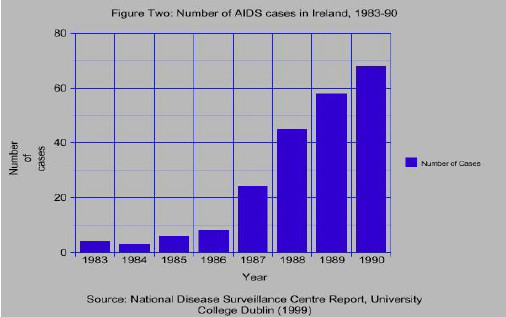
Number of AIDs cases in Ireland, 1983-1990
The work of Gay Health Action was explored through an examination of their records found in the Irish Queer Archive held at the National Library of Ireland. These sources indicate that Gay Health Action's activism was directly influenced by the international impact and context of AIDS. Articles from the National Gay Federation's magazine Out reveal a community that was quite aware of the devastation of the gay community in other countries. This awareness played a key role in instigating the foundation of Gay Health Action in January 1985 even though AIDS was not yet then a prominent public health threat in Ireland. At that point, only eleven deaths had been attributed to the syndrome in Ireland. Gay Health Action worked to raise awareness by disseminating information on the disorder, producing information leaflets and running education seminars. The group organised itself within the existing structures of the gay community, using already established methods of information dissemination within the community and establishing a telephone helpline that had clear antecedents to earlier forms of gay activism. This led Gay Health Action to take an increasingly prominent role in the management of all matters relating to AIDS in Ireland, speaking as experts on the condition to media and running an information service that superseded the role of the state's Health Education Bureau.

Irish Haemophilia Society


Number of AIDS related deaths in Ireland, 1982-1990
Yet, this form of activist response was not replicated among the varied voluntary groups representing communities that were directly impacted by the advent of AIDS in Ireland. The Irish Haemophilia Society, many of whose members became afflicted with AIDS due to the use of imported blood products which were infected with HIV,  took a quite different approach. As a reading of Lindsay Tribunal Report, the Irish Haemophilia Society's proceedings transcripts, and the society's newsletters reveals, they only began to seriously grapple with the challenge of AIDS following the infection of more than a third of their members. This fact meant that the preventative, public education role fulfilled by an organisation such as Gay Health Action was less relevant to the Irish Haemophilia Society and its members. Instead the organisation focused primarily on providing pastoral care to infected Irish haemophilia sufferers, including supports that assisted those dying from AIDS.

The Voluntary Sector and Epidemic Disease


By examining previously unstudied responses by voluntary groups to an epidemic disease in 1980s Ireland, this project aspires to add greater depth to our knowledge of Irish health policy and the role of the voluntary sector in addressing the challenges associated with an epidemic disease.

David Kilgannon is a PhD researcher in the Department of History in the National University of Ireland (Galway). His project, which is co-supervised by Dr Kevin O'Sullivan and Dr Sarah-Anne Buckley, examines the changing treatment of the disabled in twentieth century Ireland and is funded by the Wellcome Trust. His Master's dissertation, 'How to survive a plague': AIDS activism in Ireland, 1983-1989', examined voluntary sector efforts against the AIDS virus in 1980s Ireland. It was completed in the Centre for the History of Medicine in Ireland, School of History, University College Dublin under the supervision of Dr Catherine Cox.

Tuesday, 1 September 2015

Centre for the History of Medicine in Ireland (CHOMI) Seminar Series, Semester One, 2015-2016

Centre for the History of Medicine in Ireland (CHOMI), Seminar Series


Semester One, 2015-2016

Thursday 17 September 2015
Dr Georgina Laragy (Queen's University, Belfast)
'Children, welfare and space in the industrial city: Belfast 1880-1939'

Thursday 8 October 2015
Dr John Cunningham (Trinity College Dublin)
'Medicine in early modern Ireland: identifying and locating practitioners'

Thursday 5 November 2015
Dr Ciarán McCabe (Maynooth University)
'"Contagion is supposed to have been introduced from the country": civic and charitable responses to the 1817-19 fever epidemic in Dublin city'

Time: 5 pm (for all seminars)
Location: Room K114, School of History and Archives corridor, Newman Building, Belfield, UCD, Dublin 4.

Download CHOMI Seminar Series Programme

Friday, 28 August 2015

A Question of Authority: the Management of Shell Shock at the Irish War Hospitals during the Great War by Peter Reid

In this month's blog post Peter Reid, MLitt research student at the Centre for the History of Medicine in Ireland (CHOMI), UCD, looks at the treatment of shell shock in Ireland during the Great War. He argues that the formation of a rational medical service for these soldiers in Ireland was undermined by the antagonistic relationship between military and civilian medical authorities.

Queen Street, Dublin.
Image provided courtesy of Peter Holder,
Irish Historical Picture Company
On 22 July 1929, John Kelly, an ex-British soldier, fell from a window of his residence in Dublin's Queen Street and later died from his injuries while being treated at the Richmond Hospital. His wife did not witness his fatal fall, but said that her husband, 'had been in ill-health since his discharge from the army in 1919, suffering from paralysis and shell shock.1

Until recently, there had been relatively little research undertaken on the management of shell shock in Irish institutions during the Great War. In the case of Britain, Peter Leese has shown that army and military concerns dominated over those of civilian medical experts.2 This post argues that a similarly asymmetrical relationship between asylum and military medical personnel was one of the key factors inhibiting the development of a well-coordinated shell shock treatment system in Ireland.

The Irish War Hospitals


The Richmond War Hospital, 1916-1919.
Image provided courtesy of the
National Archives of Ireland.
In Britain, by 1916, demand had overwhelmed the capacity of treatment facilities for shell shocked soldiers. From the summer of that year, the first treatment centres in Ireland, which would include two war hospitals, began to open in the main urban centres of Dublin and Belfast. The first of the war hospitals, a thirty-two bed unit, the Richmond War Hospital, received its first patients in June 1916. This hospital was a separate block within the grounds of Dublin's Richmond District Lunatic Asylum, allocated by the asylum's board of governance for this purpose. It admitted only British Expeditionary Force soldiers, that is, those soldiers who had served overseas at the Western Front. The main Richmond Asylum itself, however, admitted non-British Expeditionary Forces - the home troops. The army paid a generous stipend to the Richmond Asylum for the care of both categories of soldier.

Belfast District Lunatic Asylum.
Image provided courtesy of the National Library of Ireland.
In response to rising casualty numbers, the civil and military authorities agreed to relocate existing patients from the Belfast District Lunatic Asylum and use that facility as another war hospital. The Belfast War Hospital opened in May 1917 under the management of the existing District Lunatic Asylum Committee. It provided 500 beds for the use of both expeditionary and non-expeditionary British service personnel. Dr William Graham, the Medical Superintendent of the Belfast Asylum, remained in place as the medical authority running the new war hospital.


The evidence suggests that Dr William R. Dawson, already a leading figure in Irish medicine and highly regarded by the British army, played a key role in facilitating, if not initiating, both arrangements.

William R. Dawson, appointed by the War Office in 1915,
as a specialist in nerve disease to treat British service personnel in Ireland.
Image provided courtesy of the Royal College of Physicians of Ireland.

The Resident Medical Superintendents and the Royal Army Medical Corp


King George V Hospital, built 1902
(St Bricin's Military Hospital), Arbour Hill, Dublin.
Image courtesy of the National Library of Ireland.
Tensions in the relationship between the Richmond Asylum's Medical Superintendent, Dr John O'Conor Donelan, and his military counterpart, Lieutenant Colonel Hearn, Officer in Charge, George V Hospital, Central Military Hospital Dublin, quickly became apparent. Hearn instructed Donelan by letter that as Officer in Charge of Central Hospital that he, Hearn, was ultimately responsible for all soldiers in the asylum, 'until such time as they are invalided out of the army'.3 Three days later, Hearn again wrote to Donelan and firmly reiterated the point that 'should a man in your opinion require to be moved to the General Asylum [from the Richmond War Hospital] he still remains a soldier until finally discharged from the service by recommendation of the Military Board'.4 
Dr John O'Connor Donelan, Resident Medical Superintendent,
Richmond District Lunatic Asylum, Dublin.
Image by kind permission of Dr Aidan G. Collins,
St. Vincent's Hospital, Fairview, Dublin 3.
The army's insistence on reserving the use of the war hospital solely for expeditionary soldiers, on prioritising their treatment over that of non-expeditionary soldiers, on maintaining their control over the admission and discharge of all military patients, and the complex bureaucratic needs of the military machine, served to insidiously undermine Donelan's authority. Donelan's dissatisfaction with the arrangement is evident in his asylum report of 1917 when he bemoaned the high number of discharges 'classified as only relieved'. He attributed this to 'the fact that a considerable proportion of these were soldiers under temporary treatment, who were removed by the Military Authorities to other asylums before recovery'.5 Donelan was implicitly criticising the military authorities for prioritising the needs of the army over the professional opinion of asylum medical officers, in particular himself.


When the Belfast War Hospital opened in May 1917, it was initially managed by the existing District Lunatic Asylum Committee. However, as Lieutenant Colonel J.B. Buchanan, Officer-in-Charge of Holywood Military Hospital, noted in 1919, 'this plan did not prove satisfactory'. When the Resident Medical Superintendent, Dr William Graham, died suddenly in November 1917, the Belfast War Hospital came under the direct control of the War Office.6

Consequences of an unsatisfactory relationship


Between 1916 and 1919, the Dublin and Belfast Irish war hospitals treated 1,577 soldiers. However, there were never enough beds in Ireland for emotionally traumatised soldiers such as John Kelly and, by 1921, the 'South Ireland Pension Area' - Ireland exclusive of the province of Ulster - had the longest waiting list in Britain and Ireland for treatment.7 The antagonistic relationship between medical and military actors was one factor contributing to this unfortunate situation.

Contemporary relevance


In a report issued in July 2015, the Mental Health Commission identified that a lack of cohesion and 'deep disharmony' between clinicians and managers had undermined clinical governance in Carlow/Kilkenny and South Tipperary and, in early 2014, was associated with a 'spike' in suicides in the region.8 This reflects the continuing importance not only of independent surveillance by bodies such as the Mental Health Commission and the Health Information and Quality Authority, but also of managerial and clinical relationships in the delivery of contemporary mental health services in Ireland.

Peter Reid completed a MA in the Social and Cultural History of Medicine at the Centre for the History of Medicine in Ireland (CHOMI), UCD, in 2014. The title of his MA dissertation was, 'The Institutional Management of Soldiers with Shell Shock in Ireland, 1916-19'. In September 2015, Peter will be commencing a MLitt at CHOMI, investigating the treatment of children with disability in early twentieth-century Ireland.


1 Irish Times, 24 July 1929.
2 Peter Leese, Shell Shock: Traumatic Neurosis and the British Soldiers of the First World War (Basingstoke and New York, 2002), 54-6, 98.
3 Letter to Resident Medical Superintendent, Richmond Lunatic Asylum from Lieutenant Colonel Hearn, King George Fifth Hospital, 1 August 1916, Richmond War Hospital Admission and Discharge Book, BR/Priv 1223, NAI.
4 Hearn to Resident Medical Superintendent, Richmond Lunatic Asylum, 4 August 1916.
5 Richmond Asylum Joint Committee Minutes, 1917, 17, BR/Priv 1223, NAI.
6 Medical History of the War: Report in Compliance with War Office Letter No. 24/General Number/6978 (A.M.D.2) 18 October 1919, WO 35/179.
7 Joanna Burke, 'Effeminacy, ethnicity and the end of trauma: the suffering of "shell-shocked" men in Great Britain and Ireland, 1914-39, Journal of Contemporary History, 35, no. 1 (2000), 69.
8 Irish Times, 22 July 2015.

Tuesday, 9 June 2015

A Knight at the Theatre: the Adelaide Hospital and Denominational Divisions in Dublin's Voluntary Hospitals by Robbie Roulston

One of the characteristic features of Dublin's voluntary hospitals has been their long-standing denominational divisions. In this month's blog post Dr Robbie Roulston, UCD, writes about Dublin's Adelaide Hospital, the 'most anti-Catholic hospital in the whole of Dublin', and the government's consternation arising in 1950 when the Irish President, Séan T. O'Kelly, received an invitation to attend one of the hospital's fundraising events. 


Photograph shows Adelaide Hospital nurses in uniform standing on the hospital staircase , 1950s
Adelaide nurses, on the main
staircase of the hospital,1950s

Dublin's Adelaide Hospital


The Adelaide Hospital was founded in 1839 in Dublin for the treatment of poor Protestants in Ireland. As such, the royal charter it was granted placed denominational restrictions on the patients which should be admitted to the hospital. Similar restrictions applied to staff and management. However, what was unusual was the fact that this charter remained in place until 1980.

A 'bitter anti-Catholic reputation'


Such restrictive policies were not unknown to Irish policymakers and caused a considerable degree of tension. In June 1950, the Adelaide Hospital Society issued invitations to various dignitaries for the Gala American Concert, a fundraising event for the Adelaide at the Theatre Royal, in Dublin. Invitations were sent to the Taoiseach, Fine Gael’s John A. Costello, and his wife; to members of the Government; and to a number of Army Officers. All of these officials declined the invitation owing to what the Secretary to the Government described as ‘the bitter anti-Catholic reputation of the Hospital’.

A Knight of Columbanus

Photograph shows a group of medical students receiving instruction at the Adelaide Hospital, Dublin, Ireland, c. 1950s
Medical students, Adelaide Hospital, n.d.

When an invitation for the President of Ireland, Fianna Fáil’s Seán T. O’Kelly, arrived the government assumed that he too would refuse the invitation. O’Kelly had strong Catholic credentials. He had been one of the few Knights of Columbanus in Eamon de Valera’s cabinet and a proponent of Catholic morality in Irish medical ethics and foreign policy during his career. He had form in condemning restrictive policies in hospitals and twenty years earlier had condemned hospitals which employed religiously restrictive admissions procedures. He had argued then that ‘These barriers are a relic of bygone days and they should be a relic of bygone days.’

'Things had changed now'


Photograph shows American Ambassador (Mr. George Garrett); Lord Farnham (President of the Hospital); Mrs. George Garrett; The Irish President (Sean T. O'Kelly); Mrs. O'Kelly; and Mr. Edward Bewley (Chairman). In attendance at the Gala American Concert to launch the Adelaide Hospital Fundraising Campaign (1950), Dublin, Ireland
The President, Séan T. O'Kelly and Mrs. O'Kelly attend the Gala
American Concert to launch the Adelaide Campaign (1950).
L. to R.: The American Ambassador (Mr. George Garrett);
Lord Farnham (President of the Hospital); Mrs. George Garrett;
The President; Mrs. O'Kelly, Mr. Edward Bewley (Chairman).
The presidential O’Kelly, however, was mellower than his former self. When an official in his office approached O’Kelly on the subject, informing him that the Adelaide ‘has the reputation at the moment of being the most anti-Catholic hospital in the whole of Dublin’, O’Kelly responded that he was aware of this. He acknowledged that there was a time when a Catholic priest would not be allowed inside the hospital, but he pointed out that ‘things had changed now to the extent that Catholics are admitted and priests are permitted to see them and administer the sacraments.’

The government remained uneasy and the subject moved up the ladder of protocol when the Taoiseach raised it with O’Kelly the following day. O’Kelly remained firm and informed Costello that he had already accepted the invitation and had promised to go, and that he intended to honour that promise.

O’Kelly continued to attend Adelaide functions when invited and newspapers reported on him attending the Gala American Concert in 1950, a Joseph Szigeti violin recital in 1952, and an Arthur Rubinstein piano recital in 1954.

Cartoon titled: 'She would bid him take out his chequebook'. Shows an Adelaide Hospital nurse in profile descending a stairs with her arms  open in front of her. A well dressed man in a suit sprints towards apparently in the act of signing a cheque. This cartoon was made by an Adelaide Hospital doctor during the 1950s.
'She would bid him take out his cheque book'.
Cartoon of Adelaide Hospital nurse collecting funds.
Drawn by Adelaide doctor, n.d.

A slight against the President


All of this proved very uncomfortable for Irish officials. At the Rubinstein concert the order in which the dignitaries were listed was perceived by officials as a slight against the President – the British ambassador had been listed ahead of the Irish President! A series of notes were passed between the Office of the President, the Chief of Protocol in the Department of External Affairs, and the Irish Embassy in London to see what conventions held there. In the end it was ruled that the ‘the matter is one of tact and good taste rather than of a definitive rule.’ The officials concluded that the Adelaide Hospital erred in a lack of the former rather than by a breach of the latter.

It was decided that no formal protest should be made to the organisers of the concert, but that in future the President’s attendance at such events would be organised more closely with the Secretary to the President to ensure that protocol was followed more strictly.


Ending religious restrictions


Photograph shows nurses receiving instruction at the Adelaide Hospital, Dublin, Ireland, c. 1950. Five student nurses sit at two rows of desks, facing a senior nurse seated at a larger executive desk with two other nurses at her shoulder. One desk is empty and the former occupant, a student nurse, is apparently reading something aloud to the other nurses.
Adelaide Hospital nurses in class, n.d.
In the end, the state’s real power to affect change in the management of the hospital would not lie in attendance or non-attendance at its functions or in furious memoranda on the finer points of protocol. Cash was king, and only as the Adelaide’s financial position slid from bad to worse could the state exact the concessions favoured by Irish policy makers and politicians, which was to open up admission and recruitment policies to all people irrespective of their religion. The Adelaide chose to ignore these demands while it was independent of state supports, but as it grew needy it softened its stance on various matters and relaxed most of its religious restrictions.

Dr Robbie Roulston's recently completed PhD thesis is entitled, "The Church of Ireland and the Irish State, 1950–1972: Education, Healthcare and Moral Welfare." He has taught on the history of Protestants in twentieth century Ireland in the UCD School of History and Archives. Currently, he holds a position with UCD's Academic Secretariat, working in the areas of higher education policy, governance, strategy.

Below, you can listen to Robbie's presentation at the CHOMI Seminar Series, 3 April 2014, on the Adelaide Hospital

CHOMI Seminar Series, Thursday 3 April 2014

Dr Robbie Roulston (University College Dublin)
"The most priceless possession of Protestants in this country”: the Adelaide Hospital and upholding Protestant healthcare in Ireland 1950-1972.
5 pm, K114, School of History & Archives, UCD.

Wednesday, 20 May 2015

Prisoners, Medical Care and Entitlement to Health in England and Ireland, 1850–2000

Prisoner Health Project: Wellcome Trust Senior Investigator Award

A major new research project in the history medicine has just been launched: 'Prisoners, Medical Care and Entitlement to Health in England and Ireland, 1850–2000'. This collaborative, five-year study, funded by a Wellcome Trust Senior Investigator Award, is being led by co-Principal Investigators, Professor Hilary Marland, of the Centre for the History of Medicine, University of Warwick, and Dr. Catherine Cox, Director of the Centre for the History of Medicine in Ireland, University College Dublin.


Strangely, the history of medicine, despite its strong focus on the history of institutions, has neglected the prison as a site of medical treatment. It's great to see that such an ambitious project is going to address this omission. That this is a comparative research project is also exciting; comparative historical analysis, despite its strong tradition in the social sciences and a limited recent resurgence, is long overdue a renewal.

Project aims


The co-Principal Investigators, Catherine and Hilary, are keen for the project's research to resonate with contemporary concerns in the prison service and they aim to tackle historical questions of prisoner health that are still relevant today. For example, they and their team are going to look at the high incidence of mental illness amongst prisoners, the health of women prisoners and the status of prison maternity services, as well as the response to prisoner substance abuse and the impact of HIV/AIDS. All of these topics are still major concerns in the medical management of contemporary prison populations in Ireland and England. 

Late nineteenth-century photographs of
prisoners in Reading Gaol
Berkshire Records Office P/RP1/5/2
Source: Berkshire Family Historian

Scope of project


Each of the different research strands within the project will cover the period from rise of the modern penal system during the mid-nineteenth century up to the present. Fundamental to the project is the comparative analysis of English and Irish prison services and the conceptual basis of prisoners' entitlement to health in both England and Ireland. 

Prisoner health and human rights


The project team is going to address the question of who advocates for prisoners' health, both within and without the prison service. They will also investigate the extent to which prisoners have been seen as entitled to health care and if human rights debates have had any influence on the provision of medical care for prisoners. Another principal area of historical inquiry is going to be the extent to which prison doctors have felt themselves to be constrained by dual and conflicting loyalties to the prison regime and to their prisoner patients. 

Policy workshops and public engagement


Hilary and Catherine have also said that the project is going to engage with policy makers and prison reform organisations, including the Howard League for Penal Reform. With that in mind, they are busily preparing several policy workshops and compiling a list of potential invitees. They also hope to engage with the general public and people working in the area of prisoner welfare through a series of outreach projects. Among the most interesting of these are their plans to commission both a theatrical production and a piece of artwork that will be based on their team's research findings. 

Project members


Dr. Catherine Cox, University College Dublin, Principal Investigator. 

Professor Hilary Marland, University of Warwick, Principal Investigator.

Both Hilary and Catherine are working on the relationship between the prison system and mental illness – a subject of acute contemporary relevance considering the high levels psychiatric morbidity amongst prisoners – and they are also looking at the impact of the prison on prisoner mental health. In addition, Catherine will focus on the evolution of the separate system in Ireland and its impact on mental health while Hilary will examine the question of women and mental health in the prison system.

Dr. Will Murphy, Mater Dei Institute, Dublin City University, is researching the health of political prisoners and the impact they had in shaping attitudes and practices of health and medicine in Irish and English prisons.

Dr. Fiachra Byrne, University College Dublin, Postdoctoral Research Fellow (3 years), is working on the mental health of juvenile prisoners in England and Ireland.

Dr. Nicholas Duvall, University of Warwick (year 1), University College Dublin (year 2), Postdoctoral Fellow (2 years), is going to be supporting Hilary and Catherine in their research and will also develop his own project on the health of prison officers. 

Dr. Margaret Charleroy, University of Warwick, Postdoctoral Research Fellow (3 years), is working on the management of prisoner health, disease and chronic illness.

A further Postdoctoral Fellow, who will be researching the history of HIV/AIDS in prisons under the supervision of Professor Virginia Berridge at the London School of Hygiene and Tropical Medicine is slated for appointment later this year (2015).  

Public Engagement Officers, at Warwick and Dublin, will be appointed in late 2015. They will have responsibility with implementing the project's arts and policy initiatives.

In 2016, there will be two PhDs appointed to the project. One, based at UCD, will work on prison reform movements; the other, based at Warwick, will investigate the health of women prisoners.

If you want to find out more about 'Prisoners, Medical Care and Entitlement to Health in England and Ireland, 1850–2000', you can visit the UCD project page or the Warwick project page. The project team have also announced their Advisory Board members and provide a list of recent and upcoming project activities.

For further project details or inquiries, you can contact Hilary by email at hilary.marland@warwick.ac.uk or Catherine at catherine.cox@ucd.ie


Tuesday, 5 May 2015

The Cork Street Fever Hospital Archive by Fergus Brady

In 2013, the Cork Street Fever Hospital archive was donated to the Royal College of Physicians of Ireland (RCPI). Following a recent funding award, the archivists at the RCPI began the process of cataloguing and preserving these extensive and important medical records. The project is now complete and the final collection list is available to browse through the online RCPI catalogue. In this month's post, Fergus Brady, Archivist, RCPI, reports on the archive and outlines the history of this fascinating Irish medical institution.

Photo of nurses and patients on the lower landing of Cork Street Fever Hospital, Dublin, Ireland, 1903
Nurses and patients on the 'lower landing', Cork Street Fever Hospital, 1903
(RCPI Archival Collections: CSFH/1/2/1/6)


RCPI win Wellcome Trust funding to catalogue Cork Fever Hospital Archive


A project, funded by the Wellcome Trust, to fully catalogue the archive of Cork Street Fever Hospital has been completed by the staff of the Royal College Physicians of Ireland Heritage Centre. As part of the project, appropriate measures were also taken to ensure the long-term preservation of the archive so that the hospital’s records will be accessible to researchers both in the present and into the future.

The origins of the House of Recovery and Fever Hospital, Cork Street, Dublin


Minutes, Governors of Cork Street Fever Hospital, 1801
(RCPI Archival Collections: CSFH/1/1/1)
The House of Recovery and Fever Hospital on Cork Street, Dublin, grew out of a series of meetings held between a group of wealthy and philanthropic men drawn from Anglican and Quaker congregations during October 1801. In the late eighteenth and early nineteenth centuries in Dublin, as elsewhere in Europe, insanitary conditions ensured that infectious diseases were prevalent among the general population. Those present at the October meetings had a clear idea of the nature and scale of such health issues, stating that ‘...no adequate Hospital accommodation has hitherto been provided for the relief of the Sick poor of Dublin afflicted with fever (especially such as may be of a contagious Nature)’. Influenced by the fever hospital movement in Britain, the provisional Committee believed that the solution lay in the ‘establishment of a House of Recovery to which patients on the first appearance of Fever might be removed’.1

The fever hospital opens


Original entrance to Cork Street Fever Hospital, erected in 1804
Original entrance to the hospital, erected 1804
(RCPI Archival Collections: CSFH/7/1/6)
Less than three years later, on 14 May 1804, the newly-erected House of Recovery and Fever Hospital on Cork Street admitted its first batch of patients. As its name suggests, the hospital physically separated the sick from the convalescent by the constructing two buildings 116 feet apart in what was an early attempt at infection control.2 The erection of such purpose-built buildings was intentional, as the hospital’s founders were influenced by prevailing theories regarding the control of infectious diseases.


Early years and fever epidemics


Drawing of Cork Street Fever Hospital and House of Recovery, 1899
Cork Street Fever Hospital and House of Recovery, 1899
(RCPI Archival Collections: CSFH/1/2/1/5)
In the early decades of the hospital’s existence its catchment area expanded from the Dublin Liberties to the whole of the city. Hospital buildings were extended to meet the admissions triggered by the regular epidemics which ravaged the poorest districts in the city. A fever epidemic in 1817—1819 put severe pressure on the hospital, with admissions doubling in 1818. In 1826 an epidemic of typhus necessitated the erection of emergency tents. The 1830s and 1840s were periods of exceptional activity, as the number of patients admitted swelled due to outbreaks of cholera and typhus. In 1847 tents were erected and 400 emergency beds provided to allow for the admission of patients suffering from a typhus outbreak, which had been stimulated in large part by the influx into Dublin of thousands of famine-stricken refugees from the countryside. These regular epidemics took their toll on the health of the medical staff, and in particular the nursing staff, many of whom were struck down with fevers contracted during the course of their work.

The 'Red House'


Nurse and two children on the balcony of the Red House, Cork Street Fever Hospital, Dublin, Ireland, 1909
Nurse and two children on the balcony of the Red House, 1909
(RCPI Archival Collections: CSFH1/2/1/6)
In the 1860s and 1870s epidemics of smallpox placed great pressure on the hospital’s resources, with a record case fatality rate of 21 per cent recorded in 1878. In the last few decades of the century measles, typhoid, scarlet fever and smallpox predominated, prompting the hospital governors to build the ‘Red House’ on the grounds of Cork Street, and to open an auxiliary hospital for convalescents at Beneavin, Finglas. In 1891, hospital reports recorded diphtheria for the first time, a disease which became a significant health problem in the early twentieth century with the arrival in Dublin of the virulent gravis strain.


The move to Cherry Orchard


Patient arriving in ambulance at Cork Street Fever Hospital, Dublin, Ireland, 1896
Patient arriving at hospital in ambulance, 1896
(RCPI Archival Collections: CSFH/1/2/1/5)
In the early twentieth century there were two changes that significantly altered the running of the hospital: in 1904, the hospital was granted a Royal Charter under which Dr. John Marshall Day was designated first Medical Superintendent; and, in 1936, the Dublin Fever Hospital Act changed the hospital from voluntary to municipal control. This alteration sought to “make provision for the establishment of a new fever hospital in or near the city of Dublin and for the closing of the House of Recovery and Fever Hospital, Cork Street, Dublin”.3 Planning for the development of a new hospital was long and protracted, however, with both the Second Word War and a 1944 sworn inquiry into alleged maladministration in the hospital contributing to delays. Led by the efforts of Dr. Day’s successor as Medical Superintendent, Dr. C. J. McSweeney, a 74-acre site was finally secured at Blackditch, Palmerstown, Co. Dublin, and building tenders received in early 1950. The hospital board decided that as the name Blackditch evoked images of plague and death, the address of the new hospital should be changed to Cherry Orchard. In November 1953, patients and staff vacated the premises at Cork Street and moved to the new House of Recovery and Dublin Fever Hospital, Cherry Orchard.


The Cork Street Fever Hospital archive


Staff of Cork Street Fever Hospital, Dublin, Ireland 1938. Dr. C. J. McSweeney, Medical Superintendent, is  pictured sixth from the right in the second row
Staff of Cork Street Fever Hospital, 1938
Dr. C. J. McSweeney, Medical Superintendent, is
pictured sixth from the right in the second row
(RCPI Archival Collections: CSFH/1/3/4/1) 
The archive of Cork Street Fever Hospital is large and varied, and consists of a series of records relating to hospital management, staff, students, patients, finances, buildings, hospital history and events. There are also records of inquiries, routine administration and domestic tasks, and individual Medical Superintendents. The run of minute books is remarkably complete, stretching from the first meetings of the provisional managing committee in 1801 to 1953, a span interrupted only by a gap of twelve years between 1828 and 1842. Similarly annual reports, which usually include medical reports, run from 1801 to 1953 with few omissions. Records relating to individual Medical Superintendents are particularly plentiful for Dr. C. J. McSweeney’s tenure (1934–1953), and consist for the most part in report books, research and teaching notes, drafts of articles and papers, and other ephemera. Patient records are, unfortunately, less comprehensive, with the earliest surviving register of patients dating from 1924 to 1929. Access to patient records and other sensitive files containing personal data are subject to Data Protection legislation and conditions laid out in the RCPI Heritage Centre’s guidelines. There are also some records across the various series which date from the decades following the transfer of the hospital to Cherry Orchard.

If you have any queries about the collection, please contact heritagecentre@rcpi.ie.


1. Cork Street Fever Hospital Committee Proceedings, 23 October 1801.
2. Patricia Conway, Sheila Fitzgerald and Seamus O’Dea, Cherry Orchard Hospital: The First 50 Years (Dublin, 2003), p.  2.
3. Ibid., p. 3.