Showing posts with label psychiatry. Show all posts

Monday, 6 January 2020

Irish Medical Responses to Problem Drinking from Institutionalisation to Public Health: Part II

In the second instalment of this two-part special, Dr Alice Mauger, Wellcome Trust Postdoctoral Research Fellow at the UCD Centre for the History of Medicine in Ireland explores the changing approaches of medical practitioners and psychiatrists to problem drinking in Ireland since 1922.

Read Part I here.


After the First World War, medical interest in the “drink question” began to wane and political barometers swung strongly towards attempts to limit drinking. Among the most infamous of these tactics was the United States’ prohibition experiment, which resulted in a nationwide ban on drinking from 1920 until 1933. Meanwhile, the newly formed Irish Free State government lost little time overhauling liquor regulations, restricting pub opening hours and decreasing the availability of pub licenses. While this demonstrated state concern about both levels of drunkenness and the money being spent on drink, the same government was slow to reflect on the treatment of alcoholism.  

New York City Deputy Police Commissioner watching agents 
pour liquor into sewer following a raid during the height of 
Prohibition. Source: United States Library of Congress's 
Prints and Photographs division.

A New 'Disease View'


Beginning in the United States, a new ‘disease view’ of alcohol addiction emerged after the abolition of prohibition in 1933. The fundamental difference between this new medical concept and its nineteenth-century predecessor was the perception of drink itself. While the earlier interpretation saw alcohol as an inherently addictive substance, posing a risk for everyone, the post-prohibition version portrayed drink as harmless for most but with the potential to cause disease in a minority of vulnerable or ‘defective’ individuals – labelled alcoholics.

In an era of mounting medical concerns over immunisation, tuberculosis and infant mortality, accompanied by the general rise of preventative medicine, this ‘disease view’ of alcoholism did not take hold in Ireland until after the Second World War. In the meantime, there was a marked decrease in alcohol consumption in Ireland during the first half of the twentieth century.

Alcoholism and Mental Hospitals


In 1945 new legislation broke ground, giving statutory recognition to the role played by mental health services in supplying addiction treatment. The Mental Treatment Act, 1945 specifically provided for the admission of ‘addicts’, including those addicted to alcohol, to mental hospitals. This signalled growing acceptance of alcoholism as a disease requiring treatment. It also cemented what was already a reality for the Irish psychiatric services. As mentioned in a previous post, Irish mental hospitals had been principal treatment centres for problem drinkers since the nineteenth century and by 1900, 1 in 10 admissions were attributed to ‘intemperance in drink’. 

In spite of these developments, it was not until the 1960s that psychiatrists began openly advocating the disease theory. This decade also saw the establishment of the first specialist wards for alcoholism in Dublin psychiatric hospitals like St John of God’s in Stillorgan and St Patrick’s Hospital on James’ Street. Concurrently, there was a marked rise in the number of alcohol-related admissions to psychiatric hospitals from 561 in 1958 to 1,964 in 1967.1 It is uncertain whether these figures represented an increase in the actual numbers of alcohol-related cases presenting or in the numbers being identified. What is clear, however, is that by this point the role played by psychiatric services for alcoholism in Ireland had crystallised and psychiatrists had apparently grown more comfortable with this function.
Source: Wikimedia Commons

Dr John G. Cooney


Possibly the most avid individual advocate of the new disease view was Dr John G. Cooney, a consultant psychiatrist at St Patrick’s Hospital who became one of Ireland’s leading authorities on the psychiatric treatment of alcoholism.2 Speaking at the North Dublin Medical Club Symposium in 1963, Cooney urged his medical colleagues to accept the disease view:
Too often doctors have allowed their view of alcoholics to be distorted by emotional factors. Commonly their own subconscious fears regarding alcoholism have been projected on to their alcoholic patients. If one is to treat alcoholism successfully whether in hospital of in general practice one must feel as well as believe that the alcoholic is ill and suffering from a disease just as surely as a diabetic is suffering from his excess blood sugar.3

Resistance to the Disease View


The theory’s central tenet, however, did not sit well with many Irish commentators. After all, the premise that alcoholism constituted an inherent ‘flaw’ in the individual was a difficult pill to swallow in a country with increasing psychiatric admissions for that very disorder. Illustrating this point in 1962, a consultant psychiatrist at St John of God’s, Dr Desmond McCarthy, complained:
One of the great difficulties in this country was that alcoholism was not accepted as an illness. It still carried a social stigma, a rather foolish way of looking at a serious disease. The basic illness was often hidden under other names for face-saving thus there were no reliable figures for alcoholism.4
Evidence of a persistent stigma around alcoholism in Ireland was produced as late as 1969. Reporting on an alcoholism seminar for general practitioners in Waterford that May, the Irish Times’ medical correspondent, David Nowlan wrote of the survival within the Irish medical profession of ‘medieval attitudes’. Nowlan described how one general practitioner had stood up at the end of the seminar and ‘stated quite categorically that alcoholism was a sin in the face of God and against God’s works deserving of only censure and moralistic indignation’.5

Social and Cultural Factors


By the 1970s, psychiatrists were devoting some space to the impact of social and cultural change in Ireland. According to Cooney, modernisation had brought with it a variety of new factors which were now influencing Irish drinking habits. These included increasing social mobility in rural Ireland leading to more money being spent on drink; the replacement of dimly-lit, all-male pubs with brightly-lit bars and singing lounges catering to younger married couples; expense account drinking in the cities following the patterns of London and New York; and the centrality of alcohol on all social occasions and in many business transactions. Cooney’s observations were not unfounded. The 1960s had seen a massive economic boom, resulting in greater disposable income and a dramatic climb in expenditure on drink. Inevitably, Cooney argued, ‘all this exposure to alcohol has led, in the opinion of many workers in the field, to an increase in alcoholism’.6


Campaign Poster for Public Health (Alcohol) Bill, 2015.
 With thanks to Alcohol Action Ireland

A Public Health Approach to Alcohol


Cooney’s concerns about increasing exposure to alcohol were illustrative of those in Ireland and elsewhere. The 1970s marked a turning point in attitudes towards drink in many countries. By now, epidemiologists were linking rising per capita consumption with a concurrent growth in alcohol-related harm, including deaths from liver cirrhosis and convictions for drunkenness and drink-driving. Alcohol therefore came to be presented, once again, as a problem for everyone rather than a minority deemed predisposed to alcoholism. Designated the ‘public health’ perspective, this approach gradually supplanted the disease concept. Yet, in spite of the efforts of its proponents, and its acceptance and promotion by the World Health Organisation, until quite recently governments have been reluctant to impose corresponding legislation. 

The passing of Ireland’s Public Health (Alcohol) Act in 2018 therefore represents a landmark in alcohol policy. It also reveals an unprecedented unity among medical responses to problem drinking today. Internationally, it has received strong backing from leading public health organisations and in Ireland, the Royal College of Physicians of Ireland have partnered with national charity, Alcohol Action Ireland, to form the Alcohol Health Alliance Ireland, for whom a central aim has been to support the Bill. Meanwhile, the President of the College of Psychiatrists in Ireland, Dr John Hillery, stated in November 2017: ‘the College supports the bill in its entirety, not a diluted version, to protect the mental health of our society’.7


Alice Mauger


Dr Alice Mauger
Dr Alice Mauger is a Postdoctoral Research Fellow at the Centre for the History of Medicine in Ireland in the School of History, University College Dublin. Her research project 'Alcohol Medicine and Irish Society, c. 1890-1970' is funded by the Wellcome Trust. The project explores the evolution of medicine's role in framing and treating alcoholism in Ireland. It aims to make a significant contribution to the medical humanities, exploring historical sources to better understand and contextualise Irish society's relationship with alcohol. She was awarded a PhD by UCD in 2014 for her thesis which examined public, voluntary and private asylum care in nineteenth-century Ireland. Prior to this she completed the MA programme on the Social and Cultural History of Medicine at the UCD Centre for the History of Medicine in Ireland, UCD. Both her MA and PhD were funded by the Wellcome Trust.

She has published on the history of psychiatry and alcoholism in Ireland including '"The Holy War Against Alcohol": Alcoholism, Medicine and Psychiatry in Ireland, c. 1890–1921’ and a full-length monograph: The Cost of Insanity in Nineteenth-Century Ireland: Public, Voluntary and Private Asylum Care (Palgrave Macmillan, 2017) which is available via open access and in hardcopy.


1. John G. Cooney, ‘Rehabilitation of the Alcoholic’, Journal of the Irish Medical Association 63, no. 396 (1970), 219-22, on 220.
2. Cooney was responsible for the establishment of a specialist treatment programme for alcohol-related disorders at St Patrick’s, published extensively on the topic of alcoholism and was a founding member of the Irish National Council on Alcoholism.
3. John G. Cooney, ‘Alcoholism and Addiction in General Practice’, Journal of the Irish Medical Association 53, no. 314 (1963), 54-7, on 55-6.
4. ‘Problem of Treating Alcoholism’, Irish Times, 3 March 1962, 7.
5. David Nowlan, ‘Hidden Disease Dangers: Doctors Discuss Alcohol’, Irish Times, 17 May 1969, 4.
6. John G. Cooney, ‘Alcohol and the Irish’, Journal of the Irish Colleges of Physicians and Surgeons 1, no. 2 (1971), 54.
7. ‘Public Health (Alcohol) Bill for Discussion in Senate Today: College highlights Alcohol’s Role in Completed and Attempted Suicides and Mental Health Difficulties’, The College of Psychiatrists in Ireland Blog (21 Nov 2017).

Wednesday, 15 February 2017

Event: Mind-Reading 2017

MIND-READING 2017: MENTAL HEALTH AND THE WRITTEN WORD


Venue: Studio Theatre, dlr LexIcon
Date: 10 March 2017

Conference Organisers:
Dr. Elizabeth Barrett (UCD) and Dr. Melissa Dickson (Oxford).

Keynote Speakers:
Prof. James V. Lucey (TCD),
Prof. Fergus Shanahan (UCC) and
Prof. Sally Shuttleworth (Oxford).

Introduction

This one-day programme of talks and workshops seeks to explore productive interactions between literature and mental health both historically and in the present day. It aims to identify the roles that writing and narrative can play in medical education, patient and self-care, and/or professional development schemes.

Bringing together psychologists, psychiatrists, interdisciplinary professionals, GPs, service users, and historians of literature and medicine, we will be asking questions about literature as a point of therapeutic engagement. We will explore methods that can be used to increase the well-being and communication skills of healthcare providers, patients and family members.

Conference Coordinator:
Victoria Sewell (UCD)
child.psychiatry@ucd.ie

Book HERE with UCD 


Monday, 11 April 2016

The Cost of Insanity by Alice Mauger

The Cost of Insanity: Public, Voluntary and Private Asylum Care in Nineteenth-Century Ireland

How did Irish medical practitioners and lay people interpret and define mental illness? What behaviours were considered so out of the ordinary that they warranted locking up, in some cases never to return to society? Did exhibiting behaviour that threatened land and property interests, the financial success of the family or even just that which caused embarrassment eclipse familial devotion and render some individuals 'unmanageable'? These questions are addressed in this month's post by Dr Alice Mauger. In 2014, Alice successfully completed her doctoral thesis at the UCD Centre for the History of Medicine in Ireland on domestic and institutional provision for the non-pauper insane in Ireland during the nineteenth century.

The Evolution of Asylum Care


Paying patients in the Richmond District Asylum (1885-1900).
Pictures courtesy of the Grangegorman Community Museum
The nineteenth century saw the evolution of asylum care in Ireland. While Jonathan Swift famously left most of his fortune to found Ireland's first lunatic asylum in 1746, it would be 70 years before the government followed his lead. In 1817 it enacted legislation permitting districts throughout Ireland to form asylums and by 1900, twenty-two such hospitals accommodated almost 16,000 patients. Growing demand for care for other social groups prompted the decision, in 1870, to admit some fee-paying patients, charged between £6 and £24 per annum, depending on their means. Out of this 16,000 only around 3% actually paid for their care. Private asylums, meanwhile, charged extremely high fees that were out of reach for the majority of society (usually several hundred pounds per year) and by 1900, thirteen private asylums housed 300 patients. Occupying a sort of middle ground, voluntary asylums, established by philanthropists, offered less expensive accommodation to those who could not afford high private asylum fees (from around £24 to a few hundred pounds). By 1900, these four voluntary asylum had outstripped the thirteen private ones, providing for 400 patients.

The Road to Committal


Advertisement for Farnham House, Private Asylum and
Hospital for the Insane, Finglas Dublin.
Source: Medical Directory (London, 1899), p. 1616.
Families were usually responsible for determining when it was time to commit a patient, where to send them and how much they should pay for their care. Factors such as cost, spending power, standard of accommodation, a hospital's religious ethos and the sort of people confined there all coloured these decisions. Broadly speaking, certain social groups (of the same religion) chose certain asylums.

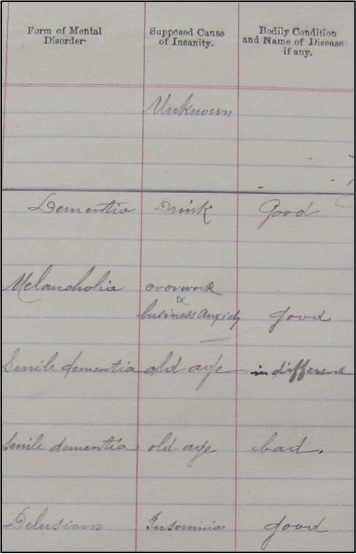
Once admitted, patients were assessed by the medical authorities who determined a cause for their illness along with a diagnosis. This process was based on the medical certificate obtained prior to committal; evidence supplied by the patient and family; and the medical practitioner's own views. The two primary nineteenth-century diagnoses – mania and melancholia – reveal relatively little about reasons for committal. The causes named, however, were far more colourful and wide-ranging and expose much about contemporary perceptions of the life events or circumstances that led to mental illness and therefore committal. Given causes encompassed a range of 'psychological' factors such as grief, bereavement, business or money anxieties and religion, and physical influences including accidents and injuries, physical illnesses, hereditary and alcohol. These later two were the most frequently employed, demonstrating widespread medical understandings of the physical nature of insanity. However, many patients, families and increasingly asylum doctors, reported that fears about financial stability, land interests and the state of the economy had caused the illness.1 In reality, it was often these anxieties that resulted in committal, especially among those with a degree of resources, such as white-collar workers, shopkeepers and farmers.

The Case of John D


Entries in Casebook 2, c.1898.
Source: St John of God's Hospital,
Patient Records.
Land and property interests certainly featured in the case of John D. In 1891, at the age of 77, John was committed to the Enniscorthy lunatic asylum by this two sons. John's sons provided details of his personal history to the asylum authorities; details which were later transcribed by the asylum's Resident Medical Superintendent, Dr Thomas Drapes, into his case notes. Reportedly a 'healthy old man', the first symptom noticed by John's sons was that he wanted to marry his servant, a girl of twenty:

Says if he doesn't marry her his soul is lost and that he'll burn in hell ... he is very supple and has often tried to take away across the country to get to this girl ... Son says he won't allow bedclothes to be changed or bed made since the girl left, as he says no one can make it but her.2
While John was a patient in the asylum, this girl visited him disguised as his niece. Following this, John's sons told Drapes to prevent any further communication between the pair. They were very much against the proposed marriage, insisting that 'she and her family are a designing lot' and 'all encourage her to get him to marry her'. One son informed Drapes that in his opinion his father would have married '"anything in petticoats" for past two years or so'. Allegedly, the girls he proposed to were 'not at all suitable, and "strealish" in appearance and habits'.

Underlying this narrative were anxieties about John's property. A farmer and a shopkeeper, John was certainly not a pauper. His maintenance in the asylum was £18 per annum and while he was in the asylum, John presented Drapes with a further £16 'to keep for him'. The sons made clear their anxieties about the family business. On one visit they stated that lately, their father 'was not capable of properly doing business in his shop'.

The real motivation for committing John, however, became clear when the patient later informed Drapes that 'he gave his sons up his land, but wished to retain his shop for himself and get a wife to mind it for him'. John also gave what Drapes termed a 'rational explanation' for his romance with the servant girl, explaining that:

the girl had been so spoken of in connection with him that her character had suffered, and that if he did not make her the only reparation he could by marrying her, he would suffer in the next world.3

Just two months after his committal Drapes discharged John. In his notes he wrote that this was 'greatly against the wishes of his sons, but I have not been able to find any distinct evidence of his insanity'.4 By 1901, John, now aged 87, had married a woman of 27, possibly the servant girl. However, ten years later, it was his son who resided at this address with his own wife and six children suggesting that he had ultimately inherited the property.5 The most plausible explanation for this outcome was that John's young wife had not borne him any children, which would have prevented her from being entitled to property rights following his death.

Conclusions


The case of John D adheres comfortably both to contemporary public hysteria over the perceived vulnerability of private patients to wrongful confinement and commonly held representations of the rural Irish.6 Although some historians have emphasised the detrimental impact of issues such as the consolidation of landholdings, emigration, land hunger and Famine memories on emotional familial bonds, historians of psychiatry have identified the 'range of familial emotional contexts' which asylum patients came from.7 Families often sent letters querying treatment, offering advice and enclosing food and money for patients.8

Yet, in cases where property or business interests were at stake, these factors tended to eclipse those of familial devotion. In fact, the high numbers of fee-paying patients who were unable to control their business or function in their profession suggests this was a major reason for committal. While the extent to which John D actually struggled in his shop is difficult to ascertain, it is conceivable that a number of other relatives' claims regarding patients' incapacity to work were genuine.

The association between working life and mental illness speaks volumes about contemporary society's interpretation of insanity and what drove families to commit relatives to asylums. In relation to social status, those unable to maintain their position within their given occupation were defined in terms of this failure. Land disputes and an inability to manage one's affairs threatened to shatter emotional familial bonds. In these cases, families may have viewed committal as a last resort in order to protect their resources or livelihood. After all, in smaller rural towns, relatives would have little control over the actions or interactions of a mentally-ill person positioned behind the shop-counter or at a farmers' market.

Dr Alice Mauger


Dr Alice Mauger was awarded a PhD by University College Dublin in 2014 for her thesis which examined institutions for the non-pauper insane in nineteenth-century Ireland. Prior to this she completed the MA programme on the Social and Cultural History of Medicine at the UCD Centre for the History of Medicine in Ireland, UCD. Both her MA and PhD were funded by the Wellcome Trust. Dr Mauger has published on the history of psychiatry in Ireland and is currently writing a monograph stemming from her doctoral research.
Below you can listen to Alice's talk, entitled 'The Cost of Insanity', given on 4 February 2016 as part of the UCD Centre for the History of Medicine in Ireland Seminar Series.


1 Fears of poverty and unemployment among pauper asylum patients are discussed by: Akihito Suzuki, 'Lunacy and labouring men: narratives of male vulnerability in mid-Victorian London' in Roberta Bivins and John V. Pickstone (eds), Medicine, Madness and Social History: Essays in Honour of Roy Porter (Basingstoke, 2007), p. 118; and, Catherine Cox, Negotiating Insanity in the Southeast of Ireland, 1820-1900 (Manchester, 2012), pp 59, 121.
2 Clinical Record Volume No. 3 (Wexford County Council, St Senan's Hospital, Enniscorthy, p. 264)
3 Ibid.
4 Ibid.
5 Census of Ireland 1901.
6 David Fitzpatrick, 'Marriage in post-Famine Ireland', in Art Cosgrave (ed.), Marriage in Ireland (Dublin, 1985), pp 116-31; Timothy Guinnane, The Vanishing Irish: Households, Migration, and the Rural Economy in Ireland, 1850-1914 (Princeton, 1997).
7 Cox, Negotiating Insanity, pp 108-9; Guinnane, The Vanishing Irish, pp 142-43, 230-35.
8 Oonagh Walsh, 'Lunatic and criminal alliances in nineteenth-century Ireland' in Peter Bartlett and David Wright (eds), Outside the Walls of the Asylum: The History of Care in the Community 1750-2000 (London and New Brunswick, 2001), p. 145.

Wednesday, 20 May 2015

Prisoners, Medical Care and Entitlement to Health in England and Ireland, 1850–2000

Prisoner Health Project: Wellcome Trust Senior Investigator Award

A major new research project in the history medicine has just been launched: 'Prisoners, Medical Care and Entitlement to Health in England and Ireland, 1850–2000'. This collaborative, five-year study, funded by a Wellcome Trust Senior Investigator Award, is being led by co-Principal Investigators, Professor Hilary Marland, of the Centre for the History of Medicine, University of Warwick, and Dr. Catherine Cox, Director of the Centre for the History of Medicine in Ireland, University College Dublin.


Strangely, the history of medicine, despite its strong focus on the history of institutions, has neglected the prison as a site of medical treatment. It's great to see that such an ambitious project is going to address this omission. That this is a comparative research project is also exciting; comparative historical analysis, despite its strong tradition in the social sciences and a limited recent resurgence, is long overdue a renewal.

Project aims


The co-Principal Investigators, Catherine and Hilary, are keen for the project's research to resonate with contemporary concerns in the prison service and they aim to tackle historical questions of prisoner health that are still relevant today. For example, they and their team are going to look at the high incidence of mental illness amongst prisoners, the health of women prisoners and the status of prison maternity services, as well as the response to prisoner substance abuse and the impact of HIV/AIDS. All of these topics are still major concerns in the medical management of contemporary prison populations in Ireland and England. 

Late nineteenth-century photographs of
prisoners in Reading Gaol
Berkshire Records Office P/RP1/5/2
Source: Berkshire Family Historian

Scope of project


Each of the different research strands within the project will cover the period from rise of the modern penal system during the mid-nineteenth century up to the present. Fundamental to the project is the comparative analysis of English and Irish prison services and the conceptual basis of prisoners' entitlement to health in both England and Ireland. 

Prisoner health and human rights


The project team is going to address the question of who advocates for prisoners' health, both within and without the prison service. They will also investigate the extent to which prisoners have been seen as entitled to health care and if human rights debates have had any influence on the provision of medical care for prisoners. Another principal area of historical inquiry is going to be the extent to which prison doctors have felt themselves to be constrained by dual and conflicting loyalties to the prison regime and to their prisoner patients. 

Policy workshops and public engagement


Hilary and Catherine have also said that the project is going to engage with policy makers and prison reform organisations, including the Howard League for Penal Reform. With that in mind, they are busily preparing several policy workshops and compiling a list of potential invitees. They also hope to engage with the general public and people working in the area of prisoner welfare through a series of outreach projects. Among the most interesting of these are their plans to commission both a theatrical production and a piece of artwork that will be based on their team's research findings. 

Project members


Dr. Catherine Cox, University College Dublin, Principal Investigator. 

Professor Hilary Marland, University of Warwick, Principal Investigator.

Both Hilary and Catherine are working on the relationship between the prison system and mental illness – a subject of acute contemporary relevance considering the high levels psychiatric morbidity amongst prisoners – and they are also looking at the impact of the prison on prisoner mental health. In addition, Catherine will focus on the evolution of the separate system in Ireland and its impact on mental health while Hilary will examine the question of women and mental health in the prison system.

Dr. Will Murphy, Mater Dei Institute, Dublin City University, is researching the health of political prisoners and the impact they had in shaping attitudes and practices of health and medicine in Irish and English prisons.

Dr. Fiachra Byrne, University College Dublin, Postdoctoral Research Fellow (3 years), is working on the mental health of juvenile prisoners in England and Ireland.

Dr. Nicholas Duvall, University of Warwick (year 1), University College Dublin (year 2), Postdoctoral Fellow (2 years), is going to be supporting Hilary and Catherine in their research and will also develop his own project on the health of prison officers. 

Dr. Margaret Charleroy, University of Warwick, Postdoctoral Research Fellow (3 years), is working on the management of prisoner health, disease and chronic illness.

A further Postdoctoral Fellow, who will be researching the history of HIV/AIDS in prisons under the supervision of Professor Virginia Berridge at the London School of Hygiene and Tropical Medicine is slated for appointment later this year (2015).  

Public Engagement Officers, at Warwick and Dublin, will be appointed in late 2015. They will have responsibility with implementing the project's arts and policy initiatives.

In 2016, there will be two PhDs appointed to the project. One, based at UCD, will work on prison reform movements; the other, based at Warwick, will investigate the health of women prisoners.

If you want to find out more about 'Prisoners, Medical Care and Entitlement to Health in England and Ireland, 1850–2000', you can visit the UCD project page or the Warwick project page. The project team have also announced their Advisory Board members and provide a list of recent and upcoming project activities.

For further project details or inquiries, you can contact Hilary by email at hilary.marland@warwick.ac.uk or Catherine at catherine.cox@ucd.ie


Tuesday, 24 March 2015

The historical development of Irish Hospitals and the importance of their records by Brian Donnelly

In this month's post, Brian Donnelly, senior archivist at the National Archives of Ireland, outlines the development of Irish hospitals from the eighteenth to the twentieth century.

Rotunda Hospital, Dublin
(RCPI Archival collections: VM/1/4/19)

The establishment of the voluntary hospitals


The early eighteenth century saw the establishment of voluntary hospitals by philanthropists, mainly in Dublin but also in the larger provincial towns. Jervis Street hospital (the Charitable Infirmary) was the first voluntary hospital Ireland and was founded in 1718.  Many of these, like Dr. Steeven’s Hospital (founded in 1733) and Mercer’s (founded 1734) would survive into the twentieth century.  The eighteenth century also saw the establishment of specialist hospitals, most of them voluntary, such as the Rotunda Lying In Hospital, founded in 1745, St. Patrick’s Hospital for mental illness, founded in 1747 and the Westmoreland Lock Hospital, for the treatment of venereal disease, in 1792. 

A modern public health service at county level began in 1765 when a parliamentary enactment provided for the erection and support of an infirmary for each county in Ireland and also permitted support for several existing hospitals, mainly in Dublin and Cork, out of public funds.  The county infirmaries were to be maintained by grand jury presentments, parliamentary grants and local subscriptions. The grand juries were groups of landowners who were called together by the High Sheriff in each county twice a year for legal and local administrative reasons.

The House of Industry hospitals, district lunatic asylums and medical dispensaries


The Dublin house of industry, a precursor of the workhouses of the nineteenth century, was founded in 1772. This institution became in time a vast concern, providing hospitals for the sick, an asylum for children, bridewells, penitentiaries for women and young criminals, a house of industry for vagrants, and cells for lunatics.  From it evolved the House of Industry hospitals – the Richmond, Whitworth and Hardwicke - and it played a major role in establishing the first and largest of the public lunatic asylums – the Richmond Lunatic Asylum – which opened for patients in 1814. Following the report of the Committee on the Lunatic Poor in 1817, the Lord Lieutenant was enabled by statute to build asylums where he considered necessary and, over the next half century, a well-developed mental health infrastructure was in place. By 1871, twenty two asylums were being financially supported by the grand juries. In 1850 a central asylum “for insane persons charged with offences in Ireland” was opened in Dundrum. This institution, the first criminal lunatic asylum in these islands, was under the direct control of the Lord Lieutenant who appointed the staff and made regulations for its management. 

A few dispensaries were supported by voluntary subscriptions in several of the larger towns and cities from the late eighteenth century, but it was not until 1805 that grand juries were authorised to give grants to dispensaries in rural areas. By the early 1830s, there were 450 dispensaries throughout the country, administered by committees of management and supported partly by subscriptions and partly by grand jury grants. There were fewer dispensaries in poorer areas, where voluntary contributions were wanting, and where it was difficult to raise enough money to start them. Inadequate as many of these dispensaries were, they represented the first steps towards domiciliary medical treatment of the rural population.


Robert Graves (1796-1853)
 (RCPI Archival collections: VM/1/2/S/35)

The impact of epidemics on the development of medical infrastructure


Epidemic disease was a major impetus in the development of a medical infrastructure. Typhus was a major scourge in Ireland in the early nineteenth century and, while several fever hospitals had been established in the larger towns in the late eighteenth century, it was not until 1807 that legislation was passed to encourage their construction throughout the country. A fever epidemic of unprecedented proportions raged in Ireland between 1816 and 1819. Under an 1818 Act, local boards of health could be established, supported partly by grand juries, which had extensive powers to combat disease. Grand juries were empowered to make presentments equal to twice the amount raised by private subscription to build fever hospitals. In 1819, legislation enabled officers of health to be appointed in parishes and a parish health tax could be levied. 

The establishment of the Central Board of Health in 1820 marked a major step in the centralisation of medical relief and local boards of health were to play a major role in combating epidemics over the following decades. The Central Board of Health collected statistics about local health conditions, advised where local boards of health should be established and when grant to hospitals should be made. When cholera broke out in Ireland in March 1832, the Central Board of Health, renamed the Cholera Board for the duration of the epidemic, supervised measures to combat the disease which included the establishment of local boards of health. 

Dublin hospitals like the Meath were at the forefront of the fight against infectious disease from the 1820s and introduced new methods of bedside clinical training to the English speaking world.  The census commissioners noted in 1854 that to these metropolitan hospitals “the Irish School of Medicine is largely indebted for the celebrity which it has so long enjoyed”. The Meath hospital received international recognition in the early nineteenth century due to the innovative teaching methods and research carried out by its physicians, Robert Graves and William Stokes. The latter had survived an attack of typhus in 1827 and identified the first case of cholera in Ireland in 1832. This new approach to clinical training had originated on the continent and its introduction into the Meath hospital heralded what has been described as the heroic age of the Irish School of Medicine. The voluntary hospital infrastructure continued to expand during the nineteenth century and following Catholic Emancipation many Catholic religious orders became involved in founding hospitals.

The Irish Poor Law, 1838


The enactment of the Irish Poor Law of 1838 was to have a dramatic effect on the provision of public health services for the rest of the nineteenth century. The country was divided into over one hundred and fifty poor law unions each with a workhouse at its centre and administered by a board of guardians.The structure of the poor law system, being modern and efficient and more easily subject to central control, was adapted on nearly all occasions where a new local function was created or an old one modified .The Medical Charities Act of 1851 led to the modernisation and extension of the old grand jury dispensary network under the boards of guardians and made a domiciliary medical service available to large sections of the population, the destitute poor, for the first time. 

By 1852, every poor law union had been divided into a number of dispensary districts, each with a dispensary and medical officer.  Patients had to apply to a poor law guardian for a ticket every time they wanted to attend a dispensary free of charge. Committees of management were responsible to the boards of guardians for the management of the dispensaries and appointing the dispensary doctors. In 1863, the dispensary doctors were made registrars of births and deaths and of Roman Catholic marriages and the practice of registering births, marriages and deaths was standardised on the 1st of January 1864. When registering deaths, the dispensary doctors were required to note the cause of death and duration of illness, thus enabling accurate statistics of mortality to be compiled for the first time. The registration of births enabled such measures as the compulsory vaccination of children against smallpox to be carried out effectively and by the end of the nineteenth century this scourge had, to a great extent, been eliminated.

While many boards of guardians had allowed the non-destitute to enter workhouse hospitals for treatment during the 1850s, the 1862 Poor Law (Amendment) Act officially opened the workhouse hospitals to the non-destitute sick. As a result of these developments, Ireland had one of the most advanced health services in Europe in the mid-nineteenth century, if policy and structure are to be taken as criteria. The Local government (Ireland) Act, 1898, replaced the grand juries by democratically elected county and rural district councils. The county councils took over the administration, either directly or through joint committees, of the district lunatic asylums.

Newcastle Sanatorium, Wicklow.
Image courtesy of NLI (L_ROY_05467)

Tuberculosis and the sanatorium


While Ireland had a low death rate from infectious disease in the first decade of the twentieth century, tuberculosis was the marked exception. The last years of the nineteenth century saw the first attacks made against the disease with the establishment of Newcastle Sanatorium in 1893. In 1904, the sanitary authorities of County Cork combined with Cork Corporation to establish Heatherside Sanatorium near Doneraile. In 1907, the Dublin City and County authorities established Crooksling Sanatorium. A Tuberculosis Prevention Act was passed in 1908 which gave the county councils power to provide sanatoria and brought the first veterinary inspectors into the employment of the sanitary authorities.  Peamount Sanatorium was founded in 1912 through the efforts of the Women’s National Health Association, the most formidable health pressure group of the early twentieth century.

Public health provision in post-independent Ireland


The turbulent years of the early 1920s saw some revolutionary changes in the public health system. In general, the boards of guardians outside Dublin were abolished and were replaced by county boards of health and public assistance, essentially sub-committees of the county councils. Most workhouses were closed to save money and central institutions called county homes were established in each county where the poor were to be relieved. While the newly styled county homes were to be reserved in theory for the old and infirm many soon included unmarried mothers, children and the mentally retarded.  Following the establishment of the Irish Free State the Department of Local Government and Public Health formally became, in 1924, the central government authority for local government and health administration. The Minister took over the Lord Lieutenant’s duties in relation to the mental hospitals. In 1930, the establishment of the Irish Hospitals Sweepstakes, a lottery to provide financial assistance to hospitals, provided a financial lifeline to many voluntary hospitals who were struggling to survive following a reduction in the number of endowments and bequests after the Great War.

The post-war period and declining mortality


There were significant developments in health care in the 1940s and 1950s. The Mental Health Treatment Act of 1945 modernised the legal code under which the mental services operated and provided important safeguards against the arbitrary detention of patients although the numbers of persons being treated continued to increase until, by 1959, there were 20,000 patients in Irish mental hospitals.  In the years immediately after 1945 there was a major effort to develop anti-tuberculosis services. The Tuberculosis (Establishment of Sanitoria) Act of 1945 permitted the Minister for Local Government and Public Health to arrange for the building of sanatoria and to transfer these to local authorities when completed. This was a major departure from established practice for the central authority as it stepped outside its normal functions of directing and co-ordinating the local services. Sanatoria were built at Dublin, Cork and Galway and were handed over when completed to the local authorities as was provided under the Act. 

There was also widespread building and conversion of buildings for the treatment of tuberculosis cases by local authorities.  These developments, together with the payment of maintenance allowances for dependents of persons undergoing treatment for infectious disease, mass radiography, BCG vaccination and new drugs such as streptomycin, led to a great decline in mortality for the disease and in the number of new cases appearing.  In 1947 the Department of Local Government and Public Health was divided into two separate departments. The Health Act of 1953 extended eligibility for general hospital services and maternity care to a much wider class. Health authorities were now required to provide child welfare clinic services and the school health service was improved. The dispensary service and dispensary doctors were transferred from the public assistance code to the health authorities. The old dispensary ticket system was done away with and replaced by medical cards. A more liberal code for the governing of county homes was introduced and provision was made for the development of a comprehensive rehabilitation service.

William Stokes (1804-78) and William Wilde (1815-76)
(RCPI Archival Collections: PDH/6/2/12)

1970s regionalisation and the Irish 'love affair' with the hospital bed


By the 1960s, it was felt that as the state had taken over the major financial interest in the health service there should be a new administrative framework combining national and local interests.  For technical and logistical reasons it was believed that better services could be provided on a regional rather than a county basis.  The establishment of the health boards under the Health Act, 1970, marked a major break in the link between the health services and county administration. At this time Ireland had the highest proportion of hospital beds to population in western Europe and the Irish hospital system was described as “one of a large number of small institutions scattered throughout the country”. The following decades would see the closure or amalgamation of many voluntary and state hospitals into larger units and the dismantling of the old mental hospital infrastructure.

The historical value of Irish hospital records


That Irish hospital records are of great historical interest has long been acknowledged. Dr. William Wilde, the internationally renowned nineteenth century physician and statistician, recognised one hundred and seventy years ago that the hospital registers of the Rotunda Hospital represented the ‘most interesting and earliest statistical tables on record’.  Ireland’s medical institutions, both voluntary and public, have a peculiarly rich and varied history and have played a paramount role in medical advances over the last three centuries.  While some collections of hospital archives are now safe in archival custody, many collections remain in peril. These archives have no protection under the law and it is often only through the good offices of interested hospital staff that material has been preserved. 


Brian Donnelly is a Senior Archivist at the National Archives with responsibility for Business and Hospital records. Images courtesy of Fergus Brády, Archivist, RCPI. 

Wednesday, 25 June 2014

A Malady of Migration: theatre production in Coventry and Dublin

At a time when the issues of migration and mental health are seldom out of the news, the Centre for the History of Medicine in Ireland (CHOMI) has worked with the Centre for the History of Medicine at the University of Warwick (CHM) and Talking Birds theatre company to develop a new theatre production which explores why the mid-nineteenth century saw a prevalence of mental disorders among Irish migrants.The new piece is called 'A Malady of Migration' and is based on research being carried out by Professor Hilary Marland of Warwick and Dr Catherine Cox of University College Dublin, in a project called Madness, Migration and the Irish in Lancashire, c.1850-1921, funded by the Wellcome Trust. They are supported by postgraduate students and others, who will conduct supplementary research and take supporting roles in the drama.

There will be an expert panel discussion after the Thursday evening performances in each venue and a post performance discussion on Saturday lunchtime, providing opportunities for audience members to discuss the making of the piece with researchers and the theatre company, and to engage in debate on issues raised by the performances. A series of short briefing sheets have been produced to complement the drama and provide background information. These can be accessed here.

Check out the Malady of Migration website here!

Performances

Shop Front Theatre, City Arcade, Coventry CV1 3HW (opposite Argos):
Thurs 26th to Sat 28th June 2014
1pm - £6 (£3) and 7pm - £8 (£4)
Box office 0845 680 1926 talkingbirds.co.uk


The New Theatre, Temple Bar, Dublin:
Thurs 3rd to Sat 5th July 2014
1pm - €8 (€4) and 7.30pm - €10 (€5)
Box office 01 670 3361 thenewtheatre.com


A Malady of Migration


Madness, migration, and the Irish in Lancashire, 1850-1921


Thursday, 12 June 2014

‘[S]he is in a highly hysterical state. She’s a woman who resists’: the Dangers of Spiritualism in J. S. Le Fanu’s All in the Dark (1866) by Valeria Cavalli

In this month's post, Dr Valeria Cavalli examines the  theme of spiritualism in Irish writer Joseph Sheridan Le Fanu's novel All in the Dark (1866), and what the author's warnings about the dangers of spiritualism tell us about Victorian attitudes to women and madness. 

The dangerous habit of practising séances


When William Maubray is called to his dear aunt Dinah’s deathbed, he hopes that he will get there in time to say goodbye. He is certainly surprised, then, to find her in quite good shape, if not for her firm conviction that she is going to die before midnight. Dr. Drake explains to the puzzled young man that his aunt suffers from nothing more serious than the ailments of a woman of her age, but that she has recently fallen victim of self-deception. The eccentric old woman has in fact taken up the dangerous habit of practising séances, and the risk is that she will drive herself mad if she insists in taking seriously the ominous revelations of her spirit friend. Written in the peak years of Spiritualism, Joseph Sheridan Le Fanu’s All in the Dark brings forth a way more terrifying reality than being haunted by ghosts, that is, being locked away in a lunatic asylum on the basis of one’s unorthodox creed.

The rise of spiritualism


Emerging in America in the late 1840s, Spiritualism spread almost immediately to Europe, finding fertile terrain in the state of religious uncertainty which was troubling part of the population, regardless of class, age, or gender. When scientific discoveries brought the credibility of the Bible into question, believers began to feel uneasy with the way Christianity explained the supernatural, and began to look for comfort in the occult. In fact, the occult could account for the supernatural according to the laws of nature: whatever forces were inexplicably ruling the Universe or man, they were completely natural, and their present state, if still unknown to science, was open to investigation. However, scientists and members of the Church together raised their voices in opposition to the movement from its very first appearance, and criticism poured from the pages of periodicals and newspapers.

Joseph Sheridan Le Fanu

Spiritualism and female transgression


As Alex Owen has pointed out in her Darkened Room (1989), many medical men regarded the movement with distaste and suspicion in part because of the increasing role it offered to women. In those years, the ideal woman was the submissive wife and mother, “the angel in the house” in charge of the domestic sphere. In giving women the authority and the right to exercise their innate spiritual powers, Spiritualism infringed on the culturally imposed limits of respectable womanhood. In the darkened room, not only did women become the principal actors of the séance, they also transgressed gender norms, by assuming male roles or highly sexualised trance personae. The subversiveness of the movement alarmed and alerted the medical profession, which was in charge of policing any deviations from the social order imposed by Victorian patriarchy. The emerging medical branches of psychiatry and gynaecology effectively teamed up to prove that women’s health depended on female biology. Since women’s role was primarily that of generator, physical and intellectual activities would compromise the balance of nerve force necessary for the functioning of the reproductive organs, thus causing mental instability. Most cases of insanity due to sexual illness tended to result in monomanias, among which Spiritualism was counted, and doctors began to consider any kind of suspension of everyday consciousness suspicious and to associate mediumistic trance, with its uncontrollable convulsions and frequent use of inappropriate language, with the pathological symptoms of hysteria.

'Queer fancies'


In All in the Dark, Dinah Perfect is depicted as a strong-willed, authoritative, and eccentric woman. Her faithful servant explains that Dinah has always been very extravagant, with her odd dispositions concerning her corpse and coffin:

She was very particular, […] and would have her way; […] she had her coffin in the house this seven years – nigh eight a’most – upright in the little press by the left of the bed, in her room – the cupboard like in the wall. Dearie me! ’twas an odd fancy, […] and she’d dust it, and take it out, she would wi’ the door locked, her and me, once a month. She had a deal o’them queer fancies, she had. [II, pp.168-9]

'She is in a highly hysterical state'


It is no surprise, then, that when the novelty of table-rapping reaches the Old World, it appeals mightily to a housebound, bored, middle-class spinster like Dinah, who is looking for excitement and escapism from the monotony of everyday life, and from the increasing fear of ageing and dying. However, Dinah’s credulity is quickly associated with hysteria. Echoing Dr William Carpenter’s theory on unconscious cerebration, the non-believing, sceptical (and alcoholic) Dr Drake describes the dangerous effects that Spiritualism could have on Dinah’s mind, by convincing her of the reality of her delusions to the point that her body comes to provoke the effects that she expects to happen. Dr Drake is afraid that Dinah will ‘frighten herself out of her wits’, and explains to William that Spiritualism can affect the nerves [I, p. 60]:

Why, you know what hysteria is. Well, she is in a highly hysterical state. She’s a woman who resists; it would be safer, you see, if she gave way and cried a bit now and then, when nature prompts, but she won’t, except under awful high pressure, and then it might be serious; those things sometimes run oft’ into fits. [I, pp. 38-9]


Wrongful confinement


At a time when the advances in the realm of the mind became increasingly associated with scandals related to wrongful confinement, Le Fanu questions the power held by Victorian psychiatry over extravagant and independent women. Dinah Perfect is certainly a bizarre character, with her many fancies and her addiction to table-turning. However, her oddities do not seem sufficient to diagnose her as incipiently insane. Dinah is an elderly woman troubled by the frightening thought of upcoming death. Her anxiety and hysterical crises echo the spiritual uncertainty that afflicted the author’s sister and wife, like many other Victorians. Moreover, her uneasy shifting between her family’s orthodox Christianity and the occult is reminiscent of Le Fanu’s own crisis of faith, which led him to find comfort in the doctrine of the Scandinavian mystic Emanuel Swedenborg.


 Le Fanu's wife Susanna (née Bennett), and his sister Catherine. All three experienced a crisis of faith at some point in their lives. The images of Susanna and Catherine appear in W. J. McCormack’s biography of Le Fanu.

'That foolish spirit-rapping'


Having experienced first hand the anxiety of spiritual doubt, Le Fanu is far from labelling Dinah mad, even though he does not sympathise with Spiritualism. In fact, all throughout the novel, Dinah sounds reasonable and practical, advising her ward on the importance of a good match in marriage, and her nephew on the more advantageous prospect of the Church rather than the Bar as a profession. Even on spiritual matters, the Rector confirms that, ‘I found her views […] all very sound; indeed, if it had not been for that foolish spirit-rapping, which led her away – that is, confused her – I don’t think there was anything in her opinions to which exception could have been taken’ [II, pp. 171-2]. On all subjects but Spiritualism, Dinah is perfectly sound. However, her fancy for table-turning would, for orthodox Victorian psychiatry, be a strong enough proof of her insanity, as the real case of Louisa Nottidge had shown.

Louisa Nottidge


Like Dinah Perfect, Louisa Nottidge was a wealthy middle-aged spinster who had also spent money ‘very wildly’ upon the word of a Spiritualist [I, p. 8]. In 1846, Nottidge decided to leave her mother’s home to follow the influential millenarian prophet Henry Prince. Prince was the founder of a small community in Somerset called the Agapemone (the Abode of Love), where he taught about free love and preached of everlasting life to a group of devotees who had agreed to donate all their wealth to the congregation. Three of the five Nottidge sisters had already joined the prophet (who had thus gained some £18,000), so that when Louisa communicated her decision to her mother, the latter had to act quickly in order not to lose another daughter, and her considerable fortune, to an unscrupulous charlatan. Mrs Nottidge had Louisa abducted and confined to the majestic Moorcroft House private asylum at Hillingdon, in Middlesex, on the grounds of theomania. Louisa spent seventeen months at the Hillingdon, and was released only because the Commissioners in Lunacy were summoned upon concerns about her failing health. After her liberation, Louisa joined the millenarian community, transferred all her possessions to Henry Prince, and took legal action against her wrongful confinement.

A fraudulent committal


Moorcroft House private asylum at Hillington.
This picture is taken from Sarah Wise’s Inconvenient People.
The case was heard in court in 1849 before the Lord Chief Baron, the Right Hon. Sir Frederick Pollock, while the attention it received in the press provoked responses from alienists John Conolly and Forbes Benignus Winslow, and Lord Ashley, Chairman of the Commissioners in Lunacy. The Lord Chief Baron accepted Louisa Nottidge’s plea and ordered a compensation for the damages received. The suit made clear that Louisa’s admission to the Hillingdon had not been fraudulently obtained, since two doctors certified her insane on the grounds that she had ‘estranged herself from her mother’s house […] to follow a person of the name of Prince, whom she believed to be Almighty God, and herself immortal’. However, as Joshua John Schwieso has pointed out, although the two doctors had been summoned by the family physician on the basis of their ‘experience in cases of insanity’, their biographies suggest that neither of them was an expert in the field. Despite all this, the final verdict was reached because the Commission in Lunacy, in the person of Mr Mylne, failed to convince the Lord Chief Baron of the necessity of keeping Miss Nottidge confined, as shown in the following report which appeared in The Times in 1849:

The Lord Chief Baron: Mr Mylne, was this lady in such a state of mind as to be dangerous to herself or to others?   
Mr Mylne: Not so as I was aware of; not so far as I knew. 
The Lord Chief Baron: If she were not so, then how was it that you kept her in this asylum for seventeen months?
Mr Mylne: My lord, it was no part of my duty to keep her there. I was only to liberate her if I saw good and sufficient reason for adopting that course. 
The Lord Chief Baron: It is my opinion that you ought to liberate every person who is not dangerous to himself or to others. If the notion has got abroad that any person may be confined in a lunatic asylum or a madhouse who has any absurd or even mad opinion upon any religious subject, and is safe and harmless upon every other topic, I altogether and entirely differ with such an opinion; and I desire to impress that opinion with as much force as I can in the hearing of one of the commissioners. […]You say unsound mind, Mr Mylne. Had she any unsoundness of mind upon any other subject under heaven except as to entertaining these peculiar religious notions?
Mr Mylne: Miss Nottidge did not exhibit any symptoms of insanity of any other subject, my lord, that I observed.

Not only did the Lord Chief Baron support an individual’s freedom to hold religious opinions (as long as they remained harmless to both the person and other parties), he, most importantly, stated that he ‘very much doubted whether, if in this case the plaintiff had been a man, or living under the protection of a husband, the defendants would have dared to have taken the steps they had’.

An unwarranted influence


This case made evident how women, and particularly single women, were in danger of wrongful incarceration, since their unorthodox religious views (Louisa’s own mother affirmed that ‘she worships a false god’) could be easily exploited for financial gain.[ix] In fact, in the case of Louisa Nottidge, what her family were trying to save was the £5,728 7s 7d that she had bequeathed to the prophet. After her death in 1858, which occurred while she was still residing at the Agapemone, the Nottidges brought Henry Prince to court and succeeded in obtaining the return of Louisa’s property on the grounds of the prophet’s unwarranted influence upon the deceased. Thus, in the early 1860s, the case of Louisa Nottidge received new attention in the press, both in England and in Ireland, and was associated with the increasing number of cases of wrongful confinement which were causing much sensation, both in real life and in fiction.

Spiritualism and madness

           
In All in the Dark, Dinah, unlike Nottidge, is surrounded by relatives and friends who love her for who she is rather than for her fortune, and who will miss her dearly after her death. However, in discursively associating Spiritualism with madness, Le Fanu is reminding the reader of the existing danger that even an incompetent doctor like Drake, with no specific knowledge or experience of insanity, could actually provide enough evidence to have a woman like Dinah confined on the grounds of her unorthodox beliefs. Furthermore, he is also presenting a reflection on the double standard with which Victorian psychiatry was dealing with its patients. After Dinah dies, her sceptical nephew William also becomes ‘addicted to the supernatural’ and begins to believe that he is haunted by the spirit of his dead aunt [I, p. 58]. He suffers from nervous strain and hallucinations, and also admits that ‘I think I’m growing as mad as […] poor Aunt Dinah’ [I, p. 216, my italics]. However, no judgement is made about the possibility of his being a case of incipient insanity. William’s temporary condition is attributed to the weight of financial and sentimental concerns which, combined with the strong tea he likes to drink (a recurring theme in Le Fanu’s fiction), the heavy tobacco he likes to smoke, and the supernatural stories he likes to read, provokes nightmares and somnambulistic states. Financial problems, disappointment in love, bereavement, and hereditary disposition were all considered by Victorian psychiatry to be factors in the detection of mental insanity. The fact that such connections are ignored in William’s case seems to validate the words of the Lord Chief Baron, who doubted whether the same precautions would have been taken if the plaintiff had been a man.
      
In All in the Dark, Le Fanu touches on the topical association of alternative spiritualities with insanity. Drawing upon his personal experience as well as his professional familiarity, in his work for the national and international press, with contemporary debates on these topics, Le Fanu investigates the power game played by Victorian psychiatry over difficult citizens, women in particular. Although the novel shows Le Fanu’s contempt of Spiritualism, it nevertheless dismisses the accusations of madness levelled at the believer, thus becoming a warning to women readers.

Dr ValeriaCavalli recently completed a PhD in the School of English, Trinity College Dublin entitled 'They said she was mad: insanity in the fiction of Joseph Sheridan Le Fanu' (2014). She may be contacted at cavalliv "at" tcd "dot" ie. Details of an upcoming conference in Dublin on J.S. Le Fanu (15-16 October 2014) may be found here.


Further reading
  • J. S. Le Fanu, All in the Dark, 2 Vols (London: Richard Bentley, 1866), Vol. 2, pp. 168-9.
  • For a historical context on Spiritualism and Victorian medicine, see Alex Owen, The Darkened Room: Women, Power, and Spiritualism in Late Victorian England (Chicago, Ill.; London: University of Chicago Press, 2004), Ch. 6.
  • On Louisa Nottidge, see Sarah Wise, Inconvenient People; Lunacy, Liberty and the Mad-Doctors in Victorian England (London: The Bodley Head, 2012), Ch. 4; Owen, pp. 151-54; and Joshua John Schwieso, ‘‘Religious Fanaticism’ and Wrongful Confinement in Victorian England: the Affair of Louisa Nottidge’, Social History of Medicine (1996), pp. 159-74.