Showing posts with label lunatic asylums. Show all posts

Monday, 6 January 2020

Irish Medical Responses to Problem Drinking from Institutionalisation to Public Health: Part II

In the second instalment of this two-part special, Dr Alice Mauger, Wellcome Trust Postdoctoral Research Fellow at the UCD Centre for the History of Medicine in Ireland explores the changing approaches of medical practitioners and psychiatrists to problem drinking in Ireland since 1922.

Read Part I here.


After the First World War, medical interest in the “drink question” began to wane and political barometers swung strongly towards attempts to limit drinking. Among the most infamous of these tactics was the United States’ prohibition experiment, which resulted in a nationwide ban on drinking from 1920 until 1933. Meanwhile, the newly formed Irish Free State government lost little time overhauling liquor regulations, restricting pub opening hours and decreasing the availability of pub licenses. While this demonstrated state concern about both levels of drunkenness and the money being spent on drink, the same government was slow to reflect on the treatment of alcoholism.  

New York City Deputy Police Commissioner watching agents 
pour liquor into sewer following a raid during the height of 
Prohibition. Source: United States Library of Congress's 
Prints and Photographs division.

A New 'Disease View'


Beginning in the United States, a new ‘disease view’ of alcohol addiction emerged after the abolition of prohibition in 1933. The fundamental difference between this new medical concept and its nineteenth-century predecessor was the perception of drink itself. While the earlier interpretation saw alcohol as an inherently addictive substance, posing a risk for everyone, the post-prohibition version portrayed drink as harmless for most but with the potential to cause disease in a minority of vulnerable or ‘defective’ individuals – labelled alcoholics.

In an era of mounting medical concerns over immunisation, tuberculosis and infant mortality, accompanied by the general rise of preventative medicine, this ‘disease view’ of alcoholism did not take hold in Ireland until after the Second World War. In the meantime, there was a marked decrease in alcohol consumption in Ireland during the first half of the twentieth century.

Alcoholism and Mental Hospitals


In 1945 new legislation broke ground, giving statutory recognition to the role played by mental health services in supplying addiction treatment. The Mental Treatment Act, 1945 specifically provided for the admission of ‘addicts’, including those addicted to alcohol, to mental hospitals. This signalled growing acceptance of alcoholism as a disease requiring treatment. It also cemented what was already a reality for the Irish psychiatric services. As mentioned in a previous post, Irish mental hospitals had been principal treatment centres for problem drinkers since the nineteenth century and by 1900, 1 in 10 admissions were attributed to ‘intemperance in drink’. 

In spite of these developments, it was not until the 1960s that psychiatrists began openly advocating the disease theory. This decade also saw the establishment of the first specialist wards for alcoholism in Dublin psychiatric hospitals like St John of God’s in Stillorgan and St Patrick’s Hospital on James’ Street. Concurrently, there was a marked rise in the number of alcohol-related admissions to psychiatric hospitals from 561 in 1958 to 1,964 in 1967.1 It is uncertain whether these figures represented an increase in the actual numbers of alcohol-related cases presenting or in the numbers being identified. What is clear, however, is that by this point the role played by psychiatric services for alcoholism in Ireland had crystallised and psychiatrists had apparently grown more comfortable with this function.
Source: Wikimedia Commons

Dr John G. Cooney


Possibly the most avid individual advocate of the new disease view was Dr John G. Cooney, a consultant psychiatrist at St Patrick’s Hospital who became one of Ireland’s leading authorities on the psychiatric treatment of alcoholism.2 Speaking at the North Dublin Medical Club Symposium in 1963, Cooney urged his medical colleagues to accept the disease view:
Too often doctors have allowed their view of alcoholics to be distorted by emotional factors. Commonly their own subconscious fears regarding alcoholism have been projected on to their alcoholic patients. If one is to treat alcoholism successfully whether in hospital of in general practice one must feel as well as believe that the alcoholic is ill and suffering from a disease just as surely as a diabetic is suffering from his excess blood sugar.3

Resistance to the Disease View


The theory’s central tenet, however, did not sit well with many Irish commentators. After all, the premise that alcoholism constituted an inherent ‘flaw’ in the individual was a difficult pill to swallow in a country with increasing psychiatric admissions for that very disorder. Illustrating this point in 1962, a consultant psychiatrist at St John of God’s, Dr Desmond McCarthy, complained:
One of the great difficulties in this country was that alcoholism was not accepted as an illness. It still carried a social stigma, a rather foolish way of looking at a serious disease. The basic illness was often hidden under other names for face-saving thus there were no reliable figures for alcoholism.4
Evidence of a persistent stigma around alcoholism in Ireland was produced as late as 1969. Reporting on an alcoholism seminar for general practitioners in Waterford that May, the Irish Times’ medical correspondent, David Nowlan wrote of the survival within the Irish medical profession of ‘medieval attitudes’. Nowlan described how one general practitioner had stood up at the end of the seminar and ‘stated quite categorically that alcoholism was a sin in the face of God and against God’s works deserving of only censure and moralistic indignation’.5

Social and Cultural Factors


By the 1970s, psychiatrists were devoting some space to the impact of social and cultural change in Ireland. According to Cooney, modernisation had brought with it a variety of new factors which were now influencing Irish drinking habits. These included increasing social mobility in rural Ireland leading to more money being spent on drink; the replacement of dimly-lit, all-male pubs with brightly-lit bars and singing lounges catering to younger married couples; expense account drinking in the cities following the patterns of London and New York; and the centrality of alcohol on all social occasions and in many business transactions. Cooney’s observations were not unfounded. The 1960s had seen a massive economic boom, resulting in greater disposable income and a dramatic climb in expenditure on drink. Inevitably, Cooney argued, ‘all this exposure to alcohol has led, in the opinion of many workers in the field, to an increase in alcoholism’.6


Campaign Poster for Public Health (Alcohol) Bill, 2015.
 With thanks to Alcohol Action Ireland

A Public Health Approach to Alcohol


Cooney’s concerns about increasing exposure to alcohol were illustrative of those in Ireland and elsewhere. The 1970s marked a turning point in attitudes towards drink in many countries. By now, epidemiologists were linking rising per capita consumption with a concurrent growth in alcohol-related harm, including deaths from liver cirrhosis and convictions for drunkenness and drink-driving. Alcohol therefore came to be presented, once again, as a problem for everyone rather than a minority deemed predisposed to alcoholism. Designated the ‘public health’ perspective, this approach gradually supplanted the disease concept. Yet, in spite of the efforts of its proponents, and its acceptance and promotion by the World Health Organisation, until quite recently governments have been reluctant to impose corresponding legislation. 

The passing of Ireland’s Public Health (Alcohol) Act in 2018 therefore represents a landmark in alcohol policy. It also reveals an unprecedented unity among medical responses to problem drinking today. Internationally, it has received strong backing from leading public health organisations and in Ireland, the Royal College of Physicians of Ireland have partnered with national charity, Alcohol Action Ireland, to form the Alcohol Health Alliance Ireland, for whom a central aim has been to support the Bill. Meanwhile, the President of the College of Psychiatrists in Ireland, Dr John Hillery, stated in November 2017: ‘the College supports the bill in its entirety, not a diluted version, to protect the mental health of our society’.7


Alice Mauger


Dr Alice Mauger
Dr Alice Mauger is a Postdoctoral Research Fellow at the Centre for the History of Medicine in Ireland in the School of History, University College Dublin. Her research project 'Alcohol Medicine and Irish Society, c. 1890-1970' is funded by the Wellcome Trust. The project explores the evolution of medicine's role in framing and treating alcoholism in Ireland. It aims to make a significant contribution to the medical humanities, exploring historical sources to better understand and contextualise Irish society's relationship with alcohol. She was awarded a PhD by UCD in 2014 for her thesis which examined public, voluntary and private asylum care in nineteenth-century Ireland. Prior to this she completed the MA programme on the Social and Cultural History of Medicine at the UCD Centre for the History of Medicine in Ireland, UCD. Both her MA and PhD were funded by the Wellcome Trust.

She has published on the history of psychiatry and alcoholism in Ireland including '"The Holy War Against Alcohol": Alcoholism, Medicine and Psychiatry in Ireland, c. 1890–1921’ and a full-length monograph: The Cost of Insanity in Nineteenth-Century Ireland: Public, Voluntary and Private Asylum Care (Palgrave Macmillan, 2017) which is available via open access and in hardcopy.


1. John G. Cooney, ‘Rehabilitation of the Alcoholic’, Journal of the Irish Medical Association 63, no. 396 (1970), 219-22, on 220.
2. Cooney was responsible for the establishment of a specialist treatment programme for alcohol-related disorders at St Patrick’s, published extensively on the topic of alcoholism and was a founding member of the Irish National Council on Alcoholism.
3. John G. Cooney, ‘Alcoholism and Addiction in General Practice’, Journal of the Irish Medical Association 53, no. 314 (1963), 54-7, on 55-6.
4. ‘Problem of Treating Alcoholism’, Irish Times, 3 March 1962, 7.
5. David Nowlan, ‘Hidden Disease Dangers: Doctors Discuss Alcohol’, Irish Times, 17 May 1969, 4.
6. John G. Cooney, ‘Alcohol and the Irish’, Journal of the Irish Colleges of Physicians and Surgeons 1, no. 2 (1971), 54.
7. ‘Public Health (Alcohol) Bill for Discussion in Senate Today: College highlights Alcohol’s Role in Completed and Attempted Suicides and Mental Health Difficulties’, The College of Psychiatrists in Ireland Blog (21 Nov 2017).

Saturday, 15 June 2019

Irish Medical Responses to Problem Drinking from Institutionalisation to Public Health: Part I

In the first of this two-part series, Dr Alice Mauger, Wellcome Trust Postdoctoral Research Fellow at the Centre for the History of Medicine in Ireland, UCD, looks at the changing approaches of medical practitioners and psychiatrists to problem drinking in Ireland at the turn of the twentieth century.

After over 1,000 days of debate, in October 2018, the Irish government passed the Public Health (Alcohol) Bill. The Act will introduce minimum unit pricing as well as rigorous regulations surrounding advertising, sponsorship, sale and supply. Under this legislation, Ireland may become the first country in the world to attach stark health warnings to alcohol products. Billed as the first time the Irish state has legislated for alcohol as a public health issue, the Act is intended to significantly alter the culture of drinking in Ireland. While unsurprisingly the subject of extensive lobbying from the drinks industry and other stakeholders, the measures have gained overwhelming support from the Irish medical profession. The Bill’s tortuous passage is therefore a reminder of Ireland’s ambivalent and complex relationship with alcohol. This relationship is deeply embedded in Irish politics, culture and society and has a very long historical lineage. 


A ‘Disease Concept’ of Inebriety


Ephraim M. Cosgrave (1853-1928). Courtesy of the
Royal College of Physician of Ireland Heritage Centre
Like their European and American colleagues, by the 1890s many Irish doctors were describing the inability to resist alcohol as a disease. But the belief shared by many that the ‘drunkard’ was to blame for their condition, and therefore deserved punishment, was resilient. 

Perhaps the most ardent Irish medical commentator on alcohol in this period was Ephraim MacDowel Cosgrave, a physician at several Dublin hospitals who would later become president of the Royal College of Physicians (RCPI). For Cosgrave, the creation of institutions specially designed for the ‘control of inebriates’ would be the answer to Ireland’s ‘drink question’.1  

Cosgrave was not alone in promoting this approach. Inebriate homes are said to have originated in the United States in the first half of the nineteenth century and by 1870 had begun to appear in Britain. Cosgrave’s stance mirrored British developments, where under the guidance of leading inebriety expert, Dr Norman Shanks Kerr, medical practitioners were canvassing for the system’s expansion. Yet, in Ireland, many doctors continued to recommend alternatives ranging from committal of drunkards to lunatic asylums to their detention at home by physical force.2  

Despite the almost draconian nature of these suggestions, such attitudes did not apparently extend to alcohol itself. Reacting to proposals to further restrict pub opening hours at weekends, in 1895 a contributor to the Dublin Journal of Medical Science declared:


We object to the grandmotherly legislation and coercion. The liberty of the subject is sufficiently restricted already, and the patience with which millions of law-respecting citizens tolerate the curtailment of their personal liberty, lest a weak brother should offend, is a marvellous testimony to our inborn respect for law. Restrictions and pledges cannot create an Utopia.3 

Such claims diverged significantly from the now commonly accepted ‘disease view’ of inebriety, which saw alcohol as an inherently addictive substance, which put anyone who drank at serious risk of losing control over their habit. In Ireland, at least some doctors were openly contesting further restrictions, a fact which lends further weight to traditional portrayals of more permissive popular attitudes towards drunkenness in Ireland. 


Institutions for Inebriates


Painting by patient in St Patrick’s Hospital, Dublin (1905).
Source: E/137 Case Book, Males, St. Patrick’s, p.32.
Calls for inebriate reformatories in Ireland were eventually met in 1898. The Inebriates Act of that year was the first to extend to Ireland and allowed for the committal to state-funded reformatories of anyone who was tried and convicted of drunkenness at least four times in one year. But what medical reformers had been campaigning for – that is the compulsory power to detain non-criminal inebriates – never became law. In Ireland, this Act led to the creation of four specialist institutions. Of these four, only the Lodge Retreat in Belfast accepted non-criminal inmates and these were limited to relatively wealthy (fee-paying) Protestant women with no compulsory power for their detention. The remaining three institutions could only be accessed by those committed through the courts. Perhaps unsurprisingly then, this inebriate system was short-lived, catered for only a small proportion of Ireland’s ‘habitual drunkards’ and by 1920, all but the Lodge Retreat in Belfast had closed.

Instead, lunatic asylums became the principal treatment centres for problem drinkers. By 1900, 1 in 10 people admitted to Irish asylums were sent there due to ‘intemperance in drink’. This trend gained increasing attention among psychiatrists, not least because of mounting uncertainty as to whether excessive drinking could actually cause mental illness. Some asylum doctors recognised intemperance as a manifestation of an existing mental disorder, others cited adulterated alcohol as a cause and still more believed that the habitual drunkard produced offspring liable to insanity. This latter claim was to be expected, given that alcohol and degeneration were now strongly linked in discussions of the alleged increase of insanity both in Ireland and overseas.

Given the influx of these cases, the Irish psychiatric community were soon called upon to respond. In 1904, delegates at a conference of the British Medico-Psychological Association in Dublin were confronted with evidence of the ‘disastrous effects everywhere observed’ of drink. Reporting on this event in the association’s official journal, the writer proclaimed:


It may cause some searching of conscience to ask whether our profession as a whole, and particularly our speciality, have up to the present taken a sufficient leading part in the holy war against alcohol. It is high time for our Irish colleagues to make themselves heard upon this subject, when in at least one asylum, one third of the male admissions are attributed chiefly to this cause.4 

This battle cry reverberated with the temperance rhetoric of the day, a movement which boasted strong support from some Irish asylum doctors. Meanwhile, members of the wider medical community showed signs of absorbing, and even propagating, the Nationalist-toned temperance claim that sobriety held the key to Irish independence. In 1904 a reviewer for the Dublin Journal of Medical Science decreed:


One of the heaviest blows which a patriotic Ireland could possibly inflict on its neighbouring British rulers would be given by taking the pledge all round – old and young – and keeping it! Why, we often say to ourselves, do not patriotic politicians utilise this fact?5 

In spite of calls to engage in the ‘holy war against alcohol’, Irish psychiatrists made little comment in the ensuing decades. Soon after, discussion of the links between alcoholism and degeneration became seriously compromised by new scientific studies which found no evidence that alcoholism in a parent gave rise to mental defects in their children.

As will be discussed in the next instalment of this series, after the First World War, there was a shift in focus towards alcohol and later, problem drinkers, with the eventual acceptance of a new ‘disease view’. 


Alice Mauger


Dr Alice Mauger
Dr Alice Mauger is a Postdoctoral Research Fellow at the UCD Centre for the History of Medicine in Ireland in the School of History, University College Dublin. Her research project 'Alcohol Medicine and Irish Society, c. 1890-1970' is funded by the Wellcome Trust. The project explores the evolution of medicine's role in framing and treating alcoholism in Ireland. It aims to make a significant contribution to the medical humanities, exploring historical sources to better understand and contextualise Irish society's relationship with alcohol. Alice was awarded a PhD by UCD in 2014 for her thesis which examined public, voluntary and private asylum care in nineteenth-century Ireland. Prior to this she completed the MA programme on the Social and Cultural History of Medicine at the UCD Centre for the History of Medicine in Ireland, UCD. Both her MA and PhD were funded by the Wellcome Trust. 

Alice has published on the history of psychiatry in Ireland including a full-length monograph: The Cost of Insanity in Nineteenth-Century Ireland: Public, Voluntary and Private Asylum Care (Palgrave Macmillan: 2017), which is available via open access and in hardcopy.


1 Ephraim MacDowel Cosgrave, ‘The Control of Inebriates’, Dublin Journal of Medical Science, Vol. XCIII (Jan-Jun 1892), pp.178-85.

2 ‘Section of State Medicine’, Dublin Journal of Medical Science, Vol. XCIII (Jan-Jun 1892), pp.327-328.

3 ‘Review of Norman Kerr, Inebriety: its Etiology, Pathology, Treatment, and Jurisprudence, 3rd edition’, Dublin Journal of Medical Science, Vol. XCIX (Jan-Jun 1895), p.50.

4 ‘Intemperance’, Journal of Mental Science, 50, no. 208 (Jan 1904), pp.117-118, p.117.

5 ‘The Medical Temperance Review’, Dublin Journal of Medical Science, Vol CXVIII (Jul-Dec 1904), p.140.


Monday, 11 April 2016

The Cost of Insanity by Alice Mauger

The Cost of Insanity: Public, Voluntary and Private Asylum Care in Nineteenth-Century Ireland

How did Irish medical practitioners and lay people interpret and define mental illness? What behaviours were considered so out of the ordinary that they warranted locking up, in some cases never to return to society? Did exhibiting behaviour that threatened land and property interests, the financial success of the family or even just that which caused embarrassment eclipse familial devotion and render some individuals 'unmanageable'? These questions are addressed in this month's post by Dr Alice Mauger. In 2014, Alice successfully completed her doctoral thesis at the UCD Centre for the History of Medicine in Ireland on domestic and institutional provision for the non-pauper insane in Ireland during the nineteenth century.

The Evolution of Asylum Care


Paying patients in the Richmond District Asylum (1885-1900).
Pictures courtesy of the Grangegorman Community Museum
The nineteenth century saw the evolution of asylum care in Ireland. While Jonathan Swift famously left most of his fortune to found Ireland's first lunatic asylum in 1746, it would be 70 years before the government followed his lead. In 1817 it enacted legislation permitting districts throughout Ireland to form asylums and by 1900, twenty-two such hospitals accommodated almost 16,000 patients. Growing demand for care for other social groups prompted the decision, in 1870, to admit some fee-paying patients, charged between £6 and £24 per annum, depending on their means. Out of this 16,000 only around 3% actually paid for their care. Private asylums, meanwhile, charged extremely high fees that were out of reach for the majority of society (usually several hundred pounds per year) and by 1900, thirteen private asylums housed 300 patients. Occupying a sort of middle ground, voluntary asylums, established by philanthropists, offered less expensive accommodation to those who could not afford high private asylum fees (from around £24 to a few hundred pounds). By 1900, these four voluntary asylum had outstripped the thirteen private ones, providing for 400 patients.

The Road to Committal


Advertisement for Farnham House, Private Asylum and
Hospital for the Insane, Finglas Dublin.
Source: Medical Directory (London, 1899), p. 1616.
Families were usually responsible for determining when it was time to commit a patient, where to send them and how much they should pay for their care. Factors such as cost, spending power, standard of accommodation, a hospital's religious ethos and the sort of people confined there all coloured these decisions. Broadly speaking, certain social groups (of the same religion) chose certain asylums.

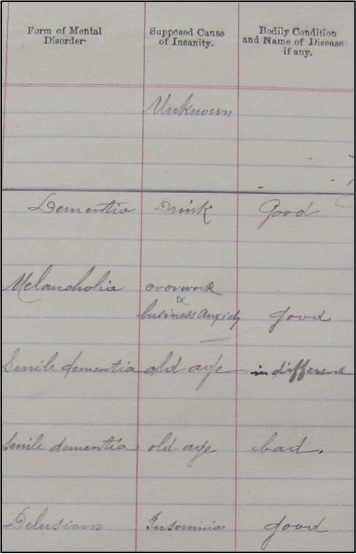
Once admitted, patients were assessed by the medical authorities who determined a cause for their illness along with a diagnosis. This process was based on the medical certificate obtained prior to committal; evidence supplied by the patient and family; and the medical practitioner's own views. The two primary nineteenth-century diagnoses – mania and melancholia – reveal relatively little about reasons for committal. The causes named, however, were far more colourful and wide-ranging and expose much about contemporary perceptions of the life events or circumstances that led to mental illness and therefore committal. Given causes encompassed a range of 'psychological' factors such as grief, bereavement, business or money anxieties and religion, and physical influences including accidents and injuries, physical illnesses, hereditary and alcohol. These later two were the most frequently employed, demonstrating widespread medical understandings of the physical nature of insanity. However, many patients, families and increasingly asylum doctors, reported that fears about financial stability, land interests and the state of the economy had caused the illness.1 In reality, it was often these anxieties that resulted in committal, especially among those with a degree of resources, such as white-collar workers, shopkeepers and farmers.

The Case of John D


Entries in Casebook 2, c.1898.
Source: St John of God's Hospital,
Patient Records.
Land and property interests certainly featured in the case of John D. In 1891, at the age of 77, John was committed to the Enniscorthy lunatic asylum by this two sons. John's sons provided details of his personal history to the asylum authorities; details which were later transcribed by the asylum's Resident Medical Superintendent, Dr Thomas Drapes, into his case notes. Reportedly a 'healthy old man', the first symptom noticed by John's sons was that he wanted to marry his servant, a girl of twenty:

Says if he doesn't marry her his soul is lost and that he'll burn in hell ... he is very supple and has often tried to take away across the country to get to this girl ... Son says he won't allow bedclothes to be changed or bed made since the girl left, as he says no one can make it but her.2
While John was a patient in the asylum, this girl visited him disguised as his niece. Following this, John's sons told Drapes to prevent any further communication between the pair. They were very much against the proposed marriage, insisting that 'she and her family are a designing lot' and 'all encourage her to get him to marry her'. One son informed Drapes that in his opinion his father would have married '"anything in petticoats" for past two years or so'. Allegedly, the girls he proposed to were 'not at all suitable, and "strealish" in appearance and habits'.

Underlying this narrative were anxieties about John's property. A farmer and a shopkeeper, John was certainly not a pauper. His maintenance in the asylum was £18 per annum and while he was in the asylum, John presented Drapes with a further £16 'to keep for him'. The sons made clear their anxieties about the family business. On one visit they stated that lately, their father 'was not capable of properly doing business in his shop'.

The real motivation for committing John, however, became clear when the patient later informed Drapes that 'he gave his sons up his land, but wished to retain his shop for himself and get a wife to mind it for him'. John also gave what Drapes termed a 'rational explanation' for his romance with the servant girl, explaining that:

the girl had been so spoken of in connection with him that her character had suffered, and that if he did not make her the only reparation he could by marrying her, he would suffer in the next world.3

Just two months after his committal Drapes discharged John. In his notes he wrote that this was 'greatly against the wishes of his sons, but I have not been able to find any distinct evidence of his insanity'.4 By 1901, John, now aged 87, had married a woman of 27, possibly the servant girl. However, ten years later, it was his son who resided at this address with his own wife and six children suggesting that he had ultimately inherited the property.5 The most plausible explanation for this outcome was that John's young wife had not borne him any children, which would have prevented her from being entitled to property rights following his death.

Conclusions


The case of John D adheres comfortably both to contemporary public hysteria over the perceived vulnerability of private patients to wrongful confinement and commonly held representations of the rural Irish.6 Although some historians have emphasised the detrimental impact of issues such as the consolidation of landholdings, emigration, land hunger and Famine memories on emotional familial bonds, historians of psychiatry have identified the 'range of familial emotional contexts' which asylum patients came from.7 Families often sent letters querying treatment, offering advice and enclosing food and money for patients.8

Yet, in cases where property or business interests were at stake, these factors tended to eclipse those of familial devotion. In fact, the high numbers of fee-paying patients who were unable to control their business or function in their profession suggests this was a major reason for committal. While the extent to which John D actually struggled in his shop is difficult to ascertain, it is conceivable that a number of other relatives' claims regarding patients' incapacity to work were genuine.

The association between working life and mental illness speaks volumes about contemporary society's interpretation of insanity and what drove families to commit relatives to asylums. In relation to social status, those unable to maintain their position within their given occupation were defined in terms of this failure. Land disputes and an inability to manage one's affairs threatened to shatter emotional familial bonds. In these cases, families may have viewed committal as a last resort in order to protect their resources or livelihood. After all, in smaller rural towns, relatives would have little control over the actions or interactions of a mentally-ill person positioned behind the shop-counter or at a farmers' market.

Dr Alice Mauger


Dr Alice Mauger was awarded a PhD by University College Dublin in 2014 for her thesis which examined institutions for the non-pauper insane in nineteenth-century Ireland. Prior to this she completed the MA programme on the Social and Cultural History of Medicine at the UCD Centre for the History of Medicine in Ireland, UCD. Both her MA and PhD were funded by the Wellcome Trust. Dr Mauger has published on the history of psychiatry in Ireland and is currently writing a monograph stemming from her doctoral research.
Below you can listen to Alice's talk, entitled 'The Cost of Insanity', given on 4 February 2016 as part of the UCD Centre for the History of Medicine in Ireland Seminar Series.


1 Fears of poverty and unemployment among pauper asylum patients are discussed by: Akihito Suzuki, 'Lunacy and labouring men: narratives of male vulnerability in mid-Victorian London' in Roberta Bivins and John V. Pickstone (eds), Medicine, Madness and Social History: Essays in Honour of Roy Porter (Basingstoke, 2007), p. 118; and, Catherine Cox, Negotiating Insanity in the Southeast of Ireland, 1820-1900 (Manchester, 2012), pp 59, 121.
2 Clinical Record Volume No. 3 (Wexford County Council, St Senan's Hospital, Enniscorthy, p. 264)
3 Ibid.
4 Ibid.
5 Census of Ireland 1901.
6 David Fitzpatrick, 'Marriage in post-Famine Ireland', in Art Cosgrave (ed.), Marriage in Ireland (Dublin, 1985), pp 116-31; Timothy Guinnane, The Vanishing Irish: Households, Migration, and the Rural Economy in Ireland, 1850-1914 (Princeton, 1997).
7 Cox, Negotiating Insanity, pp 108-9; Guinnane, The Vanishing Irish, pp 142-43, 230-35.
8 Oonagh Walsh, 'Lunatic and criminal alliances in nineteenth-century Ireland' in Peter Bartlett and David Wright (eds), Outside the Walls of the Asylum: The History of Care in the Community 1750-2000 (London and New Brunswick, 2001), p. 145.

Friday, 22 January 2016

Centre for the History of Medicine in Ireland (CHOMI) Seminar Series, Semester Two, 2015-2016

Centre for the History of Medicine in Ireland (CHOMI), Seminar Series


Semester Two, 2015-2016

Thursday 4 February 2016 
Dr Alice Mauger (University College Dublin)
'The cost of insanity: public, voluntary and private asylum care in nineteenth-century Ireland'

Thursday 3 March 2016
Dr Janet Greenlees (Glasgow Caledonian University)
'The tenuous relationship between gender, health and work, c. 1860-1960'

Thursday 7 April 2016
Dr Luz Mar González-Arias (University of Oviedo)
'Landscapes of pain: the representation of illness in Dorothy Molloy's cancer poetry'

All seminars take place at 5 pm, Room K114, School of History, Newman Building, UCD, Belfield, Dublin 4.


Friday, 28 August 2015

A Question of Authority: the Management of Shell Shock at the Irish War Hospitals during the Great War by Peter Reid

In this month's blog post Peter Reid, MLitt research student at the Centre for the History of Medicine in Ireland (CHOMI), UCD, looks at the treatment of shell shock in Ireland during the Great War. He argues that the formation of a rational medical service for these soldiers in Ireland was undermined by the antagonistic relationship between military and civilian medical authorities.

Queen Street, Dublin.
Image provided courtesy of Peter Holder,
Irish Historical Picture Company
On 22 July 1929, John Kelly, an ex-British soldier, fell from a window of his residence in Dublin's Queen Street and later died from his injuries while being treated at the Richmond Hospital. His wife did not witness his fatal fall, but said that her husband, 'had been in ill-health since his discharge from the army in 1919, suffering from paralysis and shell shock.1

Until recently, there had been relatively little research undertaken on the management of shell shock in Irish institutions during the Great War. In the case of Britain, Peter Leese has shown that army and military concerns dominated over those of civilian medical experts.2 This post argues that a similarly asymmetrical relationship between asylum and military medical personnel was one of the key factors inhibiting the development of a well-coordinated shell shock treatment system in Ireland.

The Irish War Hospitals


The Richmond War Hospital, 1916-1919.
Image provided courtesy of the
National Archives of Ireland.
In Britain, by 1916, demand had overwhelmed the capacity of treatment facilities for shell shocked soldiers. From the summer of that year, the first treatment centres in Ireland, which would include two war hospitals, began to open in the main urban centres of Dublin and Belfast. The first of the war hospitals, a thirty-two bed unit, the Richmond War Hospital, received its first patients in June 1916. This hospital was a separate block within the grounds of Dublin's Richmond District Lunatic Asylum, allocated by the asylum's board of governance for this purpose. It admitted only British Expeditionary Force soldiers, that is, those soldiers who had served overseas at the Western Front. The main Richmond Asylum itself, however, admitted non-British Expeditionary Forces - the home troops. The army paid a generous stipend to the Richmond Asylum for the care of both categories of soldier.

Belfast District Lunatic Asylum.
Image provided courtesy of the National Library of Ireland.
In response to rising casualty numbers, the civil and military authorities agreed to relocate existing patients from the Belfast District Lunatic Asylum and use that facility as another war hospital. The Belfast War Hospital opened in May 1917 under the management of the existing District Lunatic Asylum Committee. It provided 500 beds for the use of both expeditionary and non-expeditionary British service personnel. Dr William Graham, the Medical Superintendent of the Belfast Asylum, remained in place as the medical authority running the new war hospital.


The evidence suggests that Dr William R. Dawson, already a leading figure in Irish medicine and highly regarded by the British army, played a key role in facilitating, if not initiating, both arrangements.

William R. Dawson, appointed by the War Office in 1915,
as a specialist in nerve disease to treat British service personnel in Ireland.
Image provided courtesy of the Royal College of Physicians of Ireland.

The Resident Medical Superintendents and the Royal Army Medical Corp


King George V Hospital, built 1902
(St Bricin's Military Hospital), Arbour Hill, Dublin.
Image courtesy of the National Library of Ireland.
Tensions in the relationship between the Richmond Asylum's Medical Superintendent, Dr John O'Conor Donelan, and his military counterpart, Lieutenant Colonel Hearn, Officer in Charge, George V Hospital, Central Military Hospital Dublin, quickly became apparent. Hearn instructed Donelan by letter that as Officer in Charge of Central Hospital that he, Hearn, was ultimately responsible for all soldiers in the asylum, 'until such time as they are invalided out of the army'.3 Three days later, Hearn again wrote to Donelan and firmly reiterated the point that 'should a man in your opinion require to be moved to the General Asylum [from the Richmond War Hospital] he still remains a soldier until finally discharged from the service by recommendation of the Military Board'.4 
Dr John O'Connor Donelan, Resident Medical Superintendent,
Richmond District Lunatic Asylum, Dublin.
Image by kind permission of Dr Aidan G. Collins,
St. Vincent's Hospital, Fairview, Dublin 3.
The army's insistence on reserving the use of the war hospital solely for expeditionary soldiers, on prioritising their treatment over that of non-expeditionary soldiers, on maintaining their control over the admission and discharge of all military patients, and the complex bureaucratic needs of the military machine, served to insidiously undermine Donelan's authority. Donelan's dissatisfaction with the arrangement is evident in his asylum report of 1917 when he bemoaned the high number of discharges 'classified as only relieved'. He attributed this to 'the fact that a considerable proportion of these were soldiers under temporary treatment, who were removed by the Military Authorities to other asylums before recovery'.5 Donelan was implicitly criticising the military authorities for prioritising the needs of the army over the professional opinion of asylum medical officers, in particular himself.


When the Belfast War Hospital opened in May 1917, it was initially managed by the existing District Lunatic Asylum Committee. However, as Lieutenant Colonel J.B. Buchanan, Officer-in-Charge of Holywood Military Hospital, noted in 1919, 'this plan did not prove satisfactory'. When the Resident Medical Superintendent, Dr William Graham, died suddenly in November 1917, the Belfast War Hospital came under the direct control of the War Office.6

Consequences of an unsatisfactory relationship


Between 1916 and 1919, the Dublin and Belfast Irish war hospitals treated 1,577 soldiers. However, there were never enough beds in Ireland for emotionally traumatised soldiers such as John Kelly and, by 1921, the 'South Ireland Pension Area' - Ireland exclusive of the province of Ulster - had the longest waiting list in Britain and Ireland for treatment.7 The antagonistic relationship between medical and military actors was one factor contributing to this unfortunate situation.

Contemporary relevance


In a report issued in July 2015, the Mental Health Commission identified that a lack of cohesion and 'deep disharmony' between clinicians and managers had undermined clinical governance in Carlow/Kilkenny and South Tipperary and, in early 2014, was associated with a 'spike' in suicides in the region.8 This reflects the continuing importance not only of independent surveillance by bodies such as the Mental Health Commission and the Health Information and Quality Authority, but also of managerial and clinical relationships in the delivery of contemporary mental health services in Ireland.

Peter Reid completed a MA in the Social and Cultural History of Medicine at the Centre for the History of Medicine in Ireland (CHOMI), UCD, in 2014. The title of his MA dissertation was, 'The Institutional Management of Soldiers with Shell Shock in Ireland, 1916-19'. In September 2015, Peter will be commencing a MLitt at CHOMI, investigating the treatment of children with disability in early twentieth-century Ireland.


1 Irish Times, 24 July 1929.
2 Peter Leese, Shell Shock: Traumatic Neurosis and the British Soldiers of the First World War (Basingstoke and New York, 2002), 54-6, 98.
3 Letter to Resident Medical Superintendent, Richmond Lunatic Asylum from Lieutenant Colonel Hearn, King George Fifth Hospital, 1 August 1916, Richmond War Hospital Admission and Discharge Book, BR/Priv 1223, NAI.
4 Hearn to Resident Medical Superintendent, Richmond Lunatic Asylum, 4 August 1916.
5 Richmond Asylum Joint Committee Minutes, 1917, 17, BR/Priv 1223, NAI.
6 Medical History of the War: Report in Compliance with War Office Letter No. 24/General Number/6978 (A.M.D.2) 18 October 1919, WO 35/179.
7 Joanna Burke, 'Effeminacy, ethnicity and the end of trauma: the suffering of "shell-shocked" men in Great Britain and Ireland, 1914-39, Journal of Contemporary History, 35, no. 1 (2000), 69.
8 Irish Times, 22 July 2015.

Tuesday, 24 March 2015

The historical development of Irish Hospitals and the importance of their records by Brian Donnelly

In this month's post, Brian Donnelly, senior archivist at the National Archives of Ireland, outlines the development of Irish hospitals from the eighteenth to the twentieth century.

Rotunda Hospital, Dublin
(RCPI Archival collections: VM/1/4/19)

The establishment of the voluntary hospitals


The early eighteenth century saw the establishment of voluntary hospitals by philanthropists, mainly in Dublin but also in the larger provincial towns. Jervis Street hospital (the Charitable Infirmary) was the first voluntary hospital Ireland and was founded in 1718.  Many of these, like Dr. Steeven’s Hospital (founded in 1733) and Mercer’s (founded 1734) would survive into the twentieth century.  The eighteenth century also saw the establishment of specialist hospitals, most of them voluntary, such as the Rotunda Lying In Hospital, founded in 1745, St. Patrick’s Hospital for mental illness, founded in 1747 and the Westmoreland Lock Hospital, for the treatment of venereal disease, in 1792. 

A modern public health service at county level began in 1765 when a parliamentary enactment provided for the erection and support of an infirmary for each county in Ireland and also permitted support for several existing hospitals, mainly in Dublin and Cork, out of public funds.  The county infirmaries were to be maintained by grand jury presentments, parliamentary grants and local subscriptions. The grand juries were groups of landowners who were called together by the High Sheriff in each county twice a year for legal and local administrative reasons.

The House of Industry hospitals, district lunatic asylums and medical dispensaries


The Dublin house of industry, a precursor of the workhouses of the nineteenth century, was founded in 1772. This institution became in time a vast concern, providing hospitals for the sick, an asylum for children, bridewells, penitentiaries for women and young criminals, a house of industry for vagrants, and cells for lunatics.  From it evolved the House of Industry hospitals – the Richmond, Whitworth and Hardwicke - and it played a major role in establishing the first and largest of the public lunatic asylums – the Richmond Lunatic Asylum – which opened for patients in 1814. Following the report of the Committee on the Lunatic Poor in 1817, the Lord Lieutenant was enabled by statute to build asylums where he considered necessary and, over the next half century, a well-developed mental health infrastructure was in place. By 1871, twenty two asylums were being financially supported by the grand juries. In 1850 a central asylum “for insane persons charged with offences in Ireland” was opened in Dundrum. This institution, the first criminal lunatic asylum in these islands, was under the direct control of the Lord Lieutenant who appointed the staff and made regulations for its management. 

A few dispensaries were supported by voluntary subscriptions in several of the larger towns and cities from the late eighteenth century, but it was not until 1805 that grand juries were authorised to give grants to dispensaries in rural areas. By the early 1830s, there were 450 dispensaries throughout the country, administered by committees of management and supported partly by subscriptions and partly by grand jury grants. There were fewer dispensaries in poorer areas, where voluntary contributions were wanting, and where it was difficult to raise enough money to start them. Inadequate as many of these dispensaries were, they represented the first steps towards domiciliary medical treatment of the rural population.


Robert Graves (1796-1853)
 (RCPI Archival collections: VM/1/2/S/35)

The impact of epidemics on the development of medical infrastructure


Epidemic disease was a major impetus in the development of a medical infrastructure. Typhus was a major scourge in Ireland in the early nineteenth century and, while several fever hospitals had been established in the larger towns in the late eighteenth century, it was not until 1807 that legislation was passed to encourage their construction throughout the country. A fever epidemic of unprecedented proportions raged in Ireland between 1816 and 1819. Under an 1818 Act, local boards of health could be established, supported partly by grand juries, which had extensive powers to combat disease. Grand juries were empowered to make presentments equal to twice the amount raised by private subscription to build fever hospitals. In 1819, legislation enabled officers of health to be appointed in parishes and a parish health tax could be levied. 

The establishment of the Central Board of Health in 1820 marked a major step in the centralisation of medical relief and local boards of health were to play a major role in combating epidemics over the following decades. The Central Board of Health collected statistics about local health conditions, advised where local boards of health should be established and when grant to hospitals should be made. When cholera broke out in Ireland in March 1832, the Central Board of Health, renamed the Cholera Board for the duration of the epidemic, supervised measures to combat the disease which included the establishment of local boards of health. 

Dublin hospitals like the Meath were at the forefront of the fight against infectious disease from the 1820s and introduced new methods of bedside clinical training to the English speaking world.  The census commissioners noted in 1854 that to these metropolitan hospitals “the Irish School of Medicine is largely indebted for the celebrity which it has so long enjoyed”. The Meath hospital received international recognition in the early nineteenth century due to the innovative teaching methods and research carried out by its physicians, Robert Graves and William Stokes. The latter had survived an attack of typhus in 1827 and identified the first case of cholera in Ireland in 1832. This new approach to clinical training had originated on the continent and its introduction into the Meath hospital heralded what has been described as the heroic age of the Irish School of Medicine. The voluntary hospital infrastructure continued to expand during the nineteenth century and following Catholic Emancipation many Catholic religious orders became involved in founding hospitals.

The Irish Poor Law, 1838


The enactment of the Irish Poor Law of 1838 was to have a dramatic effect on the provision of public health services for the rest of the nineteenth century. The country was divided into over one hundred and fifty poor law unions each with a workhouse at its centre and administered by a board of guardians.The structure of the poor law system, being modern and efficient and more easily subject to central control, was adapted on nearly all occasions where a new local function was created or an old one modified .The Medical Charities Act of 1851 led to the modernisation and extension of the old grand jury dispensary network under the boards of guardians and made a domiciliary medical service available to large sections of the population, the destitute poor, for the first time. 

By 1852, every poor law union had been divided into a number of dispensary districts, each with a dispensary and medical officer.  Patients had to apply to a poor law guardian for a ticket every time they wanted to attend a dispensary free of charge. Committees of management were responsible to the boards of guardians for the management of the dispensaries and appointing the dispensary doctors. In 1863, the dispensary doctors were made registrars of births and deaths and of Roman Catholic marriages and the practice of registering births, marriages and deaths was standardised on the 1st of January 1864. When registering deaths, the dispensary doctors were required to note the cause of death and duration of illness, thus enabling accurate statistics of mortality to be compiled for the first time. The registration of births enabled such measures as the compulsory vaccination of children against smallpox to be carried out effectively and by the end of the nineteenth century this scourge had, to a great extent, been eliminated.

While many boards of guardians had allowed the non-destitute to enter workhouse hospitals for treatment during the 1850s, the 1862 Poor Law (Amendment) Act officially opened the workhouse hospitals to the non-destitute sick. As a result of these developments, Ireland had one of the most advanced health services in Europe in the mid-nineteenth century, if policy and structure are to be taken as criteria. The Local government (Ireland) Act, 1898, replaced the grand juries by democratically elected county and rural district councils. The county councils took over the administration, either directly or through joint committees, of the district lunatic asylums.

Newcastle Sanatorium, Wicklow.
Image courtesy of NLI (L_ROY_05467)

Tuberculosis and the sanatorium


While Ireland had a low death rate from infectious disease in the first decade of the twentieth century, tuberculosis was the marked exception. The last years of the nineteenth century saw the first attacks made against the disease with the establishment of Newcastle Sanatorium in 1893. In 1904, the sanitary authorities of County Cork combined with Cork Corporation to establish Heatherside Sanatorium near Doneraile. In 1907, the Dublin City and County authorities established Crooksling Sanatorium. A Tuberculosis Prevention Act was passed in 1908 which gave the county councils power to provide sanatoria and brought the first veterinary inspectors into the employment of the sanitary authorities.  Peamount Sanatorium was founded in 1912 through the efforts of the Women’s National Health Association, the most formidable health pressure group of the early twentieth century.

Public health provision in post-independent Ireland


The turbulent years of the early 1920s saw some revolutionary changes in the public health system. In general, the boards of guardians outside Dublin were abolished and were replaced by county boards of health and public assistance, essentially sub-committees of the county councils. Most workhouses were closed to save money and central institutions called county homes were established in each county where the poor were to be relieved. While the newly styled county homes were to be reserved in theory for the old and infirm many soon included unmarried mothers, children and the mentally retarded.  Following the establishment of the Irish Free State the Department of Local Government and Public Health formally became, in 1924, the central government authority for local government and health administration. The Minister took over the Lord Lieutenant’s duties in relation to the mental hospitals. In 1930, the establishment of the Irish Hospitals Sweepstakes, a lottery to provide financial assistance to hospitals, provided a financial lifeline to many voluntary hospitals who were struggling to survive following a reduction in the number of endowments and bequests after the Great War.

The post-war period and declining mortality


There were significant developments in health care in the 1940s and 1950s. The Mental Health Treatment Act of 1945 modernised the legal code under which the mental services operated and provided important safeguards against the arbitrary detention of patients although the numbers of persons being treated continued to increase until, by 1959, there were 20,000 patients in Irish mental hospitals.  In the years immediately after 1945 there was a major effort to develop anti-tuberculosis services. The Tuberculosis (Establishment of Sanitoria) Act of 1945 permitted the Minister for Local Government and Public Health to arrange for the building of sanatoria and to transfer these to local authorities when completed. This was a major departure from established practice for the central authority as it stepped outside its normal functions of directing and co-ordinating the local services. Sanatoria were built at Dublin, Cork and Galway and were handed over when completed to the local authorities as was provided under the Act. 

There was also widespread building and conversion of buildings for the treatment of tuberculosis cases by local authorities.  These developments, together with the payment of maintenance allowances for dependents of persons undergoing treatment for infectious disease, mass radiography, BCG vaccination and new drugs such as streptomycin, led to a great decline in mortality for the disease and in the number of new cases appearing.  In 1947 the Department of Local Government and Public Health was divided into two separate departments. The Health Act of 1953 extended eligibility for general hospital services and maternity care to a much wider class. Health authorities were now required to provide child welfare clinic services and the school health service was improved. The dispensary service and dispensary doctors were transferred from the public assistance code to the health authorities. The old dispensary ticket system was done away with and replaced by medical cards. A more liberal code for the governing of county homes was introduced and provision was made for the development of a comprehensive rehabilitation service.

William Stokes (1804-78) and William Wilde (1815-76)
(RCPI Archival Collections: PDH/6/2/12)

1970s regionalisation and the Irish 'love affair' with the hospital bed


By the 1960s, it was felt that as the state had taken over the major financial interest in the health service there should be a new administrative framework combining national and local interests.  For technical and logistical reasons it was believed that better services could be provided on a regional rather than a county basis.  The establishment of the health boards under the Health Act, 1970, marked a major break in the link between the health services and county administration. At this time Ireland had the highest proportion of hospital beds to population in western Europe and the Irish hospital system was described as “one of a large number of small institutions scattered throughout the country”. The following decades would see the closure or amalgamation of many voluntary and state hospitals into larger units and the dismantling of the old mental hospital infrastructure.

The historical value of Irish hospital records


That Irish hospital records are of great historical interest has long been acknowledged. Dr. William Wilde, the internationally renowned nineteenth century physician and statistician, recognised one hundred and seventy years ago that the hospital registers of the Rotunda Hospital represented the ‘most interesting and earliest statistical tables on record’.  Ireland’s medical institutions, both voluntary and public, have a peculiarly rich and varied history and have played a paramount role in medical advances over the last three centuries.  While some collections of hospital archives are now safe in archival custody, many collections remain in peril. These archives have no protection under the law and it is often only through the good offices of interested hospital staff that material has been preserved. 


Brian Donnelly is a Senior Archivist at the National Archives with responsibility for Business and Hospital records. Images courtesy of Fergus Brády, Archivist, RCPI.